In George Orwell's Animal Farm, Benjamen the donkey shows wisdom and discernment, and doesn't let himself be taken in by the pigs' propaganda. What if donkeys taught us? What if the dunce's cap opened our ears to the world?
The "Dan'A Dream", named after a Celtic goddess of fertility, is conceived as a master class in social intelligence facilitation.
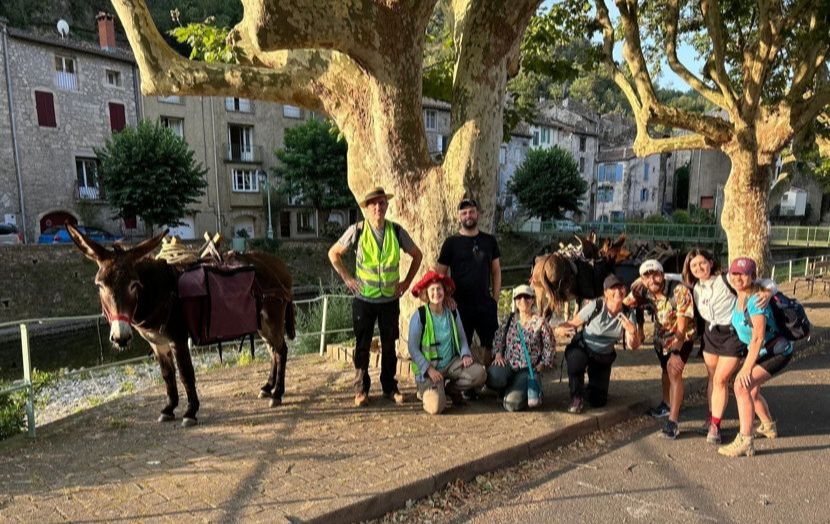
After a phase of preparation and group agreement, it took place over four intense days in the magnificent setting of the Haut Languedoc regional park. The sessions were guided by Denis and Cécile, accompanied by a team of donkeys named Gygesse, Kansas and Klarine. The days were marked by an in-depth exploration of the connection with the living, following the progression of the U theory advocated by MIT researcher Otto Scharmer, through non-verbal and immersive practices, enriched by the natural environment and work with the donkeys.
An itinerary
The training itinerary incorporates a range of pedagogical practices designed to develop interpersonal skills and collective awareness. One of the first practices explored was communication and guidance using the lanyard(the rope used to tie up a horse or donkey) . Participants discovered the subtleties of non-verbal communication and experimented with power dynamics through the use of a lanyard. This practice led to a deeper understanding of guidance and respectful communication, essential for establishing trusting relationships, both with donkeys and between participants.
Then, in the workshop "Choosing and being chosen: first contact with donkeys", participants enjoyed a unique experience of inter-species interaction. By observing and interacting with the donkeys, they learned to recognize non-verbal cues and understand the dynamics of mutual choice. This exercise reinforced their ability to observe and respect each other's rhythms and needs, a crucial skill for any facilitator.
A highlight of the training was walking in presence and silence with a donkey. This silence, shared with the donkeys, enabled participants to develop a heightened awareness of their own inner presence, as well as that of the animal. We call this practice "the double bubble". This walk, where the lanyard gradually became superfluous, was a powerful exercise in refining non-verbal communication and strengthening intuitive connection, offering a model of non-coercive leadership and better integrating negative conditioning and the concept of the membrane surrounding the facilitator and the group.
Animal mediation
The workshop "Grooming a donkey: learning gentleness, care and empathic know-how" continues this exploration of the relationship with donkeys. Participants learned how to establish a gentle contact and provide empathetic care, while observing the donkeys' reactions to adapt their gestures. This practice raised everyone's awareness of animal mediation, underlining the importance of respect and deep listening in helping relationships, both with animals and with humans.
Among the other practices tested, systemic organizational constellation was particularly revealing of our emotions. This workshop enabled participants to diagnose complex situations and imagine possible futures, using bodies and their position in space as key elements of communication. The collective dynamic created by this practice strengthened participants' ability to read and understand relational systems, fostering better group management. Tomorrow we plan to carry out an animal systemic constellation, with the donkeys acting as part of the system, further enhancing the uniqueness of the experience.
Moving on
The metaphor-based co-development session (Corev method invented atAPM ), another outstanding practice, enabled participants to explore solutions to their personal or professional situations using the power of metaphors. Inspired by Ericksonian hypnosis, this approach encouraged creativity and detachment, offering new perspectives on the problems tackled.
The "Identity T-shirt" workshop, in pairs, encouraged active listening and empathy. By creating a T-shirt symbolizing their pair's identity, participants explored how they perceive and are perceived by others, thus strengthening mutual understanding and group bonds.
Finally, the practice of "walking training review: the gift of learning" brought the training to a close on a note of mutual recognition and appreciation. By walking together, each participant had the opportunity to receive and offer positive feedback in the form of verbal "gifts", reinforcing group cohesion and valuing individual contributions.
At the end of the four days, after the creative creation of the totem donkey, the "payment in consciousness" modality was applied, enabling each participant to reflect on the perceived value of the training and contribute accordingly, according to his or her means and feelings. This approach fostered a collective awareness of the value of work and commitment, in keeping with the principles of inclusion and mutual respect promoted during the training.
This experiential training enabled participants to explore the deeper dimensions of societal intelligence facilitation, through a variety of immersive practices and encounters with local developers. The natural setting of the Haut Languedoc Regional Park, combined with attentive support and the enriching experience of working with donkeys, provided an ideal context for developing essential skills in leadership, non-verbal communication and group management. Participants leave with a concrete toolbox and an enriched understanding of their identity and posture, ready to apply these learnings in their professional and personal practices.
Note: Dan'A's dream is part of a process of empowerment of experience led by Inex, whose aim is human development through Experiential Learning (experientiel.org).
Going further
Rêve de Dan'A https://a pprendre-autrement.org/reve-dana/
Mediation and experience with donkeys brings new know-how. What donkeys teach us - Thot Cursus https://cursus.edu/fr/31329/ce-que-nous-apprend-lane
See more articles by this author