In 2020 and 2021, to avoid the spread of the covid-19 virus, we had to stay at home as much as possible. This home-away-from-home period had an effect on us in the years that followed. Going outside became a breath of fresh air, and this had repercussions right down to the school system. The idea of outdoor classes began to catch on. Well-established in Scandinavian countries, the concept gained followers during and after the pandemic.
Taking a class outside is often perceived, however, as an "ordinary" class in a less controlled environment. We almost forget that outdoor learning can lead to play. There's no added value in just lecturing in the forest. It makes much more sense to take advantage of the setting so that students can have fun.
Play promotes learning
Because, let's not forget, playing is not a senseless activity that does nothing. It's one of the first ways the brain acquires skills, makes connections and understands things. The toddler who repeatedly throws his toy on the floor may seem annoying to the parent who has to pick it up. However, he repeats the gesture because not only does it amuse him, but he can grasp that in this world, objects are attracted to the ground and that, depending on the force he applies, he will go further or less far. It's the same thing when he makes strange sounds that are repeated in a loop; he's experimenting with the way his vocal chords work, and the sound transformations he can achieve with his throat and mouth.
From the very first years of life, playing in nature enables children to acquire the muscle tone they need to learn how to hold a pencil, to develop a basic sense of space and even to test precepts that will later be used in mathematics. All elements that are much less easily learned in front of screens. That's why pediatricians and child specialists are urging families to take their children outside to play regularly, even in the dead of winter, to develop better physical, social and intellectual skills through play.
The school recipe for outdoor play
Critics might point out, however, that school is no place for play. Students need to come away from their school year with specific skills and knowledge. It would be easy to believe that spending time playing outside will only lead to delay. Yet educational research is increasingly showing the holistic benefits of this didactic approach. Contact with nature and the opportunity to get out there and expend a little energy is a real opportunity for learners. It's already possible to find pedagogical potential in free play, but there's nothing to stop us guiding the game a little so that it meets specific objectives.
In Quebec, Pascale Tremblay and Julie Turcotte have developed the "Mission plein air" program to give teachers different ideas. It's possible to organize "football-mathematics" jousts, create vocabulary word relay races, play at finding geometric shapes or patterns in the woods, and so on. This approach is all the more interesting as education experts know that abstract thinking is harder to acquire in young people. Combining more theoretical concepts with the concreteness of outdoor play combines the best of both worlds.
There are a plethora of playful approaches to different educational subjects. The little ones can have fun trying to find elements for each letter of the alphabet in a natural environment, or write a poem on a flower or tree leaf they've collected. Older children can develop treasure hunts or play shopkeepers selling natural elements (forcing them to calculate).
Of course, these play sessions require planning and, above all, the teacher's ability to keep a close eye on the group. However, the positive repercussions of these unique learning sessions will be more visible and abundant than long lecture sessions between the four walls of a classroom.
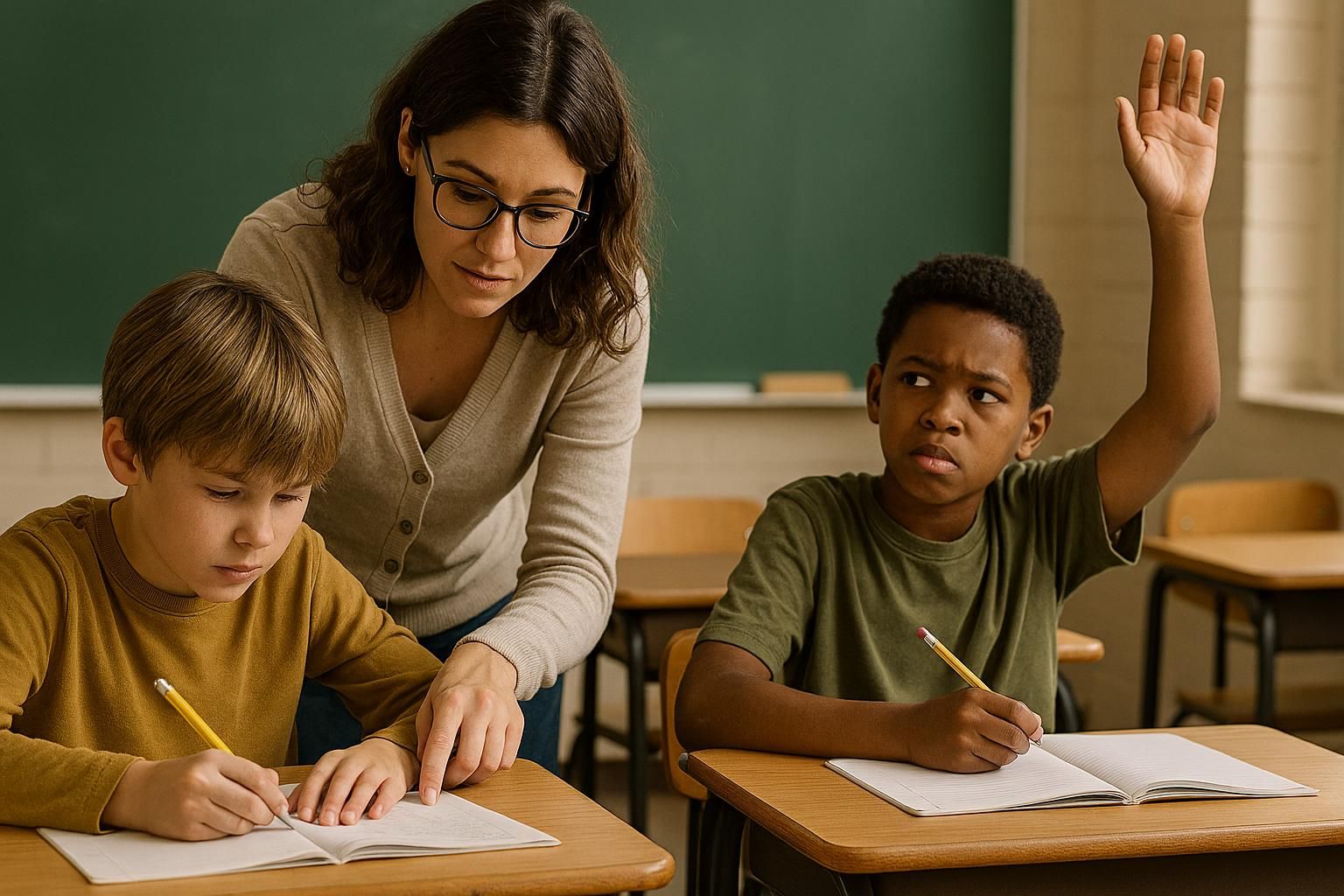
Image created by AI (Copilot)
References
Allard, Sophie. "Learning outdoors: 10 experiments and activities to do with children." Vifa Magazine. Last updated: May 28, 2021. https://vifamagazine.ca/bouger/activites-familiales/experiences-et-activites-a-faire-avec-les-enfants-pour-apprendre-en-plein-air/.
"The importance of outdoor play, even in the winter." BrightPath Child Care & Daycare Centres. Last updated: January 14, 2022. https://brightpathkids.com/family-blog/benefits-of-outdoor-play-in-the-winter.
"Outdoor play boosts school learning." Vifa Magazine. Last updated May 10, 2021. https://vifamagazine.ca/comprendre/sante-physique/jouer-dehors-favorise-les-apprentissages-scolaires/.
Kennedy, Nicoletta. "Outdoor play is important and boosts learning." First Things First. Last updated July 30, 2024. https://www.firstthingsfirst.org/first-things/active-outdoor-play-boosts-learning/.
Rekers, Angie, and Jane Waters. "Young children's outdoor play-based learning." Encyclopedia on Early Childhood Development. Last updated July 2024. https://www.child-encyclopedia.com/outdoor-play/according-experts/young-childrens-outdoor-play-based-learning.
Roy, Marie-Josée R. "Jouer dehors pour mieux apprendre!" Le Devoir. Last updated February 7, 2024. https://www.ledevoir.com/societe/education/806363/pedagogie-plein-air-jouer-dehors-mieux-apprendre?.
See more articles by this author