The excellent gesture aimed at in Japanese craftsmanship evokes the waza: a technique, an art and a disposition of mind.
Publish at November 06 2024 Updated May 14 2025


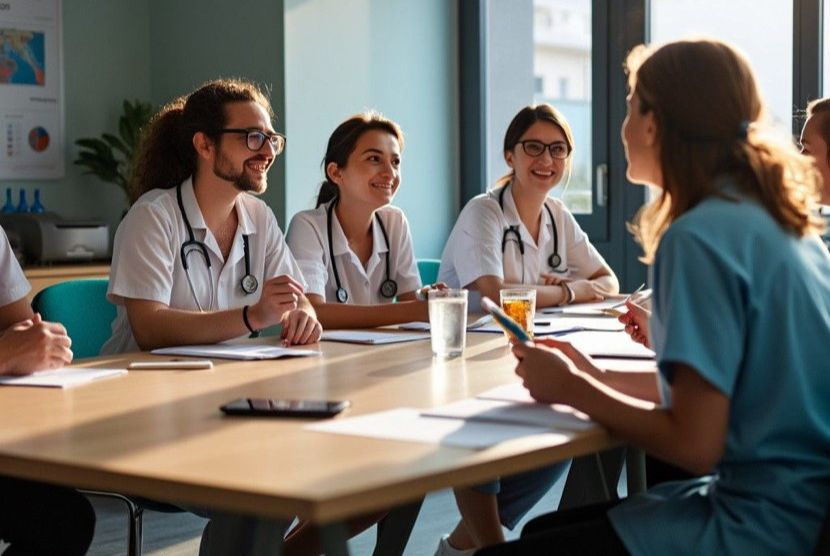
In the corridors of a hospital, decisions are rarely taken alone. Every day, there's an incessant ballet of exchanges and consultations between the various healthcare professionals. At the bedside of a frail patient, the doctor adjusts his diagnosis by listening to the nurse's observations. When the patient is relieved, the nursing assistants share their intuitions to better anticipate needs.
Because in this world of healthcare, where people are at the heart of everything, decision-making is first and foremost a team activity. A collective discipline that mobilizes complementary skills, plural knowledge and diverse sensibilities. A shared intelligence that transcends the perimeters of each individual's action to offer patients comprehensive, personalized care.
Yet, crucial as it is, this collaborative decision-making process is not always self-evident. In this still highly hierarchical hospital environment, decision-making power often remains the prerogative of doctors, at the risk of erasing the singular expertise of other caregivers. Nurses and orderlies can feel deprived of their ability to influence choices, relegated to the status of mere executors.
Conversely, too great a dilution of responsibilities can lead to paralysis of action, with each party passing on to the other the prerogative of making decisions. Not to mention the turf wars between departments, ego battles and personal rivalries that can sometimes pollute the collective dynamic.
So how can we create the conditions for virtuous and efficient decision-making collaboration? How can we ensure that each professional can make his or her voice heard, with mutual respect for roles and skills? What are the ingredients for a team synergy in which the patient remains the ultimate decision-maker?
Within a healthcare establishment, each professional holds a part of the truth about the patient. The doctor, with his clinical knowledge and overall vision, makes a diagnosis and defines a therapeutic strategy. The nurse, close to the patient, detects clinical signs, assesses needs and adjusts treatments. The caregiver, in close proximity to the patient, identifies frailties and resources.
But it's the fine-tuning of all these areas of expertise that makes it possible to understand the patient in his or her entirety, leaving nothing in the shadows of his or her care trajectory. Because illness affects people in all their dimensions - physical, psychological, social and spiritual - and requires a multi-faceted approach. By pooling their knowledge, skills and perspectives, professionals build a collective intelligence around the patient, a shared understanding of his or her situation(1).
This synergy is essential to medical decision-making. It emerges from the confrontation of points of view, is enriched by individual insights, and is strengthened by the cross-fertilization of perspectives. At every stage of the care process, interprofessional collaboration guarantees relevance and enables ongoing adjustment of care strategies. It is this teamwork that produces the most appropriate response to the patient's needs.
But the decision to treat a patient cannot be reduced to a cold clinical equation, or the mechanical application of standardized protocols. It also draws heavily on each professional's own sensitivity, singular experience, intuition and creativity. Faced with a unique patient, with his or her life history, personality, frailties and resources, the caregiver calls upon his or her expertise as much as his or her humanity(2).
For example, the caregiver who accompanies the patient in his or her daily routine will pick up on the patient's emotional state, perceiving anxieties or discomfort. The nurse, through repeated care and informal conversations, will develop an intimate knowledge of the patient's reactions, preferences and fears. The doctor, guided by his clinical intuition, will sometimes be able to uncover a rare diagnosis behind atypical symptoms.
These subtle perceptions, hunches and sensitivities enrich the decision-making process, anchoring it in the patient's experience and adapting it to his or her individual needs. Provided, of course, that these elements can be shared, clarified and discussed within the team. For it is in this space of collective deliberation that the most appropriate care options can emerge.(3)
The result of a shared vision and concerted deliberation, the medical decision engages the responsibility of the entire care team.(3) Everyone, at his or her own level, becomes a co-depository of a collectively-constructed care project. Doctors, nurses and care assistants are all involved in implementing, reassessing and adapting the project. It is their ability to interact constantly and coordinate closely that will guarantee the coherence and continuity of the care provided to the patient.(4)
Upstream, this teamwork helps to define common objectives, agree on priorities and anticipate difficulties. But it continues throughout the entire care process, through transmission, handover and readjustment. This collaborative dynamic facilitates the circulation of information, the pooling of observations and the early identification of problems. It helps weave a safety net around the patient, so that nothing is overlooked in his or her development.
The quality of inter-professional communication thus becomes a decisive factor. It presupposes, on the part of each individual, the ability to explain his or her reasoning, to argue his or her proposals, but also to be receptive to the suggestions of others. It is through this effort at dialogue, mutual understanding and recognition that a genuine team synergy can be built, guaranteeing comprehensive, personalized patient care.
However, interprofessional collaboration on decision-making still comes up against a number of obstacles. First and foremost, the weight of hierarchies historically rooted in the hospital world.(5) Despite recent developments, the doctor is still often perceived as the sole captain of the ship, the one who ultimately decides. His knowledge, status and prestige give him authority over other professionals, and pre-eminence in therapeutic choices(6).
The nurse, for example, may feel that his or her opinion, even though based on in-depth knowledge of the patient, carries little weight when compared with the medical word. As a privileged witness to the patient's clinical condition, the orderly will not always dare to question the doctor about an observed deterioration. As for the patient, he or she is often reduced to a passive role, stripped of decision-making power in favor of medical omnipotence(7).
These relationships of symbolic domination are a major obstacle to collaborative work(8) , leading to self-censorship, withdrawal and fear of judgment, which prevent constructive exchanges. How can you dare to contradict the doctor when you're an orderly? How can you assert your own expertise in the face of clinical knowledge? Deprived of the individual contributions of each professional, collective reflection is impoverished, and decisions lose their relevance.
This raises the question of how to empower non-medical caregivers. How can we enable them to fully exercise their skills and mobilize their knowledge in support of the care project? How can we create the conditions for real equality in deliberation, despite differences in status? This is the challenge of a participative management style that values the expertise of each individual, legitimizes the right to speak out, and streamlines decision-making processes.
Conversely, excessive collegiality in decision-making can also prove problematic. Under the guise of participation, there is a great risk of sinking into a form of soft consensus, where no-one dares to take responsibility. By trying so hard to get everyone involved, by multiplying the number of consultations, the decision sometimes ends up being diluted, and the action bogged down.
Yet there are clinical situations that demand responsiveness and leadership, where urgency demands immediate decisions. Faced with a gloomy prognosis or a therapeutic impasse, the team will sometimes need a voice to light the way, to assume a share of the risk, to take responsibility. Otherwise, the patient runs the risk of being held hostage to the procrastination of a team incapable of making a decision.
Of course, unilateral decisions taken in the secrecy of a one-to-one discussion are no longer the rule. But collegiality also has its shortcomings, when it becomes an instrument of protection, disempowerment and conservative choices. So we need to strike the right balance between shared deliberation and assertive leadership, constantly adjusting the cursor according to the situation.
While the doctor must know how to mobilize collective intelligence around the patient, it is also up to him or her to shoulder individual responsibility, to embody decisions when the patient's interests so dictate. It is in this permanent tension, in this dialectic of the individual and the group, that the correctness of the medical posture is at stake.
Last but not least, collaborative decision-making is still often hampered by the territorial logic and interpersonal rivalries that permeate the hospital world.(9) Despite injunctions to decompartmentalize, each department remains stubbornly focused on its own turf, anxious to protect its margins for manoeuvre. This silo culture greatly hampers the flow of information and cooperation between teams.
As a result, it is not uncommon for decisions to be taken without consultation with downstream partners, with the risk of disrupting care paths.(10) A lack of communication leads to delays in treatment, redundant examinations and even lost opportunities for the patient. When the right hand doesn't know what the left hand is doing, the quality and safety of care deteriorate.
Sometimes, it's personal sensitivities and long-standing enmities that parasitize relations between professionals. Old quarrels, ideological antagonisms, personal conflicts: there are many relational irritants that pollute the daily life of teams and weigh on their ability to interact effectively. In a high-pressure, emotionally-charged environment, tempers quickly flare.
This raises the question of how to regulate these conflicts and facilitate interfaces between players. This is a major challenge for local managers, who have a crucial role to play in mediating and easing tensions. But it's also up to facility managers to foster a culture of dialogue and cross-functionality, by creating meeting places, encouraging collaborative projects and promoting teamwork. Otherwise, cooperation will remain wishful thinking.
Effective collaboration around a decision presupposes that each professional is willing to listen to the other and really hear what he or she has to say. This means valuing their point of view, legitimizing their right to express it, and recognizing their own expertise. A posture of openness and mutual respect, based on an assumption of competence shared by all.
For it is in recognizing the unique contribution of each individual that a virtuous cooperative dynamic can flourish. When the nurse feels authorized to share his or her clinical observations, and these are taken into account by the doctor. When the caregiver is invited to share his or her feelings about the patient's condition, and his or her opinion is integrated into the team's reflection. When the patient himself is considered a full partner in the decision, drawing on his experiential knowledge of the disease.
It is through these positive interactions that everyone feels their skills are recognized, and their professional identity enhanced. A feeling of legitimacy that boosts self-esteem and motivation to commit to a collective approach. After all, how can professionals be expected to cooperate if they feel ignored, discredited and deprived of their own expertise?
Deciding together means creating the conditions for authentic dialogue, in which each player feels authorized to say what he or she knows, perceives and feels. A secure relational space, devoid of judgment and power struggles, conducive to the emergence of a free and fertile caregiver voice.(11)
But mutual recognition is not enough. Each person's opinion must be taken into account and have an influence on the final decision. Professionals need to experience in practice their ability to influence the choices that concern patients. Otherwise, consultation risks being reduced to a mockery of democracy, generating frustration and disengagement.
Co-decision means accepting to be influenced, to have one's vision of things challenged. It means agreeing to adjust one's clinical judgment according to the insights provided by one's peers. It also means relinquishing some of your decision-making autonomy to build a genuine collective intelligence in the service of the patient(11).
Sharing power implies sharing responsibility. Once they have taken part in the process of reflection, all players become co-responsible for the choices made, and must feel committed to their implementation. There are no sudden decisions here, and even less criticism behind the scenes. Instead, everyone is involved, from the design of the care project through to its final evaluation.
This co-responsibility is all the more crucial when the decisions to be taken have far-reaching consequences for the patient. Faced with complex, uncertain and equivocal situations, the only way to arrive at the "least bad" solution is to reflect on the situation from different perspectives. It's a demanding process, and one that calls on everyone's ethical commitment.
Finally, it would be pointless to think of shared decision-making without involving the main person concerned: the patient.(12) For a long time held in a passive position, subject to the omnipotence of medical knowledge, patients are now recognized as central players in their own care, with rights and powers of their own. The French law of March 4, 2002 formalized this paradigm shift, affirming the primacy of the patient's wishes and the need for free, informed consent(13).
In practice, however, patient participation in decisions concerning them remains limited. Between abstruse medical jargon, lack of time on the part of caregivers and the weight of fears and unspoken words, dialogue is not always easy. Many patients struggle to understand the ins and outs of therapeutic choices, to project themselves into the various possible scenarios, and to express their preferences.
Genuinely involving patients requires a great deal of educational and relational work on the part of professionals. This involves creating the conditions for a gradual, repeated announcement, tailored to the patient's ability to understand. Taking the time to listen to the patient's experiences, values and priorities. Open up a space where patients can confront medical knowledge with their experiential knowledge, and express their doubts and expectations.
This process of working alongside the patient is all the more crucial when the decisions to be made involve existential issues. Beginning or stopping major treatments, entering palliative care, managing the end of life: these are all pivotal moments when the patient's voice must be heard in full awareness. This ethical requirement calls for an unwavering commitment on the part of caregivers to support these final decisions.
Today, collaborative decision-making is coming up against rapidly changing conditions in healthcare establishments. Budgetary constraints and the pressure to be more efficient mean that there is less time for discussion and consultation. Driven by the urgency of their tasks and the management of workflows, professionals are struggling to find the breathing space they need to reflect on their work.
As a result, multidisciplinary staff meetings, once the ideal place for pooling knowledge, are increasingly overridden by the imperatives of profitability. Reduced to a minimum, and carried out at breakneck speed, they struggle to fulfill their deliberative function, to the benefit of purely organizational aims. This managerial drift undermines the collegiality of decision-making, and gives precedence to medico-economic criteria over the co-construction of an adapted care project.
In the departments, the ever-increasing workload is hampering inter-professional communication.(14) Everyone is chasing time, caught up in the spiral of unbridled activism. Exchanges are reduced, communications are impoverished, and consultation meetings are spaced out, resulting in a loss of links that is detrimental to the continuity and quality of care.
The question then arises as to what resources should be allocated to preserve this time for collective elaboration. How can we safeguard the time for shared reflection that is so vital to working together around the patient? How can we resist the temptation to adopt a "protocolized" approach, which reduces the scope for discussion in the name of efficiency? This is what governance is all about: creating the organizational conditions for genuine cooperative work.
The development of outpatient care and short-term hospitalization is also disrupting team decision-making processes. With patients coming and going at a frenetic pace, it's becoming difficult for professionals to ensure longitudinal follow-up and build a shared vision of situations. Fragmented stays, the multiplication of caregivers and the loss of familiar points of reference are all factors that undermine team cohesion.
In this context of accelerating trajectories, there is a great risk that decisions will be concentrated on acute care, to the detriment of a global approach to the patient. Each professional is confined to his or her own area of activity, with no overall vision of the patient's care. This fragmentation of care greatly hampers inter-professional collaboration and continuity of care.
So how, in this instantaneous world, can we think in terms of the long term? How, in this fragmented world, do we reweave the bond around the patient? The challenge of the shift to ambulatory care is to reinvent cooperation methods adapted to the new temporalities of care. In particular, this will require greater decompartmentalization between the city and the hospital, to ensure effective links at every stage of the patient's care.(10) But it will also require better circulation of information, thanks to digital tools for sharing healthcare data.
In today's complex, meandering healthcare pathways, shared decision-making needs more than ever to be based on a cross-disciplinary, de-chronologized approach. This is a challenge for healthcare teams, calling for new interpersonal and organizational skills.
Faced with these upheavals, the healthcare world is experimenting with new, more collaborative and integrative ways of organizing work. This is reflected in the growing number of pathway coordination mechanisms, regional support platforms and cross-functional mobile teams(15), all of which are shaking up traditional hierarchical lines and reshuffling the decision-making deck.
Henceforth, it is no longer status or professional affiliation that takes precedence, but the ability to interact, coordinate and co-construct responses adapted to patient needs. Decision-making processes are becoming more horizontal, drawing on the collective intelligence of those working in the field. A small revolution in this hospital-centric world, which is forcing us to rethink the modalities of clinical leadership(16).
What we're talking about here is a new kind of management. A more participative management style, one that stimulates team creativity and unleashes their power to act. One that encourages cross-functional exchanges, cross-fertilization of knowledge and experimentation with new ways of working together. Management in project mode, focused on the collective resolution of concrete problems(17).
But it is also a more reflective management style, attentive to creating the conditions for ongoing feedback on collaborative practices. In a world in perpetual motion, where organizations are being reshaped at breakneck speed, it is crucial to take the time for metareflection, to constantly adjust processes and postures.
These are just some of the challenges facing healthcare managers, who are called upon to become cooperation facilitators and regulators of professional interfaces. This is a key role in fostering a shared decision-making culture, conducive to a collective commitment to serving patients.
In the final analysis, shared decision-making appears to be a horizon towards which to strive, an ideal that regulates healthcare practices. In an increasingly complex and uncertain world, where healthcare issues are becoming globalized, only collective intelligence can meet the challenges of caregiving. Faced with better-informed and more demanding patients, professionals have no choice but to combine their expertise to build tailor-made solutions.
But this collaborative revolution cannot be decreed. It presupposes profound cultural and organizational changes, and the emergence of new ways of relating and cooperating within teams. A whole range of levers needs to be activated, from participative management to inter-professional training, to break down statutory barriers and instill a team spirit.
The stakes are high, because the very meaning of care work is at stake in this ability to think and act together. At a time of excessive protocolization and the race to keep up with workloads, shared decision-making reaffirms the primacy of the individual consultation, the human relationship and the collective commitment to the patient. As if to remind us that medicine is about relationships and meaning, before being a technical and financial equation.
Finally, the challenges of inter-professional collaboration around decision-making are not the exclusive preserve of the hospital world. Schools and universities, too, are faced with the need to bring together players with different statuses, knowledge and skills. Teachers, educators, psychologists, nurses, social workers: these are just some of the professionals who are called upon to work together to provide pupils and students with comprehensive, personalized support.
Here too, the quality of cooperation comes up against territorial logic, symbolic hierarchies and the fragmentation of interventions. Here too, the challenge is to create the conditions for horizontal and inclusive consultation, free from statutory precedence.
How can we ensure that the voice of the educator is taken into account as much as that of the teacher? Can the psychologist's expertise influence educational choices? How can we ensure that students in difficulty are involved in the decisions that concern them?
It's only through mutual recognition of skills, the opening up of areas of action, and the involvement of the learner, that a collective intelligence can be built to serve the success of all. This cultural change calls for a strong commitment to collaborative working on the part of management, just as the hospital world is seeking to embrace cross-functionality.
Illustration: AI-generated - Flavien Albarras
References
1-L'intelligence collective pour redonner du sens à l'hôpital - Objectif Soins & Management n° 0289 du 30/09/2022, [no date]. [online]. Available at: https://www.espaceinfirmier.fr/presse/objectif-soins-et-management/article/n-289/l-intelligence-collective-pour-redonner-du-sens-a-l-hopital-LQ6991920C.html [Accessed October 29, 2024].
You might also like:
The excellent gesture aimed at in Japanese craftsmanship evokes the waza: a technique, an art and a disposition of mind.
Learning to the end, learning from your own end
This is an article for those who are learning to the limit and wonder how far they can learn. Without suspense, the answer is: until the end. But you have to be prepared...
Psychological safety and collective intelligence facilitation
The psychological safety promoted by Edmonson underpins the power to act, is a dialogical construction and enables learning to be multiplied.
Vegetable gardening in winter: how to prepare the soil and what to harvest
In winter, prepare your soil with mulch and green manures, grow cold-hardy vegetables (of which there are many), and protect your crops with sails, tunnels or greenhouses. A semi-underground greenhouse can even enable you to harvest all year round without heating.
AI and music composition: what's next for artists?
The music world, like the fine arts, is currently experiencing a debate on AI. Some see it as a tool for creativity, while others denounce its learning methods, editing and so on.