Art and poetry to learn differently
An exploration of art thinking and poetry in generative learning
Publish at November 20 2024 Updated November 19 2024


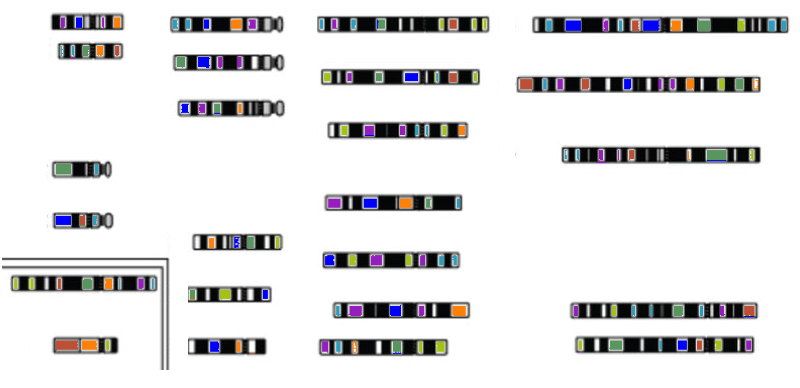
Rapid advances in genetic sequencing have enabled companies such as Ancestry, 23andMe, MyHeritage, FamilyTreeDNA, GEDmatch, Geneanet, Nebula Genomics and Living DNA to offer the general public genetic sequencing tests to trace ancestry and briefly identify a few genetic traits or predispositions.
Humans have 23 pairs of chromosomes: 22 pairs of autosomal chromosomes and one pair of sex chromosomes (XX for women, XY for men). (1)
Autosomal DNA is inherited equally from both parents: 50% from the mother and 50% from the father. It contains the majority of genetic information, including most physical characteristics and genetic predisposition to disease. (2)
Transmitted autosomal DNA segments are reduced by half with each generation. As a result, autosomal DNA is less accurate at detecting distant ancestors beyond 5 to 7 generations. 1/2, 1/4, 1/8, 1/16, 1/32, 1/64, 1/126, after 7 generations, 1/126 mixed with 125/126 other sequences makes it unlikely to identify portions of DNA, as only portions of DNA are sequenced. For a few hundred dollars, you can't expect too much. The first sequenced genomes cost $2.7 billion!(3)
Two techniques are used to identify maternal and paternal lineage
Y chromosome DNA (Y-DNA)
Transmitted exclusively from father to son, it is used to trace paternal lineage directly in males. For females, a close male relative is used. Unlike autosomal DNA, it does not undergo recombination during meiosis (DNA duplication), which means it remains virtually unchanged from generation to generation.
Mitochondrial DNA (mtDNA)
Transmitted only by the mother, it provides information on the direct maternal lineage. During fertilization, the mitochondria of the sperm are destroyed, and only those of the egg are inherited. mtDNA undergoes little recombination, making it a reliable marker for analyzing maternal lineage over long periods, sometimes going back thousands of years.
In short, Y-DNA traces the direct paternal lineage and mtDNA traces the direct maternal lineage. Both types of DNA provide information on only one lineage at a time, and are not interchangeable. Autosomal DNA is therefore preferred by companies for a broader view of ancestry, as it contains DNA segments inherited from all recent ancestors, regardless of sex. The path of direct lineage is sometimes surprising.
But the question remains: how reliable are these tests?
The same person who sends his or her samples to these companies will receive as many different interpretations. The reason for this depends on a number of factors, including
The type of sequencing method
These sequencing methods continue to evolve and refine periodically. As with the resolution of telescopes, test accuracy is a very active area of research.
Database size
Each company uses a different database, and the larger it is, the better its accuracy. This is a critical factor in the race to acquire genetic data from as many humans as possible. The company with the largest database is almost de facto the most reliable.
Geographical distribution of database data
Some genetic traits are shared by several people in a specific environment - races come to mind, but these are more likely to be communities, islands, villages or isolated regions. The better located and geographically diversified the samples, the better we can trace population movements.
Under-represented populations, such as indigenous peoples or certain economically marginalized ethnic groups, may give much less accurate results, as databases contain few samples of these groups. On the other hand, certain populations are over-represented, distorting the significance of ancestry. Their results should therefore be taken with a grain of salt, especially when claiming a particular ancestry.
Handling and processing errors
The possibility of handling errors (corrupted samples) and processing errors still exists, but remain marginal, as discrepancies in results appear suspicious and are more easily spotted.
Disease identification by markers
Disease markers are difficult to identify reliably, and are not a priority for these companies. Before being alarmed by their results, it's best to ask for a professional clinical laboratory test that can more accurately identify a larger number of specific genetic markers.
In short, genetic sequencing is still in its infancy and is still limited to generalities. As far as the commercial offer is concerned, reliability is relative due to lack of precision. The companies with the largest databases offer the best chances of reliability.
Having your genome sequenced is an almost absolute means of identification. The information held by these companies can be hacked, shared for research purposes or shared with law enforcement agencies. In Canada alone, the National DNA Data Bank contains over 400,000 profiles of convicted criminals (7,8). Most countries operate such databases, and may request the collaboration of companies in specific cases.
Having your genome sequenced by these companies means making it public, sooner or later. But for anyone who frequents social networks, this shouldn't worry them too much.
In countries where ethnicity is critical, these tests can be used as a tool for radical discrimination, not even leaving the choice of whether or not to take them. The ridiculousness of the concept of race could be pushed to the limit. What percentage of ethnic impurity will be allowed?
The United Nations' "Universal Declaration on the Human Genome and Human Rights" (9) reminds us of a number of principles that should guide our practices..:
Illustration - Wikipedia - Genome
References
1- Key concepts in medical genetics - Agence de la biomédecine
https://www.genetique-medicale.fr/la-genetique-l-essentiel/les-notions-cles-de-la-genetique/article/les-notions-cles-de-la-genetique-medicale
2- Genealogical DNA testing - Wikipedia
https://fr.wikipedia.org/wiki/Test_ADN_g%C3%A9n%C3%A9alogique
3- The Human Genome Project Turns 20: Here's How It Altered the World - Biology-MIT
https://biology.mit.edu/the-human-genome-project-turns-20-heres-how-it-altered-the-world/
4- Human Genotyping with Arrays - Illumina
https://www.illumina.com/techniques/microarrays/human-genotyping.html
5- Array genotyping as diagnostic approach in medical genetics - National Library of Medicine
https://pmc.ncbi.nlm.nih.gov/articles/PMC9482391/
6- Autosomal DNA testing - What is it and what does it tell you? - Nebula
https://nebula.org/blog/fr/test-dadn-autosomique/?srsltid=AfmBOoqkuKfHWqfirQageHTrHMWQSMVfz2CWSXeSmoxyVgshA25Ie6Xh
7- National DNA Data Bank of Canada -
https://www.grc-rcmp.gc.ca/corporate-organisation/publications-manuals-publications-guides/national-dna-data-bank-annual-report-banque-nationale-donnees-genetiques-rapport-annuel-2020-2021-fra.htm
8- Annual Report 2020-2021
https://www.grc-rcmp.gc.ca/fr/banque-nationale-donnees-genetiques-du-canada-rapport-annuel-20202021?wbdisable=true#a5_6
9- Universal Declaration on the Human Genome and Human Rights
https://www.ohchr.org/fr/instruments-mechanisms/instruments/universal-declaration-human-genome-and-human-rights
You might also like:
Art and poetry to learn differently
An exploration of art thinking and poetry in generative learning
Can language be modeled? Yes! and moreover, it is something that does not date from yesterday... of course, we immediately think of computer programming languages, but without the Babylonian precursors, we would be far from it! Let's dive into the modeling of languages over time...
By reconnecting with nature, immersing ourselves in the seasons and letting our emotions and bodies guide our minds... What effect do the seasons have on pedagogy?
School systems differ from country to country. Yet they all fear one thing: dropping out of school. So the aim is to prevent learners dropping out at all costs. To do this, however, we need to be able to detect early those at risk of dropping out. Could AI help?
How does machine learning improve the credibility of online information?
Measuring media quality is a subjective exercise. Human reasoning is the only way to ensure perfect detection of fake news. But experience with Artificial Intelligence shows that it can be of great help.