The energy of the seasons according to the Chinese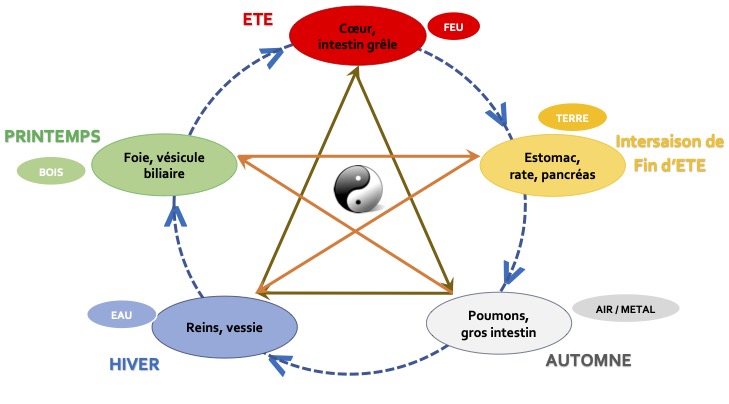
In Chinese culture, there are 5 seasons: spring, summer, autumn and winter, with an inter-season between summer and autumn.
Each season and inter-season corresponds to a particular energy, quite similar to what happens in Nature, associated with an organ, viscera, organ of expression, element, color and emotional state.
The quest of each season is to maintain both bodily and emotional balance, in order to stay healthy. To achieve this, we need to maintain our energy levels, taking into account our biological rhythms. This is achieved through diet, movement, expression and some form of spiritual practice.
Winter is associated with the kidney, bladder and genitals. The kidney is associated with water. Winter's organs of expression are the ears, and thus listening. Winter is the season when Nature and the body come to rest. It's also a time for introspection and deep-seated emotions, from peace to fear.
The place of vibration in energy
The latest scientific discoveries demonstrate the omnipresent role of sound (vibratory frequency) in everything that exists in the known world. Some even claim that sound is the origin of life. Our body has a vibratory frequency, as do all living beings, plants and animals, but also the mineral world, water and even the planets, which vibrate below what the human ear can perceive.
The vibratory frequency of the human body can vary according to the individual's energy level. The more this energy is nurtured, the higher the vibratory frequency, the healthier the person, with a strong immune system. Particularly in winter, when the overall energy level of living organisms tends to drop due to the absence of sunlight, it is particularly important to strengthen our individual energy levels.
Our vocal organ
Our body is equipped with a powerful vibratory system, consisting of the vocal cords and phonatory muscles inserted in the larynx. To vibrate, the vocal cords need the breath, i.e. the lungs, respiratory muscles and diaphragm.
To resonate, sound needs bones, especially those of the skull. We also use the lips and palate of the oral cavity to form intelligible sounds like words (articulation). Our entire body is in fact a musical instrument, with its own resonance box.
This highly sophisticated vibratory system is instinctively and easily used by human beings from birth. Small children spontaneously produce a wide variety of powerful sounds, and love to play them. Singing comes naturally, even before speaking. This ability to use the voice extensively tends to be lost as they grow older, due to the under-use of certain muscles and the habit of restricting expression to conform to social customs.
Talking or laughing too loudly, singing without seeking aesthetics, or producing strange sounds for fun is hardly accepted as adults in our highly policed societies. What's more, the intensive use of digital tools bends us in half for hours on end, impairing the proper functioning of the diaphragm and keeping us in a static position, which atrophies the muscles.
As we age, our vibratory system tends to become less and less operative, with the voice no longer carrying as much (power), harmonics diminishing (depth), and sounds being limited in their diversity (vocal richness). The body ceases to vibrate sufficiently to remain healthy.
The effects of sound and vibration on health
Our society has become accustomed to abusing sound. Our cities are extremely noisy, music is omnipresent, often at far too high a level, and our machines and other technological tools emit sounds that are sometimes unnecessary (keyboard clicks, e-mail jingles, beeps or various ringtones, etc.).
In reality, this is pollution, just as harmful to our health as light pollution, the effects of which we are beginning to identify more clearly. We no longer know what true silence is. In this permanent cacophony, we can no longer distinguish the sounds of Nature, let alone our own sounds.
Our bodies spontaneously emit sounds. It also vibrates naturally, and we can perceive this vibration if we relax and pay attention to it. Making sounds when we move, yawn, sigh... and of course when we digest is natural, but we've learned to avoid making these sounds so as not to be noticed and judged negatively. This constant control of the body leads to tension, tension we're not even aware of. What's more, by over-soliciting our ears with sounds that are too loud, undiversified and flat (e.g. the deleterious effects of intensive MP3 listening on hearing capacity, deplored by ENT specialists), we also lose our ability to emit good quality sounds, since the ear is the body's guide for regulating sound emission (see the work of Tomatis, in particular, on this subject).
So sounds can destroy. They can also heal. Indeed, medicine has begun to take an interest in the use of sound to help the body heal. At the Créteil hospital, for example, there is a service for cancer patients that uses sound therapy. Alternative medicine also incorporates this approach, using, for example, singing bowls and therapeutic tuning forks to regulate bodily and mental energy.
To vibrate is to live (FM Dru). The first scientist to mention this reality was Georges Lakhovsky, in 1930. According to him, all the frequencies of the elements making up our body create a personal resonance, a "vibratory rate", and it is the harmony of cellular vibration that ensures the body's vital functions and maintains good health. By stimulating this vibration, we can stimulate life and biology.
Sound vibration and sound yoga
Eastern cultures have developed various ancestral practices aimed at stimulating energy, such as Qi Gong, Tai Ji Quan, martial arts and yoga. Sound yoga is in this vein. It's a practice of bodily and spiritual hygiene, combining breath, sound and, to a certain extent, movement.
"The voice is the best therapeutic instrument, the ultimate remedy available at any given moment. When we sing, we stimulate our organism from within, through the vibration of the larynx, and we are not dependent on any external source or remedy. The voice is the instrument of self-healing par excellence". FM Dru.
Through vibration and sound expression, based on the repetition of vowels (the 5 mother-sounds) and mantras, sound yoga brings various benefits: harmonization of brain waves, improved concentration and clarity of mind, stimulation of blood circulation, stimulation of the vagus nerve and the parasympathetic system, improved quality of sleep, relief of certain pains, overall stimulation of physical energy and improved mood.
Sound yoga, or Nada Yoga, is a meditative discipline that delves into the world of sound vibrations to promote physical and mental well-being. It can be practised alone, in a place with acoustics conducive to the diffusion of harmonics, or in a group. The collective repetition of carefully selected sounds on a steady note, combined with the relaxation and mutual trust offered by the group, produces particularly regenerating sound effects. This singing, a natural yet regulated expression of the body, requires no prior singing skills or musical knowledge.
Nor is there any judgement or quest for performance or accuracy. The rightness and harmony of the sounds produced come from bodily relaxation and a benevolent acceptance of the emotions that may arise in oneself and in others.
In winter, the season of anchoring and interiority, of gentleness and listening, we sing in particular combinations of the mother-sound OU, which vibrates in the pool and allows us to dive into ourselves. The key words of the mother-sound OR are Depth, Trust and Reconnection. Add the O mother sound, the sound of softness, roundness and interiority. We can also add an MMM, which brings the vibration inside ourselves, as in the mantra AUM (A - O - OU - M), the Sanskrit mantra of realization and incarnation.
Sound yoga practice, group dynamics and healthy living
In the group practice of sound yoga, each individual is carried along by the collective sound. They no longer sing, they ARE sung. They experience, sometimes for the first time in their lives, a sense of integration into a vast whole that may include other members of the group, but also, more broadly, all living things.
So, even without associating a structured spiritual approach with this practice, it's not uncommon to feel linked and connected to something greater than oneself as one sings the mother-sounds and, in the process, feels oneself vibrating from head to toe.
Practised regularly and in tune with the energy of the seasons, sound yoga is an approach to healthy living, self-regulation and self-healing. Practised in a group, it also contributes to mental hygiene through the sense of belonging and physical joy it brings.
Sources
Comte, Emmanuel. Le son des vibrations, influence des sons et de la musique sur la santé et le développement personnel. Dangles, 2015 - https://amzn.to/3E5LpzC
Cristol, Denis. Learning from the depth of sounds, bone resonances . March 8, 2022. On: https: //cursus.edu/fr/23790/apprendre-de-la-profondeur-des-sons
Dru, François-Marie. Tout est vibration. Leduc éditions, 2021 - https://amzn.to/4ad8vAB
Dru, François-Marie. What is sound therapy? On: https: //www.sonicmedecine.com/
Demouth, Olivier. Yoga du son, voix de l'âme, voie du coeur. Ed. La Plage, 2024 - https://amzn.to/3WjmL57
Fargeot, Denis and Véronique. La pratique du yoga du son, guérir par les 5 sons-mères. Le courrier du livre, 2015 - https://amzn.to/3PzzH2Y
The benefits of sound yoga. On: https: //www.osersavoix.fr
The seasons according to Chinese medicine. https://joelle-tareau.fr/les-saisons-selon-la-medecine-traditionnelle-chinoise-1-6
Sebih, Marion. Kundalini des saisons, le yoga du vivant. Flammarion, 2021 - https://amzn.to/42duJR8
Tomatis, Alfred. L'oreille et la voix, on chante avec son oreille. Laffont, 2006 - https://amzn.to/4gMnUu2
See more articles by this author