From an early age, most children see their parents go away to "work. They quickly understand that there is necessity, importance and reward in working. How and to what extent?
Publish at January 22 2025 Updated January 22 2025


Africa is experiencing a shortage of engineers, is the quintessence of an article published in March 2021 on the Eco Fin newspaper website. The same observation had already been made by Unesco in 2008. The article focuses in particular on the mismatch between training and skills.
Paradoxically, in parallel with this observation, we note a multitude of creations, sometimes made by people without a very advanced academic background. It's this category that interests us in this article.
In Africa, it's common to come across people, both schooled and unschooled, making prototype devices (airplanes, water-powered generators, racing cars, sports mats, etc.) or inventions from scratch, with derisory means.
Some of these inventions are simply reproductions of existing devices, made by people who have never been to engineering school or even used the objects they make with local materials. Whether they are original inventions or already existing ones, these young engineers, ready to transform the world, very often have no support, due to a lack of incubators or political or economic will. However, the fact remains that they are intelligent people, even geniuses. How can we capitalize on these creations? How can we guide these unknown, solitary engineers so that they can develop their talents? How can they adapt to the speed of Western creativity?
On October 4, 2024, on the page of a Cameroonian influencer with a large Facebook following, Stev Fah, was presented an invention by a Cameroonian engineer, Mba Hamadou. Mba Hamadou has developed a generator using water as an energy source. An invention that could revolutionize the energy sector in Cameroon. Cameroon is one of the largest hydroelectric basins in Africa. So inventing an energy source that runs on water could be accessible to many Cameroonians who live with the martyrdom of untimely power cuts. As can be seen on the influencer's page, several comments congratulate him on his feat, while others draw attention to the engineer's need to patent his invention and, above all, to be careful, as he and his invention could face competition from behemoths such as the oil industry, who are not prepared to lose their gains.
While this invention may seem original, there are others that are in fact copies, showing only the genius of the manufacturers. Such is the case with the 3D printer.
Arol is just 15 years old, and without any engineering training, this young man has created a printer made from recycled materials. So, he's not the inventor of 3D printers, but he was able to train himself to make a copy. He brilliantly explains his work in an interview available on Initiative Africa's YouTube page. This achievement is similar to those of Flanan Soro in Côte d'Ivoire.
Mr. Soro is a mechanic in his seventies. In his garage, we discover several objects assembled by him and his team: a water pump, a car and a helicopter. The helicopter isn't flying yet, but the car is. He's not young, but like most African geniuses, he's the product of self-training.
In 2015, Vidiol Tsagué, then a high school student, built a prototype airplane that took off thanks to a battery and a remote control. In fact, there's no originality in this production, but given the context, this young man's invention is fascinating. African inventors and engineers are in the same situation. How can we capitalize on these geniuses who were born in the "wrong place"?
When we say "wrong place", we're referring to contexts where there are hardly any serious incubators to inspire engineering vocations, and where politics doesn't attach much importance to these initiatives. In all the inventions mentioned, one common difficulty stands out: the lack of support. This support can be provided in several ways.
In short, in a world where the brain drain is understandable insofar as people are all seeking well-being and are ready to settle in places where they can develop professionally, it makes no sense to want to keep people on the spot.
However, if a country wishes to develop, it is essential to combat the brain drain, which differs from the brain drain in that the former is a discreet removal of intelligence by other countries, while the latter is a vital move for reasons of professional security. This struggle involves mentoring engineers or geniuses so that they have the motivation to flourish locally.
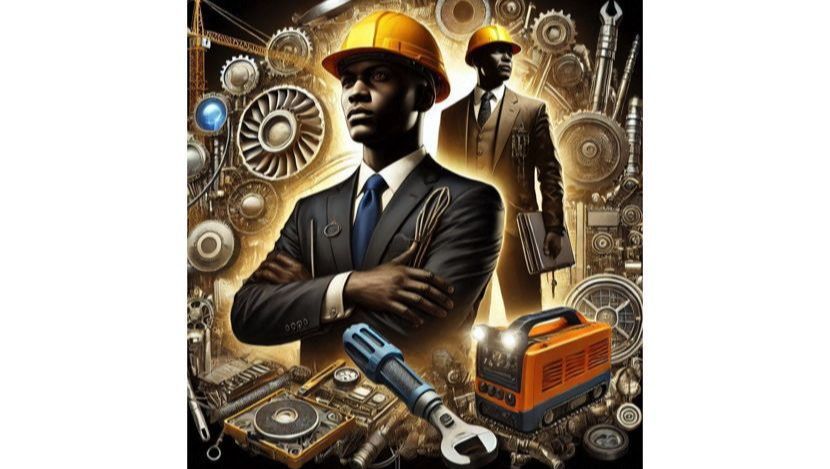
Image, Copilote, "Can you create an image of African engineers?"
Bibliography
Maingari, Daouda, (2011), "Exode des cerveaux en Afrique : réalités et déconstruction du discours sur un phénomène social", https://shs.cairn.info/revue-education-et-societes-2011-2-page-131, Pages 131 à 147
3D printer from recycled material: a young Cameroonian's ingenuity inspires Africa: Camerounweb, 2024, "Cameroun: il invente un générateur électrique à eau", https://www.camerounweb.com/CameroonHomePage/business/Cameroun-il-invente-un-g-n-rateur-lectrique-eau-771834
Mbengue, "Flanan Soro, un inventeur de génie", 2024, https://www.youtube.com/watch?v=zD0XdTAKBXY
Ngono Atangana, Vanessa, 2011, "L'Afrique connait un manque d'ingénieurs en qualité et en quantité (UNESCO)" (Africa lacks engineers in quality and quantity) - https://www.agenceecofin.com/formation/2603-86571-l-afrique-connait-un-manque-d-ingenieurs-en-qualite-et-en-quantite-unesco
You might also like:
From an early age, most children see their parents go away to "work. They quickly understand that there is necessity, importance and reward in working. How and to what extent?
Distance or face-to-face learning
Isn't there also a certain unconsciousness in considering that we can transmit skills involving exchanges between human beings and an engagement of the body using digital modalities?
Student empowerment and parental responsibility
Learners' failure is often blamed on the school. There may be other reasons for students' lack of guidance and empowerment. In this respect, the imposition of a set path by the parent is often a source of internal conflict and demotivation for the learner. Hence the need to build a framework conducive to student empowerment, through listening and dialogue.
The nervous limits of teachers
The search for efficiency, amplified by ever more efficient technological and administrative systems, is leading us to a reordering of relationships. Teachers can be the victims, but they can also benefit if they guide the changes...
Semantic optimization: balancing algorithmic performance and reading pleasure
Semantic optimization is not a binary choice between algorithms and humans, but a balance that maximizes both performance and reader enjoyment.