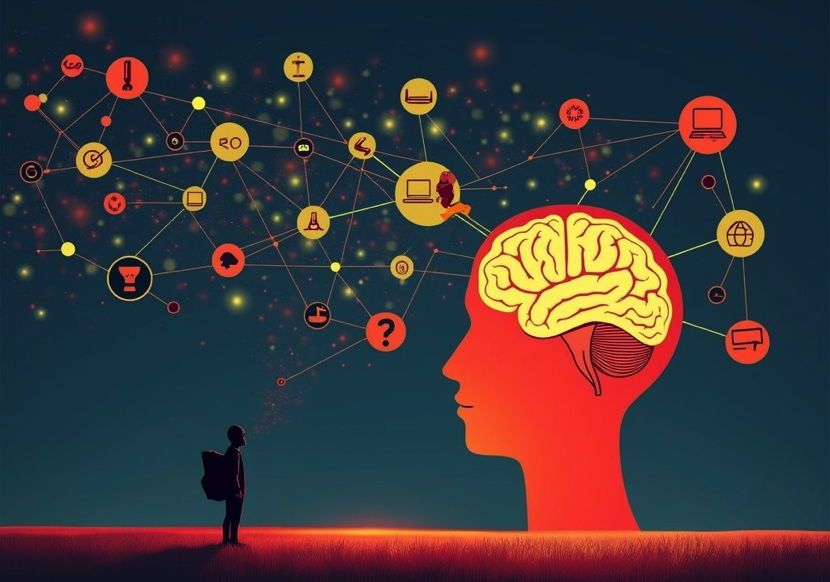
From our earliest childhood to the university classroom, via our social interactions and media consumption, influence is a constant companion. Sometimes subtle, sometimes overt, it seeks to direct our thoughts, emotions and behavior, whether for commercial, political or ideological ends. In our hyper-connected world, we are more than ever exposed to a continuous flow of persuasive stimuli. Targeted advertising, carefully calibrated political speeches, the positions taken by influencers followed by millions of subscribers... It's hard to escape!
In the face of all this hype, a burning question arises: what are the inner workings of influence? What goes on deep inside our minds when we are subjected to an attempt at persuasion? Spectacular advances in cognitive neuroscience are providing fascinating answers to these questions. Thanks to brain imaging and other brain exploration techniques, researchers are gradually uncovering the neurobiological mechanisms underlying our receptiveness to influence.
Emotions, cognitive biases, social pressure, the power of language... So many levers of influence that find their source in the depths of our gray matter. Far from being trivial, these often unconscious processes raise major issues. From our capacity for independent thought to crowd manipulation, sectarian aberrations and fake news, the issues raised by influence are of concern to citizens, educators and decision-makers alike.
In order to gain a clearer understanding of these issues and develop a heightened sense of vigilance, it's crucial to grasp what neuroscience has to say about the brain mechanics of influence. That's the purpose of this article, which takes you behind the scenes of persuasion. In the course of our exploration, we'll unravel the major psychological mechanisms of influence revealed by neuroscience, from the key role of emotions to the effect of language, via our cognitive biases and our sensitivity to group pressure.
Understanding is already a way of protecting ourselves. But beyond a better understanding of the workings of persuasion, this journey to the heart of the influenceable brain raises a broader reflection on our relationship to influence. There's a fine line between positive and harmful influence. That's why we need to develop our discernment if we are to navigate wisely in a world where influence is becoming ever more pervasive and insidious.
Emotions, the gateway to influence
Emotions play a central role in our decision-making, far more than we realize.(1) Fear is a frequently used lever, notably in prevention campaigns (tobacco, road safety) but also in politics.(2) Enthusiasm and positive emotions are also used to generate support, whether in advertising or motivational speeches. As for empathy, it creates a strong emotional bond to encourage identification and commitment.
Brain imaging reveals that messages with a strong emotional impact activate key brain regions such as the amygdala, the seat of emotions, sometimes bypassing reasoning areas. In this way, a message can influence our attitudes without us even being fully aware of it(3).
Cognitive biases, mental shortcuts that trap us
Our brains tend to operate in "automatic" mode when processing the immense quantity of information they receive. It thus takes shortcuts called "cognitive biases" which, while often useful in everyday life, can also play tricks on us in terms of influence.
Among the most commonly exploited biases is the confirmation bias, which leads us to retain only information that confirms our initial beliefs.(4) Influencing strategies can thus reinforce our opinions by presenting us with only one facet of a subject. The simple exposure effect, on the other hand, explains why we tend to develop a preference for things that are familiar to us: hence the importance for brands of ensuring a regular advertising presence.(5)
Thehalo effect leads us to extend a positive judgment based on a single characteristic (6): a physically attractive person will thus be judged more competent or likeable. Finally, the anchoring bias underlines our difficulty in breaking away from a first impression, even a false one: a high starting price will induce the idea that a product is of high quality(7).
Neuroscience shows that these biases are embedded in our cognitive functioning at a very deep and automatic level, making them difficult to control consciously. Influencing strategies skilfully exploit these shortcuts in our thinking.
Social influence or group pressure
Being accepted and integrated into a group is a fundamental human need. This need to belong is a powerful lever of influence, well illustrated by the famous case of the "fax machine": in the 1960s, American companies pushed sales of this useless device, claiming that "everyone was getting equipped". Social proof - trusting the group's behavior in an uncertain situation - and normative influence - the willingness to conform to collective expectations - are major drivers of social influence.
Neuroscience reveals that our brains are eminently social.(8) The discovery of mirror neurons, which activate when we observe an action as if we were performing it ourselves, sheds light on our unconscious tendency to imitate.(9) This cerebral mimicry is thought to be the basis of empathy and learning, but also explains the phenomena of emotional contagion and conformism.(10) For our brains, agreeing with the majority opinion is a "default" response to reduce the cognitive cost and psychological discomfort associated with difference.
Language, a formidable tool of influence
Words are never neutral. The choice of terms, associations of ideas, metaphors and the narrative in which a message is set are all linguistic elements that powerfully influence our perception. Advertisers are well aware of this, using terms that are empowering and "aspirational". In politics, the use of war or family metaphors and specific lexical fields is not insignificant, and activates very specific representations in our minds.
Storytelling has become a major tool of influence, playing on our sensitivity to narrative.(11) Our brains think "naturally" in terms of stories rather than raw facts. By immersing us in a story, a brand or a political leader engages us and anchors his or her message in a lasting way.
Neuroscience research shows that language mobilizes a vast cerebral network. Semantic priming - the activation of certain brain zones linked to an idea by the simple evocation of a word - is another lever of influence proving that language can literally manipulate our thought networks.(12)
Educating for influence: enlightened understanding
Awareness of our own sensitivity to influence is a crucial first step. Far from being a weakness, this sensitivity is inscribed in our cerebral functioning. By better understanding the mechanisms that make us susceptible to influence, we can develop metacognition, a reflection on our own way of thinking, to better regulate our relationship with persuasion.
Decoding the attempts at influence to which we are subjected is essential. This is where media and information literacy comes into its own, equipping citizens to deal with the onslaught of persuasion.(13) Learning to
- identify the intentions behind a message,
- analyze its rhetorical construction,
- verify sources and
- cross points of view.
This education in influence must also include ethical reflection. Not all influence is harmful or manipulative. An inspiring speech, creative advertising or a call for solidarity can all be forms of positive influence. The boundary lies in the intention: are we seeking to emancipate or enslave, enlighten or mislead, respect the autonomy of thought or alienate it?
Ultimately, the best bulwark against the excesses of influence remains the critical spirit. This ability to question, to not take at face value what is presented to us, to uncover the flaws in a line of reasoning, is a precious safeguard. But it's not an innate skill. Critical thinking is cultivated and exercised throughout life, and education has a major role to play in sharpening it.
Free to think
At a time when influence pervades every corner of our connected lives, it's vital to understand its inner workings. Emotions, cognitive bias, social pressure, language... These are all persuasion levers rooted in our cerebral functioning, often unbeknownst to us. This enlightened understanding is the first step towards greater vigilance and better discernment in the face of the many solicitations that seek to direct our thoughts and behavior.
Far from a simplistic vision opposing influence and free will, the challenge is to develop a lucid and enlightened relationship with influence, knowing how to identify its motives and question its intentions, in order to better preserve our capacity for autonomous reflection.
It's up to educators to integrate this knowledge and guide learners along the path to critical insight. By developing their understanding of the mechanisms of influence and their ability to decode them, by nourishing their reflection on the ethical stakes of persuasion, and by cultivating their critical spirit, they will contribute to shaping citizens capable of preserving their freedom of mind and action.
Illustration: AI-generated - Flavien Albarras
References
1- What our decisions owe to our emotions, [undated]. [online]. Available at: https: //popsciences.universite-lyon.fr/le_mag/ce-que-nos-decisions-doivent-a-nos-emotions/ [Accessed February 8, 2025].
2- PUBLIC SÉNAT (dir.), 2024. L'utilisation de la peur est politiquement utile mais c'est un risque pour un pays [on line]. March 15, 2024. Available at: https://www.youtube.com/watch?v=sOzCRjM_5M4 [Accessed February 8, 2025].
3- GUILI, Vincent, 2020. Neuroimaging and brain mechanisms of emotions. Sciences de la vie et de la Terre [online]. October 30, 2020. Available at: https: //svt.enseigne.ac-lyon.fr/spip/?Neuro-imagerie-et-mecanismes-cerebraux-des-emotions [Accessed February 8, 2025].
4- Confirmation bias, 2024. Wikipedia [online]. Available at: https: //fr.wikipedia.org/w/index.php?title=Biais_de_confirmation&oldid=220665231 [Accessed February 8, 2025].
5- Simple exposure effect - Definition of cognitive bias, explanation, examples, [no date]. Biais cognitif [online]. Available at: https: //biais-cognitif.com/biais/effet-de-simple-exposition/ [Accessed February 8, 2025].
6- Halo effect - Definition of cognitive bias, explanation, examples, [no date]. Biais cognitif [online]. Available at: https://biais-cognitif.com/biais/effet-de-halo [Accessed February 8, 2025].
7- Anchoring (psychology), 2024. Wikipedia [online]. Available at: https: //fr.wikipedia.org/w/index.php?title=Ancrage_(psychology)&oldid=219105149 [Accessed February 8, 2025].
8- Du contexte au cortex : à la découverte des neurones sociaux | CNRS, 2017. [online]. Available at: https://www.cnrs.fr/fr/presse/du-contexte-au-cortex-la-decouverte-des-neurones-sociaux [Accessed February 8, 2025].
9- JULIEN, Christian, 2008. On "mirror neurons". Les Lettres de la SPF. 2008. Vol. 20, no. 2, pp. 121-141. DOI 10.3917/lspf.020.0121. https://shs.cairn.info/revue-les-lettres-de-la-spf-2008-2-page-121?lang=fr
10- Mirror neurons, for better or for worse... | La Ligue de l'Enseignement et de l'Éducation permanente, [no date]. [online]. Available at: https: //ligue-enseignement.be/education-enseignement/articles/dossier/les-neurones-miroirs-pour-le-meilleur-et-pour-le-pire [Accessed February 8, 2025].
11- L'impact du Storytelling dans les Campagnes d'Influence - Hado, [no date]. [online]. Available at: https: //www.trenderz.io/blog-posts/limpact-du-storytelling-dans-les-campagnes-dinfluence [Accessed February 8, 2025].
12- Semantic priming: activating our categorization of the world | Institut du Cerveau, [no date]. [On-line]. Available at: https: //institutducerveau.org/actualites/amorcage-semantique-activer-notre-categorisation-monde [Accessed February 8, 2025].
13- Media and information literacy, 2024. Wikipedia [online]. Available at: https: //fr.wikipedia.org/w/index.php?title=%C3%89ducation_aux_m%C3%A9dias_et_%C3%A0_l%27information&oldid=220403449 [Accessed February 8, 2025].
See more articles by this author