Does an unstable and potentially worrying environment necessarily lead to emotional fragility in individuals?
The current evolution of our society does not reassure us. Wars, violence against women, racism and generalized intolerance, climate change, pollution of all kinds, suffering in the workplace... Some days, we can feel that everything is hopeless and that the present and the future can only be bleak. Add to this difficulties in relationships with family and friends, health worries, money problems... and you can find yourself in a state of permanent anxiety, a source of malaise and demotivation.
" Today, we know that physical health is the fruit of a healthy lifestyle: regular exercise and body care, healthy food and rest. Few people know that the same applies to mental health, with the same ingredients (...) Maintaining a state of inner peace despite life's shocks, frustrations and frictions is also a question of mental hygiene, just as brushing your teeth is a question of physical hygiene". T. D'ANSEMBOURG, D. VAN REYBROUCK
Unfortunately, we don't learn to welcome and regulate our emotions, either at school or in our families. Nor do we learn to take responsibility for our needs. In our emotionally-charged society, especially when it comes to worry and fear, the most common behavior is to blame our environment and the actions of others.
We behave as if our only choice were to endure, or rather, as if there were no choice at all. We have little power to change the behavior of others, indeed. On the other hand, we do have the power to change our own behavior, and we also have the ability to change the way we look at situations, in order to identify the opportunities as much as, if not more than, the negative effects.
Human beings are governed by their needs
This is what Non-Violent Communication (NVC) is all about. These needs are universal, in other words they are present in all human beings. They are also very diverse and numerous, even if, fundamentally, NVC identifies only two at the root of all the others: the need to feel we exist (including survival) and the need for love.
There are physiological needs (to feed, breathe, rest...) and psychological needs (to feel safe, to connect with others, to be recognized, to be loved, to realize oneself, to learn...). In other words, we don't all have the same hierarchy of needs, as Abraham Maslow once claimed.
Some needs are also more vital than others, meaning that if these needs are not met, the individual will wither and fall ill. These vital needs are not just physiological. The need for meaning, for contact with others or with Nature, for learning, for freedom, for sovereignty (control) over one's own life, etc. can, depending on the individual, be just as necessary to good physical and mental health as eating or sleeping.
At every moment, we feel these needs, between which we arbitrate more or less consciously when they don't seem compatible at the very moment (e.g. to rest or to distract ourselves, to set limits to feel respected or to please to feel loved, to express ourselves to be recognized or to keep quiet to remain at peace etc.).
The frustration or satisfaction of these various needs is signified by the body, which highlights them through sensations of physical tension or well-being, and through emotional manifestations: the frustration of a need can lead to anger or sadness, associated with headaches, backaches, stomach aches, accelerated breathing, sweating, crying... the satisfaction of a need leads to relaxation of the body, mental and physical peace and even joy, with positive consequences for health and the immune system.
Experiencing emotions means being alive. They also contribute to the pleasure of living. Unfortunately, we have a tendency to reject unpleasant emotions (some even call them "negative"), seeing them above all as nuisances to be avoided, whereas, like pleasant emotions, they are simply signals indicating the level of frustration or satisfaction of our needs, comparable to the warning lights on the dashboard of our cars. Their raison d'être is actually to keep us healthy. So the more violently these emotions manifest themselves, the greater the frustration, and therefore the greater the urgency to remedy it.
Empathizing with others
The notion of empathy has been democratized in recent years, but unfortunately often in the form of an injunction. Managers are expected to show empathy to their teams, doctors to their patients, teachers to their pupils, parents to their children and so on. We rarely talk about the empathy we can give to ourselves, which is in fact the first step before we can give it to others. Caregivers, for example, whose empathy is much in demand, are very often faced with burn-out, not least because they don't take as much care of themselves as they do of others. This can also be the case for mothers, who attend to their family's multiple needs all day long, without taking the time to look after themselves.
What is empathy? It's a capacity that all human beings are born with, and which may or may not be developed. It's a non-judgmental welcome, a benevolence that implies acceptance, a form of compassion too. I recognize needs and emotions in others that I'm likely to experience myself, and this helps me to understand them, and therefore to dialogue better with them.
Self-empathy means granting myself the possibility of feeling needs and emotions of all kinds, and recognizing their usefulness without judging them (we're talking here about the emotion itself, not its translation into action, such as anger, which would generate verbal or physical violence). I welcome this emotion for what it is, i.e., a signal, an alert that points to frustration or the satisfaction of my needs, and thus contributes to my survival and well-being.
Self-empathy also means identifying the need behind the emotion and taking action to satisfy that need. Because, according to non-violent communication (NVC), we are responsible for satisfying our needs. This doesn't mean we can't ask others for help in satisfying them, but we mustn't expect them to agree to help us, and even less to be the only ones able to satisfy our needs (recognition, love, respect, trust, etc.).
Stress is part of life, but becomes dangerous for physical and mental health if it is excessive or permanent.
The accumulation of frustrated needs and unregulated emotions leads from simple stress to violence towards oneself and/or others. By ignoring our needs and rejecting our emotions, we create physical and mental tensions that drain us of vital energy. What's more, this lack of inner peace prevents us from remaining available and stable in the face of life's events.
We become increasingly intolerant of the vagaries of each day, and of behaviors and opinions too different from our own. Depending on our state of temporary or permanent stress, every annoyance can become totally unbearable and lead us to over-react in an uncontrolled way. When we reach this level of emotional fatigue, everything becomes a battle.
If we simply sit back and wait for change and peace to come from outside, we run the risk of ending up in extremities such as violence, depression or burn-out, or at the very least, misanthropy and social isolation.
An emotional hygiene tool suggested by non-violent communication (NVC): the availability funnel
Ecology isn't just about respecting and preserving nature and the living around us. Living things are also within us. How can we claim to preserve the living when we don't respect ourselves enough to learn to regulate our emotions? As we've seen, the fear and stress we feel all the time lead us to become tense, distrustful and sometimes violent. Calm, distance and empathy are needed to recognize, respect and cooperate with other living beings, from plants to humans.
When the level of frustration reached is too high or has been entrenched for too long, it is much more difficult to remedy. In this field, as in others, anticipation is one of the keys. Anticipation combined with awareness.
NVC has developed numerous tools to help individuals identify their needs, regulate their emotions and communicate in a benevolent way, in order to contribute to peace within oneself and around oneself. Among these tools, the Availability Funnel (also known as the Inner Space Scale) is designed to help regulate inner balance on an ongoing basis, with the aim of avoiding emotional escalation and the point of no return. It's an internal tool, based on self-awareness and the conviction that we are responsible for our behavior and can change it. Only the individual can use it for himself.
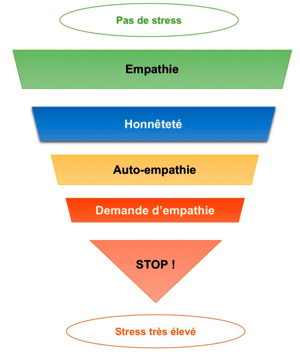 The funnel is structured in five stages, each of which corresponds to a different level of inner stress and the actions required to regulate it.
The aim is not to totally eradicate stress - which is part of life - but to maintain it from non-existent to moderate, without ever going beyond that. This permanent regulation enables you to look after your personal well-being, while remaining a tolerant and benevolent individual towards others, or at the very least capable of listening, as the two issues are in fact intimately linked.
When we use this tool regularly, becoming increasingly aware of what motivates our actions and makes us react, we increase the time spent in a state of zero or very limited stress, and lose the need to enter into conflict.
- At the highest level of the funnel, stress is non-existent. No annoyance, no major fatigue, pleasant relationships - in other words, sufficiently nourished needs. At this level, it's possible to empathize with others, because we have the necessary inner calm.
- At the 2nd level of the funnel, there is a slight stress that may be due to a passing annoyance or a slight health problem (hunger, headache, transient fatigue...). At this level, inner calm is more relative, and it's already less easy to ride out the difficulties of everyday life.
The aim is to get back to the 1st level, and this can be done by practicing what NVC calls "honest expression", in other words, putting words to the problem, identifying the frustrated need and regulating it by nurturing it (rest, food, frank exchange with the person concerned...).
- At the 3rd level, the stress is greater, probably because it was not taken into account at the previous level. Emotions become invasive and unpleasant, and there may be longer-lasting physiological effects. It becomes difficult to have peaceful relationships with others, as the tolerance threshold is lower because the inner space is filled with preoccupations.
At this stage, the important thing is to pause and practice self-empathy: What exactly is happening to me? What are my emotions and my body telling me? What can I do to feel better? What are the needs I've been ignoring? This pause in the conversation, in the activity, in the relationship... is essential to the awareness that will enable the necessary adjustments to be made.
- At the 4th level, the individual has become a nuisance not only to himself, but also to others. Emotions take up so much space because they are not heard, that they lead to uncontrollable reactions and behaviors (verbal violence, emotional outbursts of all kinds, passive aggression, intentional or unintentional breakage of objects, various clumsinesses, everyday accidents, forgetfulness, etc.), which can have deleterious effects not only on the environment, but also on oneself.
At this stage, you should withdraw from relationships with others, as you run the risk of hurtful words and brutal gestures, which will be expressed as unanticipated defensive reflexes. When you've let yourself fall to this level of the funnel, you need to look around you for sympathetic help, which can also be professional. It's no longer possible to manage alone. Empathetic listening from outside is essential.
- At the lowest level of the funnel, reached if the descent has not been interrupted at the previous stages, the only solution is to STOP. This STOP can be imposed by the body or decided by the individual. It's about taking a vital break to regenerate. Unlike the relatively short break in step 3, this break will be more substantial.
It could be a long vacation or a period of sick leave, or even a professional change, a divorce, a sabbatical... These long breaks or major changes are sometimes very welcome in a life, but it would be more satisfying and joyful to decide on them in an available and conscious state rather than out of vital obligation.
- And if we go beyond the STOP? Then the door is open to all kinds of extremes, from burn-out to suicide, to physical violence against others.
Cultivating your inner space
As you can see, to maintain space inside yourself, and thus stability and comfort for yourself and others, you have to nurture your needs yourself. This means identifying them and keeping an eye on them, so as to respond without delay to the frustrations of varying degrees that the simple fact of being alive brings with it every day. The most effective way to do this is to remember to check your stress level every morning and several times during the day, especially when you've just suffered a setback. In this case, the "good little soldier" attitude, which leads us to carry on against all odds, ignoring the physical or emotional pain, is counter-productive.
The sooner we take frustration into account, the easier it is to regulate with everyday resources: talking to a friend, going for a walk, watching a good series, listening to music, sleeping, playing with our children, eating a good meal, indulging in a sporting or artistic activity, gardening, decorating our home, getting a massage, ... or simply offering ourselves a moment of deep breathing. We all know what nourishes us and brings us well-being.
By taking care of ourselves every minute of the day, we can contribute to a more serene, tolerant and pleasant world for all.
"Every morning, the men and women who take care of the parcel of reality entrusted to them are unknowingly saving the world. Christiane SINGER.
Illustration: dominador - Pixabay
References
D'ANSEMBOURG, Thomas, VAN REYBROUCK, David. La paix, ça s'apprend! Healing from violence and terror. Babel, 2021
https://amzn.to/43l0V5n
https://www.leslibraires.ca/livres/la-paix-ca-s-apprend-guerir-thomas-d-ansembourg-9782330157067.html
D'ANSEMBOURG, Thomas. How to recognize your needs to move towards the life you want? - 2020 - https://www.youtube.com/watch?v=m81GG7TN4wM
Self-empathy: getting down into yourself before you can get up. April 2019. On: https: //apprendreaeduquer.fr/auto-empathie-communication-non-violente/
HECQUARD, Françoise - Knowing how to be available to yourself and to others. October, 2019
https://dynamiquesdechangement.fr/2019/10/05/savoir-etre-disponible-a-soi-et-aux-autres/
HOBART, Fabien. Defining the scale of your availability. June 2020.
https://etreprof.fr/ressources/3887/definir-l-echelle-de-sa-disponibilite
KOTSOU, Ilios. Petit cahier d'exercices d'intelligence émotionnelle, ed. Jouvence, 2024
PEIFFER, Christophe. What is your inner space? October 2015.
https://www.leblogdesrapportshumains.fr/quel-est-votre-espace-interieur/
ROSENBERG, Marshall. Words are windows (or they are walls): an introduction to Nonviolent Communication. Ed. La Découverte, 2016
https://amzn.to/4h96ZBo
https://www.leslibraires.ca/livres/les-mots-sont-des-fenetres-ou-marshall-b-rosenberg-9782889538942.html
See more articles by this author