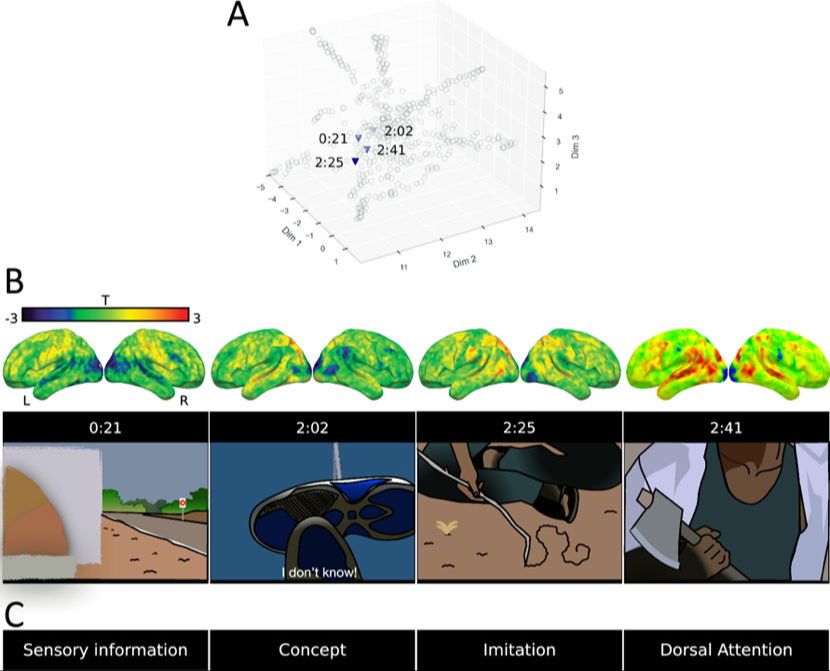
By observing a person's physiognomy and attitudes, we can often deduce their emotional state and the type of thoughts they harbor. By observing their travel patterns on a map, we can also predict where they're going and what they'll be doing. If we transpose this kind of information to brain activity, might we be able to read a person's thoughts?
This is the challenge set by Inria's Mind project team. Using functional MRI brain imaging to map brain activity dynamically and precisely, and with the help of artificial intelligence, to create a 3D "Morphospace" to which a number of functions and activities (memory, language, movement, emotions, etc.) are associated. Subsections allow us to go even further in the dynamic interpretation of these patterns. For example, in the emotions section, these can include joy, sadness, fear, etc.
"A first conclusion that validates the initial stage of the project... but not only. For the realization of this new way of understanding and visualizing cognition offers a major opportunity: that of being able to guess, from an image of the brain, the cerebral activity at play."
Better still, like Mendeleev's first version of the periodic table of the elements, which was highly incomplete but guided the discovery of the missing elements, this morphospace includes areas and patterns of activity that remain mysterious. Human thought cannot be reduced to neuronal activity alone, and the intricacy of neural networks is highly complex. This tool opens up many new avenues for uncovering the missing elements.
For the full article: Predicting thoughts, an attainable challenge?
For the publication in Nature Communications - The morphospace of the brain-cognition organisation
Learn more about this
news
Visit inria.fr
See more news from this institution