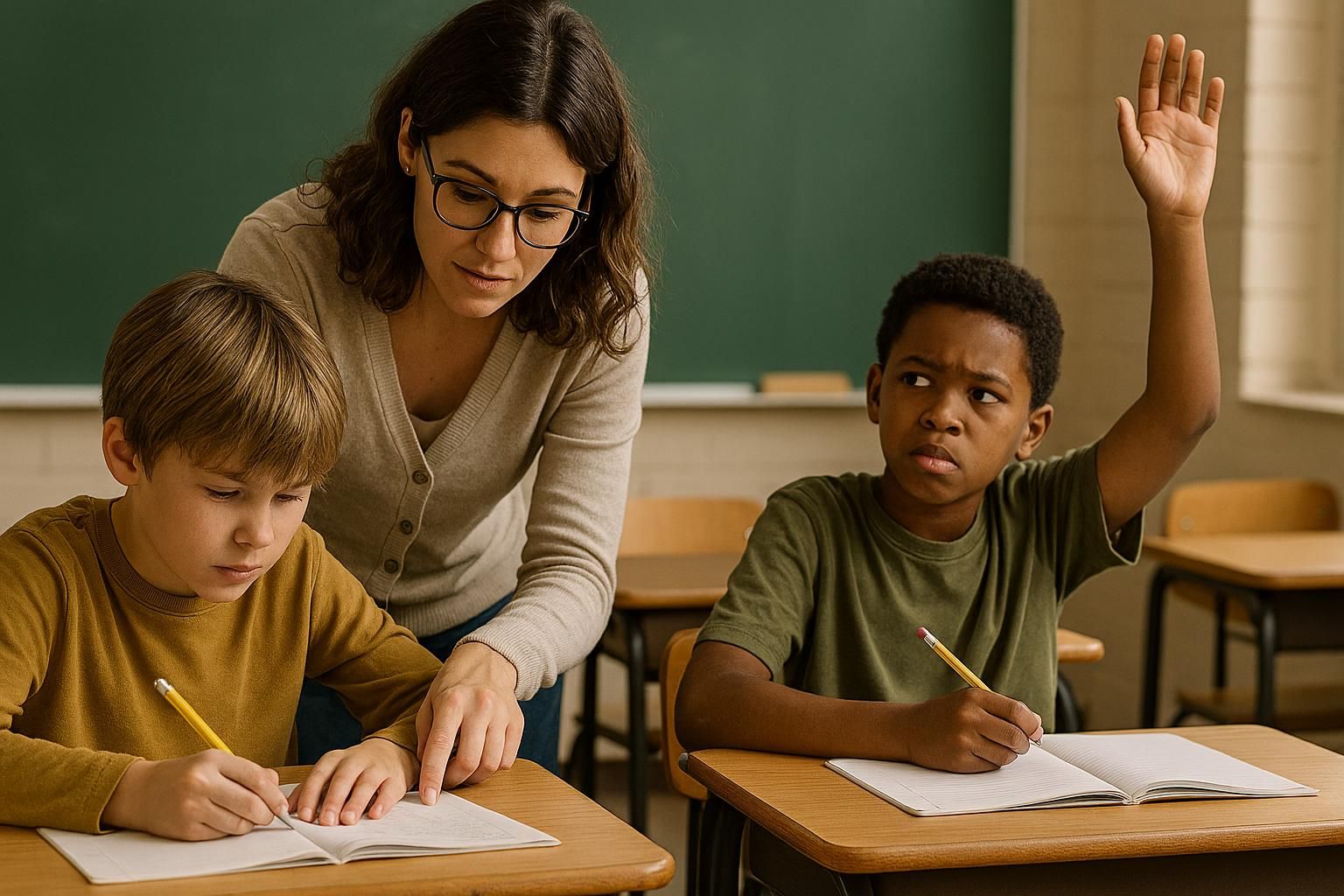
Access to learning is a universal right. The vast majority of the world's nations and cultures agree that all future generations deserve a similar, comprehensive education. In reality, however, schools unconsciously or unconsciously reproduce biases and divisions based on various criteria, such as socio-economic background, gender, ethnic origin and so on. All in all, the school is much less universal than it would like to be. Not to mention the differences that can play out with certain physical and intellectual disparities.
Unfortunately, some will argue that this is a reality that cannot be countered, and that while schools can try to mitigate inequalities, they have little pedagogical power to do so. In their view, it might be better to place similar learners together in a class to avoid excessive differences.
Others, however, promote a truly universalist approach to education, allowing classes to be taught to students who are just as likely to be normal as those with disabilities or learning difficulties.
The values of universality
What we call Universal Design for Learning (UDL) approaches the architectural model of "universal design". It's a proactive, intentional framework that comes into play as soon as a program is created, to make it accessible to every potential learner.
The image has often circulated online of three children of different heights trying to watch a soccer match behind a fence, signifying the differences between status quo, equality and equity. In the context of the AUC, the idea is rather to remove the obstacles, in this case the fence, and place a grid around the pitch so that everyone can watch despite their differences in height.
This approach must meet a number of criteria, including :
- Universality: Provide access to rich learning experiences that meet everyone's needs.
- Equity : Expand students' knowledge, regardless of their background, skills or level of understanding.
- Simplicity: Ensure that instructions and expectations are easy for everyone to understand.
- Flexibility: Adapt teaching strategies to the different profiles in the classroom.
This last point is essential, since it requires the teacher to think about several modes of engagement, representation and expression in the classroom. This means, among other things, thinking about different ways of communicating the information to be learned to students, and offering different avenues of assessment. Rather than imposing an oral presentation, the teacher can propose a variety of methods, such as multimedia, writing, oral presentations, recordings or other means of completing a task. This also means clarifying for everyone the timetables for exercises, exam objectives, etc.
Ensuring learner comfort
This Quebec teacher sums up the implementation of AUC in her casevery well: ensuring that every student is comfortable with the didactic approach used. The teacher's job here is to ensure that everyone responds well and has access to devices or accommodations that enable them to be in the best possible learning posture. Trial and error are perfectly normal. Ideally, we should be quick to correct anything that goes wrong with the student, so that he or she can enjoy an optimal learning experience.
Nevertheless, this reality is cause for concern among teachers. Teacher training still favors a one-size-fits-all approach for an entire class, in the hope that as many children as possible will be able to master knowledge. As a result, this value of inclusion, so dear to the AUC, can seem almost impossible to achieve.
Fortunately for them, initiatives and resources are beginning to appear to help them in this transition. The Canopé network is now offering various AUC training courses to all interested teachers. These began in autumn 2024, but will be repeated several times throughout the year and hopefully beyond.
Incidentally, this is one of the most important points that could stand in the way of such a conception of education: the lack of available training. Insufficient financial resources could also play a role in the difficulty of implementing differentiated pedagogy of this kind.
Secondly, some institutions and individuals are rather resistant to the integration of artificial intelligence in education. Yet AI is likely to be one of the most decisive tools in the democratization of the universal design of learning. It will easily be able to analyze data, suggest approaches and techniques for each learner according to limitations (or not) so that the lesson is fun, safe and leads to knowledge acquisition. This will certainly not be the only way to establish universal education, but it cannot be ignored as it will reduce the teacher's workload.
Image: Gerd Altmann from Pixabay
References:
Cournoyer, Laurence. "Universal design for learning (UDL)." Collège Ahuntsic. Accessed March 15, 2025. https://www.collegeahuntsic.qc.ca/services-aux-etudiants/services-adaptes-saide/personnel-enseignant/conception-universelle-apprentissage.
Dionne, Stéphanie. "Universal design for learning: benefits and challenges." L'École Branchée. Last updated: October 5, 2021. https://ecolebranchee.com/la-conception-universelle-de-lapprentissage-avantages-et-defis/.
"Faire classe à tous les élèves: oui, mais comment?" Réseau Canopé. Last updated: October 8, 2024. https://www.reseau-canope.fr/actualites/article/faire-classe-a-tous-les-eleves-oui-mais-comment.
Gube, Maren. "Online Resources on AUC." Association Québécoise Pour L'équité Et L'inclusion Au Postsecondaire. Last updated: October 13, 2023. https://aqeips.org/projets/projets-completes/page-de-ressources-sur-la-conception-universelle-de-lapprentissage-cua/ressources-en-ligne-sur-la-cua/.
Higounet, Julie. "AI in the service of Universal Design for Learning (UDL)." EDHUMAN. Last updated: April 20, 2024. https://www.edhuman.org/post/l-ia-au-service-de-la-conception-universelle-des-apprentissages-cua.
"Universal Design for Learning." Campus Mental Health Innovation Center. Last updated January 31, 2024. https://campusmentalhealth.ca/fr/trousses-doutils/accessibilite-et-adaptation/accessibilite/la-conception-universelle-de-lapprentissage/.
Leclerc, Katia. "L'évaluation des apprentissages dans une perspective inclusive." CTREQ - RIRE. Last updated: June 5, 2024. https://rire.ctreq.qc.ca/levaluation-des-apprentissages-dans-une-perspective-inclusive/.
"What is Universal Design for Learning (UDL)?" CSS RÉCIT Des Découvreurs. Accessed March 15, 2025. https://recit.cssdd.gouv.qc.ca/approches-pédagogiques/conception-universelle-de-lapprentissage.
"What is universal design for learning?" TA@l'école. Last updated September 24, 2024. https://www.taalecole.ca/modules/cua-differenciation-pedagogique/introduction/quest-ce-que-la-cua/.
Schenk, Viktoria. "Universal Design for Learning (UDL), what is it?" Evaluo. Last updated: January 20, 2025. https://evaluo.eu/conception-universelle-de-lapprentissage/.
See more articles by this author