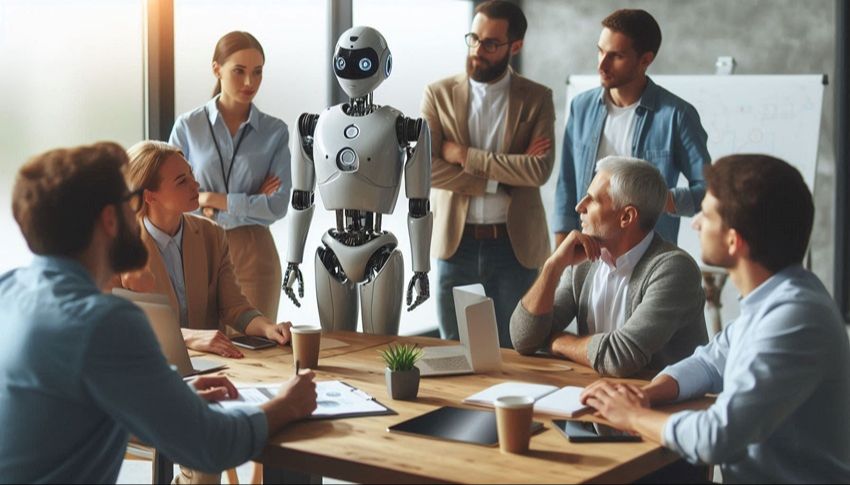
"Alone, we go faster; together, we go further." This maxim well represents the idea of teamwork whether in the school or professional context. Of course, deciding everything on your own is much faster. There's no dithering, no discussion, just pick the path that seems most interesting and go for it.
But if it takes longer, the work of multiple brains put together can illuminate avenues we wouldn't have thought of. It's possible to bounce off someone else's opinion, draw inspiration from it, and create an approach that's even more productive or relevant because it will have taken several angles of view at once rather than just one.
In short, teamwork, despite its more time-consuming aspect, is often encouraged for its possibilities. And in an age when artificial intelligence is making inroads everywhere, including in human resources management, why not in teamwork too?
A bad teammate?
Is it possible to team up with artificial intelligence? Technically, there's nothing to prevent it. On the contrary, robots are programmed to help humans in their work, whatever that may be. But do they make good working partners? That depends very much on the situation.
On the one hand, some research tends to show that integrating AI from the outset to help a team come up with ideas offers excellent results. On the other, studies carried out in a context where human partners are gradually replaced by algorithms show a drop in performance.
It all depends on the situation in which AI is used. Researchers from Harvard Business School and the Wharton School conducted a large-scale experiment in a company with hundreds of employees. These were divided into four categories: two-person teams from R&D and marketing with or without AI, and single individuals with or without AI.
Each group was asked to provide ideas for new products, as well as packaging and distribution strategies. The researchers then analyzed what was produced and were able to note a few things:
- Individuals on their own with AI were more efficient and came up with better proposals than teams without AI.
- Teams generally saved less time during the exercise.
- Novices produced products as good as their experienced colleagues.
- Teams produced significantly more high-quality ideas than individuals.
- Teams with AI were three times more likely to come up with innovative concepts requiring transformations within the company.
Artificial intelligence is therefore a great team player for a person working in his or her own corner, capable even of imparting knowledge to neophytes. When it joins a team, change is possible, but it's not immediate, but it's qualitatively interesting.
Taming the "new kid on the block
This is easily explained by the fact that, although artificial intelligence tools have been democratized, they are still new to the workplace. We don't yet know what we can and can't do with them. Of course, everyone has heard that typing sentences on Copilot or ChatGPT is enough. However, to do so without a clear idea will lead to shaky results, vague answers without reaching the objective. The key is to tame this new colleague by understanding how to write requests that are more precisely in line with what you're looking for.
The best uses of the integration of algorithms in a company will be those that take into account the company' s specificities. All conversational robots can provide a sample letter or contract. If the context and spirit of the company are not conveyed, a lot of time will be wasted sorting the wheat from the chaff in what the AI proposes. It will take dozens of requests to come up with something drinkable. It's by taking into account the specificities of the environment that it will be possible to find ways to better manage projects, develop procedures, reduce the number of meetings needed to move forward, reduce infobesity, etc.
Many managers are still wary of integrating artificial intelligence into their companies, fearing the reaction of their employees. Human resources managers who have to introduce the new kid on the block need to be transparent and reassuring. The idea is not to replace them, but simply to improve tools and approaches. They will need to provide training to ensure a better understanding of AI's possibilities and their place, so that everyone can provide feedback on current uses.
Above all, humans must not be allowed to become pawns in the service of the algorithm; it is the latter that must best help people.
Image by IA (Copilot)
References
Blais, Olivier. "Generative AI: a virtual colleague who doesn't want to collaborate?" Les Affaires. Last updated: February 24, 2025. https://www.lesaffaires.com/dossiers/transformation-numerique-soyez-ambitieux-mais-prudents/lia-generative-un-collegue-virtuel-qui-ne-veut-pas-collaborer/.
Chan, Alex. "The role of AI in the evolution of human resource management." Oracle. Last updated August 7, 2024. https://www.oracle.com/ca-fr/human-capital-management/hr/ai-hrm/.
"AI for project management: increasing team efficiency." AI Marketing Engineers. Last updated May 10, 2024. https://aimarketingengineers.com/fr/ia-pour-la-gestion-de-projet-augmentant-lefficacite-des-equipes/.
Kircher, Aashna. "Working with AI: what do employees think and how can we optimize adoption?" Workday Blog. Last updated: December 15, 2023. https://blog.workday.com/fr-fr/how-employees-feel-ai-at-work.html.
Maes, Arne. "AI: the tombstone of teamwork?" BNP Paribas Fortis. Last updated April 1, 2025. https://www.bnpparibasfortis.com/fr/blogs/blog-chief-economist/article/l%27ia---la-pierre-tombale-du-travail-d%27%C3%A9quipe.
Martinez, Juan. "When AI agents integrate a team, performance plummets." Harvard Business Review France. Last updated: October 12, 2024. https://www.hbrfrance.fr/carriere/quand-des-agents-ia-integrent-une-equipe-la-performance-chute-60784.
Narayana Murty, Rohan, Ravi Kumar, Hemanth Yamijala, and George Nychis. "Teach AI to work like a member of your team." Harvard Business Review. Last updated April 21, 2025. https://hbr.org/2025/04/teach-ai-to-work-like-a-member-of-your-team.
Tank, Aytekin. "The future of teamwork: how AI-based tools are reshaping collaboration." Unite.AI. Last updated August 22, 2024. https://www.unite.ai/fr/the-future-of-teamwork-how-ai-driven-tools-are-reshaping-collaboration/.
Yan, Bei, and Necdet Gurkan. "It depends on the timing: the ripple effect of AI on team decision-making." ScholarSpace. Last updated January 3, 2023. https://scholarspace.manoa.hawaii.edu/items/8041e945-bd1c-4bc5-8db8-43667507461d.
See more articles by this author