Learning by walking: four types of reflexive and embodied walks
On the road, everyone's network is on the move
Publish at August 26 2025 Updated August 26 2025


“We suffer twice—first in fear, then in failure,” Sophocles once said. But what if we could avoid both?
As someone who has spent more than a decade building and evaluating learning systems across Africa—from grassroots NGOs to the African Union—I’ve seen brilliant projects fall apart not for lack of funding or talent, but for lack of anticipation.
That’s why premortem analysis changed everything for me.
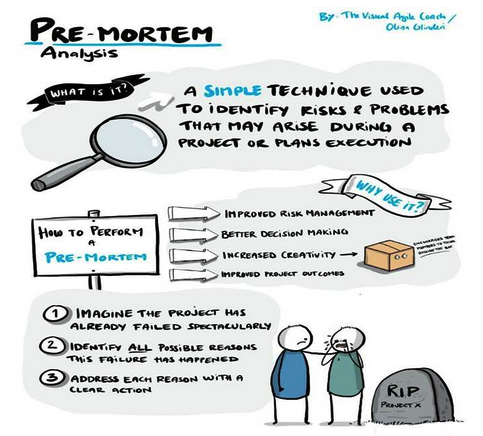
Coined by cognitive psychologist Gary Klein, a premortem is a simple yet powerful mental shift. Instead of asking “What might go wrong?” we ask:
“It’s two years from now. The project failed. What went wrong?”
This isn’t mere pessimism—it’s prospective hindsight. And studies show it makes us 30% more likely to identify real risk factors early.
Unlike traditional risk assessments, a premortem creates space for honest, often unspoken truths. In African contexts where hierarchy, optimism, and “saving face” can prevent dissent, this tool is gold.
In 2023, I led curriculum development for the Access STEM Project funded by Siemens Stiftung, bringing open educational resources (OER) to teacher training institutions in Ghana. The goal? Equip educators with localized STEM materials via BlueTown’s solar-powered network.
Everything seemed perfect—until we ran a premortem workshop with teachers.
A soft-spoken science instructor said:
“What if this all fails because some teachers don’t know how to use the digital tools?”
That moment sparked a chain of decisions: extra digital literacy sessions, peer-learning support groups, and backup materials for offline access. Without that one insight, thousands of teachers could have been left stranded with resources they didn’t know how to use.
Instead, we reached over 5,000 educators, improved teaching strategies, and enhanced vocational learning for students.
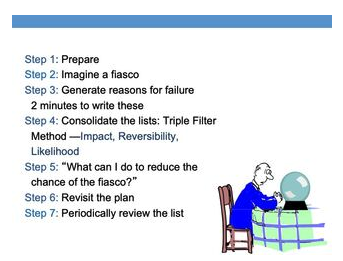 After applying premortem analysis in over 11 training programs and consultancies—including work with GIZ, the IFC, and Siemens Stiftung—here’s a practical process I use:
This approach doesn’t just improve the outcomes. It builds psychological safety—an environment where people feel free to raise concerns that save millions.
Africa is a continent of immense educational innovation. From mobile learning apps to multilingual eLearning platforms, there’s a lot of excitement.
But excitement without scrutiny is dangerous.
I've seen platforms launched without enough teachers trained. Curricula adapted without testing for cultural context. Mobile learning initiatives rolled out in areas with limited data access.
A premortem would ask:
These are not hypotheticals—they are recurring real-world problems.
In 2019, I helped design WACSI’s first online course on Alternative Funding Models for Civil Society Organizations. It was a breakthrough initiative—but we underestimated how busy CSO leaders were. Completion rates suffered.
A premortem would have revealed that risk. Today, I prioritize microlearning, mobile-friendly formats and executive buy-in to avoid similar issues.
Now, whether I’m training MILEAD fellows in design thinking or advising Vietnam’s EdTech Hub on AI for learning, premortem thinking is my invisible co-pilot.
If you want to go deeper, here are two complementary methods I’ve used successfully:
Both methods cultivate adaptive foresight—a superpower for anyone navigating complex systems like education.
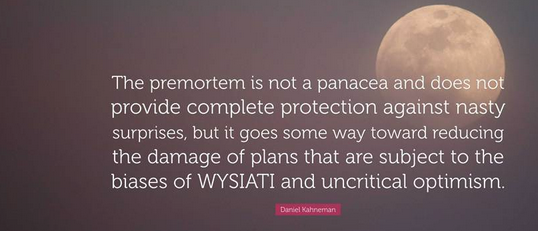
The best learning solutions are not the most sophisticated—they’re the most resilient.
Premortem thinking helps us design systems that bend without breaking. It makes space for humility, insight, and inclusivity. In African education—where resources are precious and the stakes are high—we cannot afford to fail blindly.
Design with failure in mind—not just success.
And when you do fail, let it be a lesson—not a surprise.
Have you used premortem thinking in your education projects or teaching?
What unexpected failures have you prevented—or learned from?
You might also like:
Learning by walking: four types of reflexive and embodied walks
On the road, everyone's network is on the move
Schools that close in on themselves! Why and how to reverse this phenomenon.
Constraint liberates from the moment when constraint sets up a framework but does not restrain or restrain. It is by rebuilding an educational system that the school will be able to open up again, following the example of the Saunalahti school.
Or how to inspire people to teach differently, both in and out of school. A quest for innovation in which ICT should play a major role.
Back to reality through seniors
Seniors have a role to play in giving younger generations a better balance when it comes to the virtual world. For one thing, they come from a much less cyber-dependent era. What's more, they have real-life experience, decades of life experience and a better relationship with nature. It's a good idea to make the most of them and reconnect them with the younger generation.
Follow a marked path... and beyond
Following in the footsteps of predecessors is proof of continuity in an evolving process. However, creating new paths to foster other perspectives bodes well for posterity. The world is a series of new ideas and directions in a continuous process of construction.