This is a radical transformation that is taking place. From now on, the crowd observes itself and is observed. Its action is multiplied by the digital power.
.Publish at October 01 2025 Updated October 03 2025


From the censorship of textbooks to the 4-day school week, from education vouchers handed out to parents to the hiring of unlicensed teachers, certain principles that seemed immutable are now becoming negotiable. How did what seemed simply unthinkable a few years ago become the subject of debate and draft regulations a few years later? That's what the concept of the "Overton window" is all about.
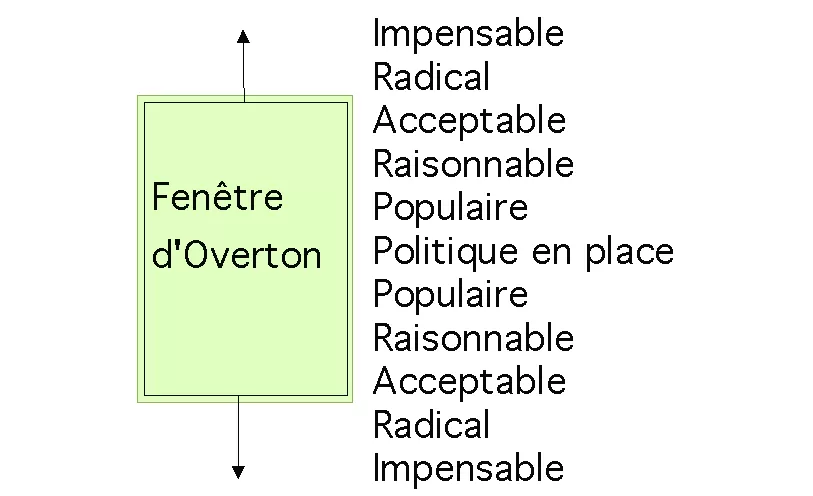
The Overton window is a description of the dynamics of idea change in a social group. Along a continuum, they move from the center to the two extremes, following a series of gradual stages that can be influenced.
At the center, the policy in place, then the idea is popular in one sense or another, and is ready to be defended politically, then the idea seems merely reasonable, then the idea is considered acceptable as a subject for discussion, then we move out of the space of debate, the ideas are on the radical fringe, raising opposition or, for the unthinkable idea, rejection.
Political strategists systematically work to enlarge or restrict the size of the window and its position to the left or right of the value spectrum. The strategies are relatively simple and well-known:
School leadership can use this technique to advance certain issues, or to counter attempts in the opposite direction, such as book censorship or school segregation. It's a question of deciding whether to let others decide the fate of your school, or to decide for yourself what kind of school you want to teach or study in.
Controlling the agenda means :
Leaders who stand up for what they believe in don't always win popularity contests in the short term, but they do build the trust and stability their communities need in the long term.
References
A look at how ideas are now shifting in education - District Administration - Dr.Dana Godek and Michael Moore
https://daleadershipinstitute.com/2025/09/19/a-look-at-how-ideas-are-now-shifting-in-education/
Shifting Boundaries of Acceptability: Examining the Overton Window and
Its Modern Manipulators in U.S. Discourse - Douglas C Youvan - Research
Gate
https://www.researchgate.net/publication/385385191_Shifting_Boundaries_of_Acceptability_Examining_the_Overton_Window_and_Its_Modern_Manipulators_in_US_Discourse
Overton window - Wikipedia - https://fr.wikipedia.org/wiki/Fen%C3%AAtre_d'Overton
The Overton window - Mackinac Center
https://www.mackinac.org/OvertonWindow
You might also like:
This is a radical transformation that is taking place. From now on, the crowd observes itself and is observed. Its action is multiplied by the digital power.
.The masks neurodivergent children wear
Children are unrivalled at expressing themselves uncensored about what they think, what they see and so on. As they grow up, the adults in their lives will soon teach them to mask certain aspects. However, some children don't need societal pressure to wear masks. They're already doing it to protect themselves.
Making the most of conflict, now
Inevitably, when humans are put together, conflicts can arise. There are many reasons why this can happen: annoying habits, character clashes or miscommunication. Whether it happens at work or at school, both human resources and teachers must act to prevent the situation from escalating and the parties from becoming irreconcilable.
Procrastination, an obstacle to achieving goals
Procrastination affects productivity and makes you a spectator of your own life. How does it relate to goal-setting?