12 questions from course researchers
Over 2,000 personal queries summarized.
Publish at October 08 2025 Updated October 08 2025


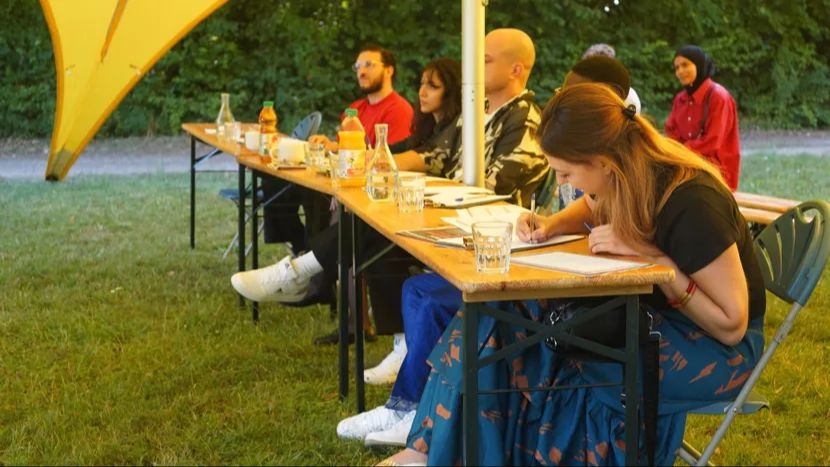
The popularity of eloquence competitions means that we need to take a closer look at one of the key players without whom there could be no merit: the jury. By jury, we mean a group of people (jurors) who deliberate after the performances to rank the speakers from most to least deserving.
To this end, contest organizers have an interest in better managing certain aspects of the activity. An efficient, objective jury avoids the frustrations associated with verdicts. To demonstrate this, we'll look at a few cases of contestation, then identify the qualities of a good juror, and finish with some principles to help build a jury.
In Denzel Washington's The Great Debater , a famous film set against the backdrop of the debate sequence, the coach of Wiley's team, played by Denzel, has a refrain to motivate his debaters. During each training session, he asks "Who's the judge?" and the learners reply "The judge is God" and he continues "Why is it God?", to which they reply "Because he decides who wins and who loses, but not my opponent".
This sentence has the merit of establishing the judge as a God whose decisions cannot be contested, because God is all-knowing, just and impartial. Denzel's debaters must be prepared to accept the judges' results, whatever the outcome. In fiction, this works very well. However, in real life, in the eloquence championships I regularly follow or take part in, it doesn't always work like that. The jury's report and decisions are not always well received. To illustrate this, I'll use two cases. In one case, I'm the debater, and in the other, I'm the competition organizer.
- In 2023, during the first edition of CIDDAR, the RIPAO Tenth Anniversary Debating Competition renamed in 2025 the RIPAO International Debating Competition, we had complaints from debaters. One such complaint was made by one of the two French teams, represented by Mario and Louiza. Louiza had been eliminated in the first phase and felt that the jury had not been impartial, or at least not up to the task of debating. This request obliged the organizing team to request the presence of at least one French national on the jury for future phases. This was the case with the representative of the French-speaking Debating Federation, Samy.
I was particularly struck by this situation, as I remembered my elimination in 2018 at the International Francophone Debating Championship in Lebanon.
- Indeed, having arrived late, i.e. two days after the start of the competition, my teammates and I, namely Djimmy from Benin and Ariane from Côte d'Ivoire, had, to make up for the delay, debated for a whole day, i.e. three debates on the same day. It was the only way to stay in the race. After this marathon day, when the list of 16 speakers selected for the semi-final was published, a juror approached me and announced that I'd been ranked 17th, just half a point short of making the short list. I'm frustrated, all the more so because she had criticized my accent during one of the debates where she was a juror. At this point, I consider myself a victim of my diversity. I find this situation unfair.
First of all, it should be pointed out that no school trains judges or jurors who specialize in eloquence competitions. Anyone can be a judge. It all depends on the competition and the realities of each contest. Some competition organizers draw up their own jury charters. However, certain criteria apply across the board:
Jurors must also be sensitive to diversity. Because in competitions, we meet speakers from many different backgrounds, with different idiolects and sociolects, and different values that must be taken into account when deliberating.
These are just a few of the basic elements required of an impartial and skilled judge. So how do you build an effective, objective jury?
Sometimes, in competitions, organizers find it difficult to find enough judges. As a result, you need to know how to balance the composition of each jury. In the preliminary phases, which generally require more evaluators, juries should be balanced, with the less experienced taking on the more experienced.
If there are former participants in the competition, they should be given priority and responsibility. An experienced juror, or at least a former speaker, should chair the jury. And if experience is lacking, interested parties should be trained. Generally speaking, there are no jury problems in the final stages. In fact, organizers are spoilt for choice, which can sometimes lead to casting errors.
There is a practice in the French-speaking world of inviting personalities (teacher, lawyer, company director, actor, etc.) who have not taken part in the previous phases to act as jury members for the final. I don't agree with this approach, because very often, after eliminating candidates on the basis of well-established criteria, we leave them in the hands of people who are certainly experienced in their fields, but who have not received any contextualized coaching in the context of the competition whose final they are judging. It's an approach that lends visibility to the competition, but runs the risk of losing the objectivity consistent with the entire competition process.
To avoid this, the jury, which is often very large, should always include one or two jurors who have taken part in previous phases. This is a position defended by the Réseau International pour la Promotion des Arts et de l'Oralité(RIPAO).
In conclusion, human beings are by nature subjective, but objectivity must be the permanent quest of anyone who has to judge others. In agonistic activities such as oratorical games, the jury, generally an odd one, must be as objective as possible to avoid the frustrations that can mar tournaments. Until we see AIs like MLO AI take the place of humans, the success of verbal jousting competitions depends largely on the quality of the jurors.
You might also like:
Winter: a real whiteboard for teachers
Winter is a season that leaves no one indifferent. You either love it or hate it. Nevertheless, it offers teachers a superb opportunity to create interactive activities that require no electricity, just ingenuity and snow.
The entire network structure is important, not just a handful of influencers.
Truant students? Let them do puzzles!
It is possible to improve attention through training. While it is said to be disrupted by electronic devices, it can be worked on through games. Puzzles, in particular, are activities that stimulate the whole brain while combining fun and relaxation. An interesting pastime to bring into the classroom or even online.
It's all we talk about, but the term "curation" refers to a wide variety of practices, not all of which have the same added value. A welcome blog post reminds us what quality curation is all about.