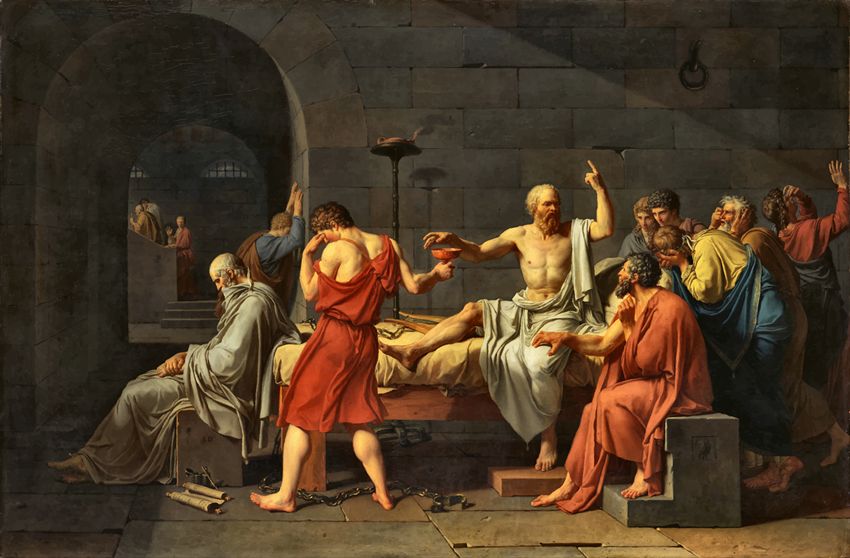
A revealing judgment of what was happening politically in Athens at the time
The trial of Socrates is undoubtedly one of the most fascinating in history. The famous philosopher was accused of various ailments and was forced to drink a poison, hemlock, before dying at the age of 71.
The man who had been cited as the wisest by Pythia, the figure of divination in ancient Greece, didn't really believe it, so he decided to go and question the "wisest and most learned" of Athens. This ironic questioning generally reveals the blind spots in the knowledge of these fellow citizens. This trial has many grey areas and misunderstandings that have fascinated historians.
Today, we know that it took place a few years after the terrible Peloponnesian War between Athens and Sparta, among others. For a time, the Spartans conquered the city and established a republican government in place of democracy. The latter was overthrown a few years later, and democracy returned to Athens. Socrates, however, was not a great fan of the democratic system, preferring the republic. As a result, some held a grudge against him and his followers. Then there was the accusation of not worshipping the gods; absurd, since the Greek city was far from orthodox and, moreover, many citizens were happy to call themselves atheists.
On the other hand, several sources show that, on the contrary, Socrates had great respect for the deities. Finally, the question of the corruption of youth, which seemed to be an attack on his potential homosexuality, was more related to the fact that young Athenians were imitating the philosopher and questioning their elders and colleagues.
What's also surprising is Socrates' defense. He didn't want anyone to write a plea for him, even though this was common practice in trials of the time. It was Socrates who, in part, insisted on a trial with a fatal outcome, rather than exile.
Was it a way for the philosopher to end his life by defending his work? Possibly, his pleadings seem to lead us to believe so, and in fact, various actions against him confounded the jury's decision to condemn him. A verdict that did not succeed in removing the thinker from history, quite the contrary. On the contrary, thanks to his disciple Plato, he has left a lasting imprint on our collective imagination.
All our lives have an online component. As a result, a large proportion of Internet users are at risk of being tricked by hackers. A short game invites Internet users to remember certain elements of cybersecurity using a space theme.
To a layman, music is just a tune performed by a musician. Yet, if he were to play Meludia, he would learn all the rudiments and terms associated with musical practice.
How do you talk to children about genetics and heredity? A British museum has come up with the method: design a game in which you create a line of adorable creatures with precise objectives. The game is fun, colorful and easy to learn. Even adults will succumb to the charms of the bugs and their large families.
The Englishes MOOC course was developed by an artist and is designed for anyone interested in the (English) language. It explores the history of English, its pronunciation, and its relationship to the art world.