
Writing, reading and the alphabet: a trio through time, the complexity of the brain and human mutations.
Publish at December 10 2025 Updated December 10 2025


Menstruation affects over 50% of the world's population, for almost half of a woman's life, and yet we don't know that much about it. We know the physiological process, but little is known about the effects of this hormonal cycle. An aberration that quickly becomes clearer when we see how medical research has long been a male domain, and how research into women's bodies has often been under-funded.
Neuroscientists Elizabeth Rizor and Viktoriya Babenko from the University of California decided to follow thirty women through their menstrual cycle, documenting changes in brain structures.
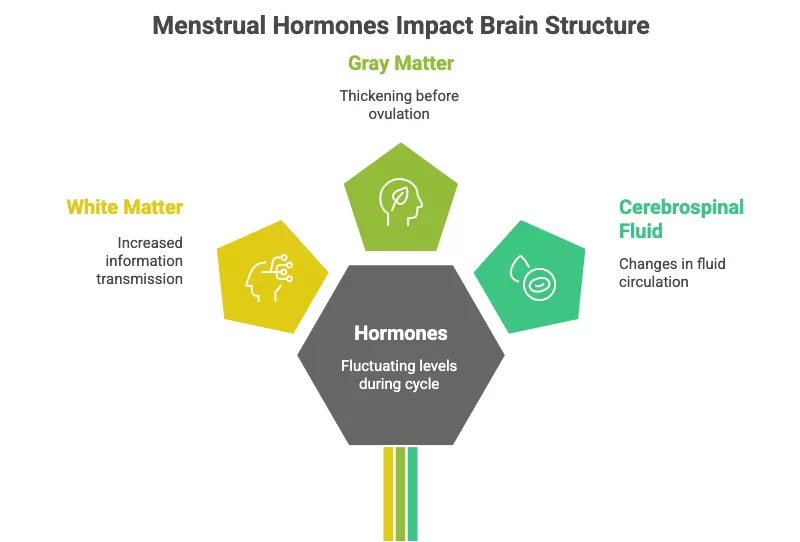
Using magnetic resonance imaging (MRI), they noticed that white matter, a tissue of the central nervous system made up of neuron axons connecting to gray matter, changed in response to hormones. Among other things, this internal substance showed significant transformations just before ovulation. The white matter seemed to prepare to send out more information than usual.
The hormone that stimulates the production of ovarian follicles prior to ovulation seemed to be associated with a thickening of the brain's gray matter. Luteinizing hormone (LH) triggers ovulation and the formation of the corpus luteum (progesterone). Finally, progesterone, which increases after the ovulatory period, affects cerebrospinal tissue and the amount of fluid moving through it.
This seems to go hand in hand with another study from 2024 which showed that each phase of the menstrual cycle seemed to have various influences on the brain, with changes depending on the brain, the woman's age and where she lived in the world.
What does this discovery change for women? For the moment, nothing. Nevertheless, these findings on brain changes are an important starting point for subsequent research.
Now that scientists seem fairly certain of changes in the structure of women's brains during their cycle, it will be possible to analyze more precisely the effects of these changes on physiological and mental functioning. Researchers hope to gain a better understanding of why some women experience mental imbalance during menstruation.
Illustration: Shutterstock -2574966003
References
Scientists Identified Structural, Brain-Wide Changes During Menstruation - https://www.sciencealert.com/scientists-identified-structural-brain-wide-changes-during-menstruation
Menstrual cycle-driven hormone concentrations co-fluctuate with white and gray matter architecture changes across the whole brain - https://onlinelibrary.wiley.com/doi/10.1002/hbm.26785
Menstrual cycle - https://fr.wikipedia.org/wiki/Cycle_menstruel
A man's world: how healthcare and research is failing women - https://acmedsci.ac.uk/more/news/a-mans-world-how-healthcare-and-research-is-failing-women
Women's health is massively underfunded and is one of the biggest missed opportunities in health - https://www.gavi.org/vaccineswork/womens-health-massively-underfunded-and-one-biggest-missed-opportunities-health
A gendered practice of medicine? - https://cursus.edu/fr/22693/une-pratique-genree-de-la-medecine
Underfunding of Research in Women's Health Issues Is the Biggest Missed Opportunity in Health Care - https://www.rand.org/pubs/commentary/2022/02/underfunding-of-research-in-womens-health-issues-is.html
White substance - https://fr.wikipedia.org/wiki/Substance_blanche
Learn more about this news
You might also like:
Writing, reading and the alphabet: a trio through time, the complexity of the brain and human mutations.
What is the ideal school for the 21st century?
Listening to the students is the first step in building a pedagogical strategy that will correspond to them, towards the school of tomorrow
Co-creativity and disabilities: different ways of working in teams
Co-creation is not a fad, but it is not a panacea either. It must be complemented with other project and team management formulas if we want to achieve a sustainable and fair result in our organizations.
Empathy for a student Christmas
We are in the middle of an economic crisis. Have you noticed this? If you have a good income, maybe a little, but not much. Perhaps you perceive it more through your students, the less well-off, the more fragile, those who have problems that are growing in class, even at the university level, those who are less and less present and who will one day disappear from your horizon. Be attentive and proactive in order to help them.
Presentation of the Syllabus to Students: Getting the Facts Right
Many teachers consider the syllabus as a static reference document. However, some teachers do not hesitate to modify it as needed, to better correspond to the reality of the field. There is nothing better than discussing it with the students.


