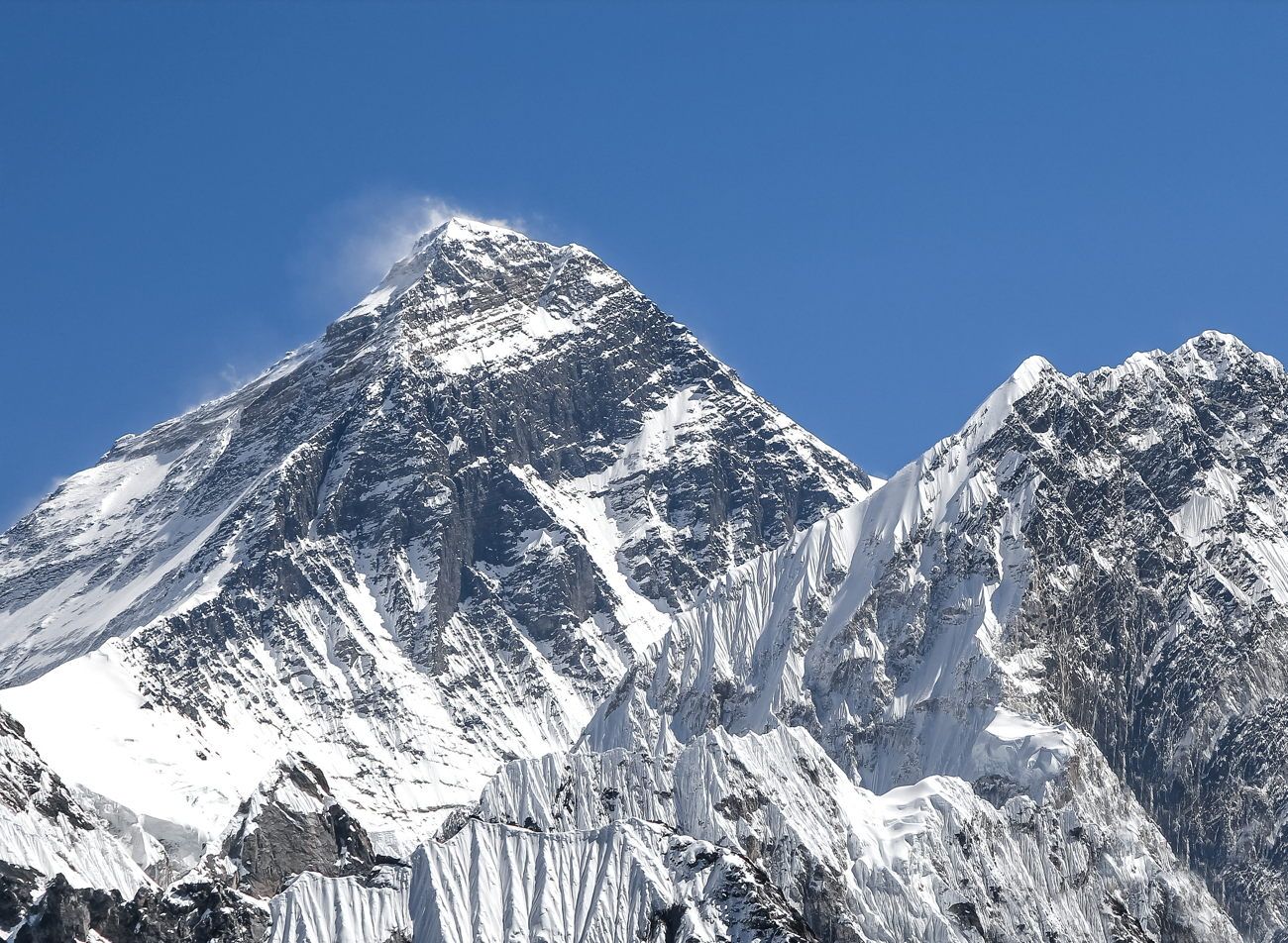
Many a mountaineer struggles to climb Everest, which culminates at exactly 8,848 metres above sea level: on Earth, it remains the undisputed queen of the mountains, towering over the immense Indian and Nepalese valleys. From a geophysical point of view, however, it's a trompe-l'oeil, since the most extreme reliefs on our planet are not on the surface, but 2,900 kilometers below the surface and plunging deep into it.
It's here, at the boundary between the solid mantle and the liquid iron core, that titanic domes rise up, which in no way resemble mountains, but can be compared to "super-panaches" of ultra-dense matter. These structures, known to seismologists as LLSVPs (Large Low Shear Velocity Provinces), are 1,000 km high, much more than the 8.8 km of Everest, and as vast as continents. If we think of Everest as a grain of sand, the LLSVPs, by comparison, are as tall as 30-storey skyscrapers.
If they are so deeply buried, how is it possible to know they exist? How can we measure them?
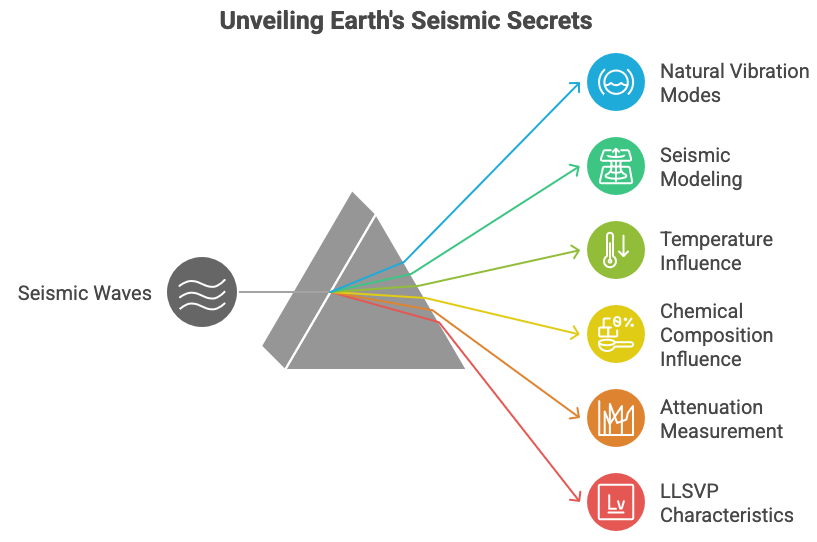
The team led by Arwen Deuss, an internationally-renowned seismologist specializing in the study of the Earth's deep structure (University of Utrecht, Netherlands) has used a measurement methodology that allows our planet to be analyzed like a musical instrument. The modeling of specific vibration modes, enabling us to probe the LLVSP as never before: an unprecedented physical feat of the year 2025, published in the prestigious journal Nature on January 22.
Planetary resonance: when the Earth sounds like a tuning fork
In order to penetrate almost 3,000 km of rock, it is of course impossible to send a probe; the deepest borehole ever drilled by man was no more than 12 km deep. To "see" into the darkness of the lower mantle, Deuss's team therefore treated the planet as a resonant body. When a high-magnitude earthquake occurs, the entire Earth vibrates and waves propagate along its surface, distorting at very low natural frequencies. These are known as eigenmodes of vibration.
To study how the energy of these vibrations dissipates and stifles through the depths, the researchers had to use a seismic modeling tool called QS4L3. Most seismic models measure wave velocity.
To understand, imagine that the intense heat radiated by the Earth's core (which peaks at around 6,000°C) "softens" the mantle rock just above it. The hotter the rock, the more malleable it becomes, and the more the waves slow down. Conversely, in an area further away from this heat source, the rock is more rigid and the waves travel at full speed.
The problem is that temperature is not the only factor influencing this speed. A rock with a very heavy or dense chemical composition can also slow down the waves, even if it's not particularly "soft". Scientists have therefore been faced with a conundrum since 2018, when the LLSVPs were discovered: do they indeed slow down the waves because they were areas of intense heat (soft), or because they were made of a different material (dense)?
Thanks to the QS4L3 model, the Utrecht researchers were able to measure attenuation, a physical parameter that finally distinguishes the influence of temperature from that of chemical composition. Thanks to attenuation, it is now possible to measure the loss of vibration energy as it passes through matter.
For example, when you strike a steel bell or a block of foam, the wave will not propagate in the same way.
In steel, a rigid material, the vibration travels far and long; in foam, which is soft, it is immediately absorbed and stifled. This stifling is called attenuation. Until now, it was assumed that LLSVP, heated to white by the core, was as viscous as plasticine and therefore had to absorb seismic energy (and therefore high attenuation).
However, QS4L3 reveals the opposite: the vibrational energy is not stifled as much as it should be in these zones: they retain their physical integrity in the face of mantle currents. If these waves are slowed down but their energy is not absorbed, then we are not dealing with ordinary rock softened by heat, but with a chemical composition that is intrinsically denser than the rest of the Earth's mantle.
LLSVPs are so dense and heavy that they act like dead weight. They stabilize the base of the mantle by preventing hot rock currents from flowing freely. Our planet's internal heat therefore accumulates and stagnates in these places, forming thermal reservoirs that don't mix with the rest of the Earth's mantle.
The plate cemetery: billions of years of fire archives
Where does this material come from ? How can an LLSVP rise to one-sixth of the Earth's radius without ever diluting in our planet's subterranean hell? The explanation lies in the endless recycling cycle of the Earth's crust. LLSVPs are in fact nothing more than massive accumulations of the remains of ancient tectonic plates.
For billions of years, plate tectonics have plunged ancient ocean floors into the depths through subduction. As this rock (basalt) sinks, it is subjected to such pressure that it is transformed into an extremely dense, metal-rich material. Because it becomes much heavier than the surrounding mantle rock, it can no longer float: it sinks by gravity until it runs aground at a depth of 2,900 km, just above the liquid core.
Over the course of geological eras, these plate remnants don't mix with the rest of the Earth's "paste" and clump together to form what seismologists call " plate cemeteries ". It is precisely these clusters of ancient debris, compacted and frozen together, that make up the LLSVPs mapped by the QS4L3 model.
Because they are too dense to be carried away by mantle currents, they can be compared to geodynamic anchors, forcing the mantle's internal heat to bypass them. In this way, they channel burning magma towards their edges, creating thermal highways that rise to the surface to fuel our planet's most active volcanoes, such as those in Hawaii and Iceland.
In this respect, the LLSVPs are the true Pillars of the Earth(to borrow a phrase from Ken Follett), colossal rock masses that influence virtually all of the Earth's geography. Their geoid shape, the movement of tectonic plates, the power of volcanic eruptions, their speed of rotation and even the intensity of their magnetic field.
They are the cogs in an immense thermal machine, without which the planet's geological thermostat would spiral out of control, triggering extreme climatic cycles that would turn our beautiful Earth into a cold, barren world, depleted of all its internal heat... as Mars is today.
Illustration: Shutterstock - 176328998
References
EverestIs No Longer Earth's Tallest Mountain: Scientists Uncover Continent-Sized Structures 100X Taller and Billions of Years Old: https: //dailygalaxy.com/2025/11/everest-no-longer-earths-tallest-mountain-scientists-uncover-structures-100x-taller/
Global 3D model of mantle attenuation using seismic normal modes: https: //www.nature.com/articles/s41586-024-08322-y
Joint seismic and geodynamic evidence for a long-lived, stable mantle upwelling under the East Pacific Rise https://www.researchgate.net/publication/264234570_Joint_seismic_and_geodynamic_evidence_for_a_long-lived_stable_mantle_upwelling_under_the_East_Pacific_Rise
Record of massive upwellings from the Pacific large low shear velocity province https://www.nature.com/articles/ncomms13309