While Malaysia has been transforming its infrastructure over the past two decades under the impetus of the Malaysia 2020 plan, the picture isn't quite as rosy once you leave the polished asphalt of the capital. In rural areas, where the jungle reigns supreme, roads become death traps as soon as the sun goes down. Every year, over 6,000 people die in Malaysia as a direct result of road accidents - 3 to 4 times more than in France with an equivalent population.
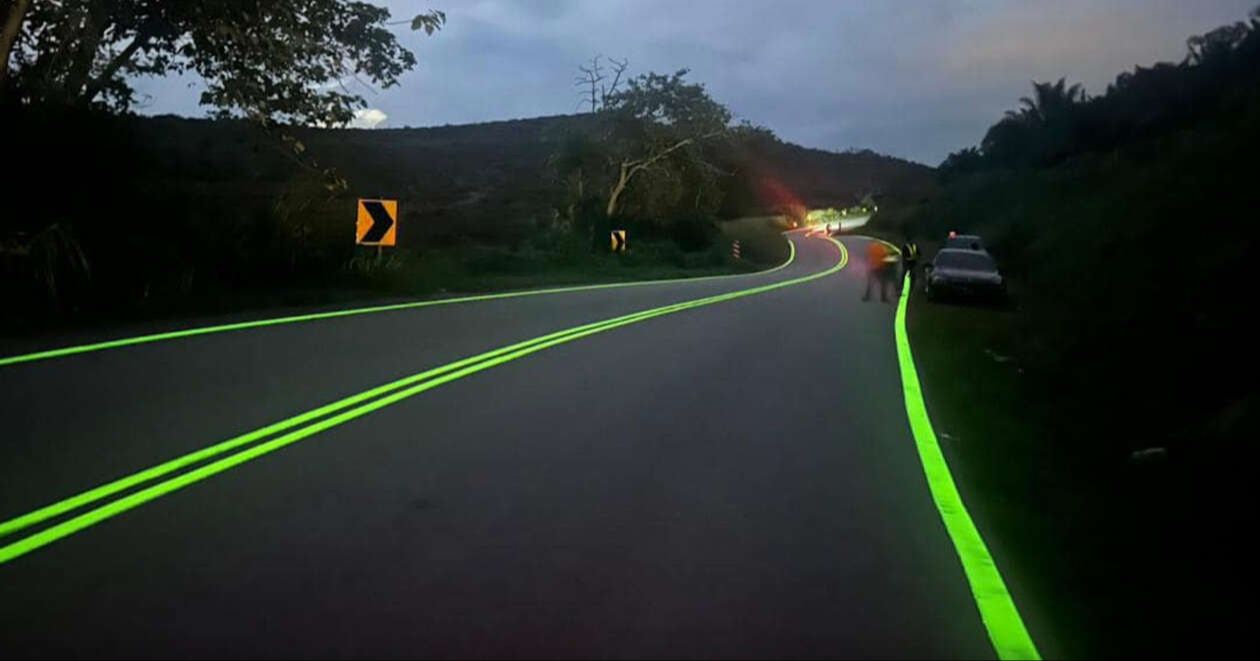
To stem the tide, the Ministry of Public Works came up with the idea of conducting an experiment in Semenyih (a small town southeast of the capital, Kuala Lumpur). The idea was to replace the 245 m of energy-guzzling roadside lampposts with photoluminescent paint as road markings. The end of 2024 brought the project to a halt: far too expensive to maintain, the paint was totally unsuited to the country's climate.
An untenable long-term financial drain
Unlike retro-reflective road markings, which need to be scanned by headlights to be visible, the markings tested at Semenyih were composed of phosphorescent pigments that stored photons during the day. When night fell, these pigments were able to release the accumulated energy in the form of visible light. In short, the road shone on its own, without consuming a single watt of electricity: rather clever, but only on paper.
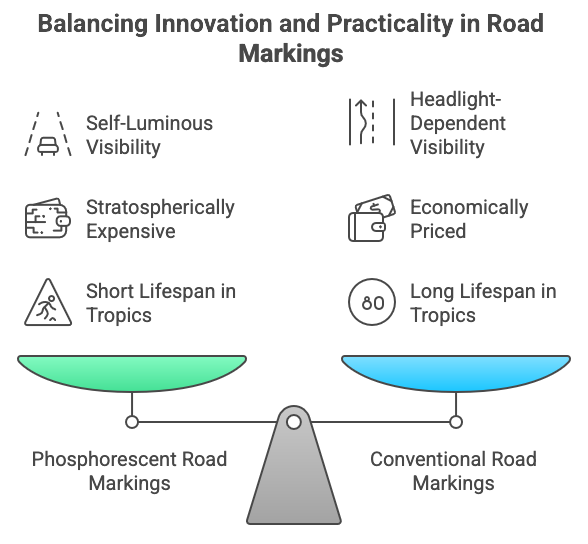
The paint was stratospherically expensive, costing around 749 MYR (Malaysian Ringgit), or around 158 euros per square metre. A staggering figure when compared with the RM40 (just €8.50) required for conventional thermoplastic marking. Do the math yourself: for the price of a single meter of luminescent road, the government could paint almost twenty with normal signage.
Why such a hefty bill? It could possibly be explained by the complexity of the rare-earth-doped strontium aluminates that make up this type of high-quality paint. Standard markings reflect light with simple glass beads, which are much less expensive.
Ahmad Maslan, Deputy Minister of Public Works, was categorical before Parliament: "The cost is too high. The cost is too high, so we're probably not going to go ahead with the installation of these lanes ", he explained to the national media Paul Tan.
For the State, the investment would have been substantial, especially as this type of paint inevitably loses luminosity during the night: a very bad financial equation. " We carried out tests, but the results did not convince the Ministry's experts ", Maslan concluded, sealing the fate of the other 15 sections (around 15 km of track), which were initially to benefit from this paint job. Indeed, the project had planned to extend into the districts of Sepang, Kuala Langat and Petaling, key areas in the state of Selangor.
Tropical climate: the executioner of innovation
If the portfolio said no, it was also because the Malaysian sky was not very cooperative. In Europe, we use this type of paint for rare cycle paths (in Holland, for example, the country of bicycles par excellence), but it didn't stand up to the test of the tropical climate. Malaysia is rinsed by violent monsoons for several months of the year, so the polymers in the paint didn't particularly appreciate it. Not that it never rains in northern latitudes, but there's a world of difference between temperate rainfall and equatorial deluges of constant humidity!
According to studies cited by the Institute for Road Safety Research (MIROS) and published in the International Journal of Pavement Research and Technology, painted pavements lose their lustre in just 12 to 18 months - far too short a life cycle for an investment of this magnitude. Between the leaching caused by torrential rain and the hydrolysis of the chemical binders that hold the pigments in place due to UV rays, the paint didn't stand up to Mother Nature's assaults.
Alexander Nanta Linggi, the Minister of Public Works, who had been enthusiastic during a visit to the Semenyih pilot section in October 2023, had to temper his enthusiasm. He finally admitted in an official statement that sustainability remained the project's dark spot, noting that implementation costs remained " relatively high " in relation to the results achieved.
While initial reactions from the general public were generally positive, and spread through viral videos, they soon gave way to discontent. They were quick to point the finger at a superficial, almost gimmicky innovation that contrasted too sharply with the dilapidated state of the country's roads. Spending a fortune on shiny paint? A golden bandage on a wooden leg, when what's really needed is a complete overhaul of rural road networks.
In fact, one Internet user cursed the country's authorities on Facebook: " Ask your agents to drive in the rain or at night - you'll see poor visibility, potholes and uneven roads. That's what causes accidents.
It's hard to argue with him: in urban planning, a sense of priorities must be maintained to guarantee the success of a project. If a road is to become less dangerous, perhaps the quality of the asphalt should be addressed before trying to make it shine.
However, the Malaysian failure is not necessarily synonymous with the death of this technology in emerging countries with tropical climates. Institutions such as TU Delft in the Netherlands and companies in Japan are continuing to work on more resistant pigments and less expensive application methods. A useful innovation is above all a resilient one, so let's hope that one day this research will lead to a viable economic model for the countries of the South.
References
Malaysia Painted Roads That Glow in the Dark Instead of Using Lights-Until a Hidden Problem Shut It Down https://indiandefencereview.com/malaysia-painted-roads-that-glow-in-the-dark-instead-of-using-lights-until-a-hidden-problem-shut-it-down/
Glow-in-the-dark road markings too costly, gov't unlikely to proceed further with them - Ahmad Maslan https://paultan.org/2024/11/22/glow-in-the-dark-road-markings-too-costly-govt-unlikely-to-proceed-further-with-them-ahmad-maslan/
Malaysia https://fr.wikipedia.org/wiki/Malaisie
Observatoire national interministériel de la sécurité routière https://www.onisr.securite-routiere.gouv.fr/etat-de-linsecurite-routiere/bilans-annuels-de-la-securite-routiere/bilan-2024-de-la-securite-routiere
Road traffic, perception of nuisance - Guilaine Bomba - Thot Cursus
https://cursus.edu/fr/29217/trafic-routier-perception-des-nuisances-these
Luminescent paint https://fr.wikipedia.org/wiki/Peinture_luminescente
Performance Evaluation of Road Marking Materials under Tropical Climate https://link.springer.com/journal/42947