AI levers for which development?
The mutual learning of the algorithm and the human will produce major transformations between voluntary dispossession and involuntary servitude. The AI learns to answer, the human learns to question.
Publish at February 06 2026 Updated February 06 2026


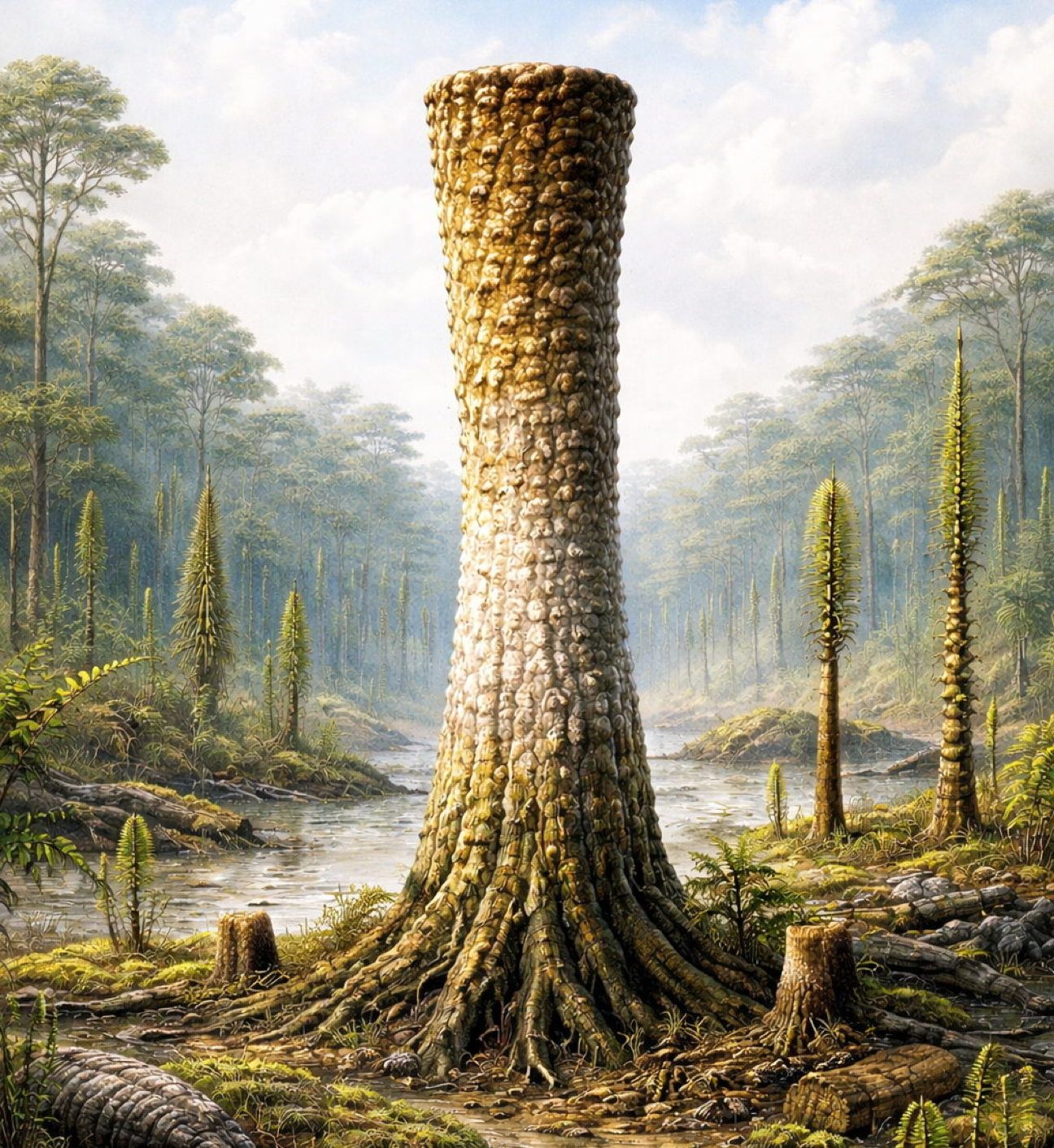
If it's hard enough to imagine what life was like for human populations in the past, it's hard to imagine what life on earth was like even before the first hominids. How can we imagine life in the Devonian, for example, the Paleozoic period that stretched from 416 to 359 million years BC?
Its name comes from the first geological traces of this period found in Devon County, England. In this remote period, the planet was warming up and the first massive land masses were beginning to form. Forests did not yet exist, but they would take shape over these millions of years. Scientists call this the "age of fish", as the oceans see the diversification of life forms. Armored fish and sarcopterygians - fleshy-finned fish that are the ancestors of vertebrates - appeared.
Thus, the land that emerged from the water was populated only by plants, primitive insects and the first arthropods (insects, spiders, crustaceans, etc.). Today's arachnophobes can target the birth of what terrifies them in this prehistoric era. The first tetrapods - i.e. amphibious life forms - on land appeared, according to fossil evidence, towards the end of the Devonian. And while the ground is not yet occupied by trees, tubular giants nearly 8 meters high and 1 meter wide can be seen.
In 1843, Sir William Edmond Logan discovered the fossil of what appears to be a trunk nearly 2 metres long and 91 centimetres wide in the Gaspé region of Quebec, Canada. In 1859, however, Canadian scientist John William Dawson analyzed the fossil in Montreal and interpreted it as the wood of a conifer that had been eaten by fungi. He called this new class Prototaxites, meaning "first conifer".
But just 15 years later, Dawson's conclusion would be challenged. On closer study of prototaxite anatomy, researchers realized that the cell structure was more reminiscent of algae, lichens and fungi. Indeed, many will conclude that they are giant Devonian fungi.
However, this hypothesis hardly holds up over time. After all, how could such large fungi have survived in soils that were still poor in organic nutrients? Especially since no spores of this type of organism are known to exist.
As a result, the question of this life form remains unanswered. Some continue to believe in an ancestor of fungi, while others point to the simple but logical solution: it's an extinct species. But a species of what?
So, for 165 years at least, the debate has been going on about the nature of prototaxites. In January 2026, however, it would appear that a breakthrough has been made. A team of researchers from the University of Edinburgh, Scotland, were lucky enough to stumble across some very well-preserved fossils from this period in the chert [siliceous sedimentary rock] of Rhynie.
What was different from other prototaxite finds was the fact that it was accompanied by Paleozoic fungi. As a result, this 407 million-year-old ecosystem could be analyzed by the team and compared with other fungi from this period. The chemical analysis led to the debunking of a myth.
They discovered that fungi from this period possessed chitin, which was not at all the case with prototaxite. Analysis of the internal structure only confirmed the point, since the ramifications and interconnections of the microscopic inner tubes had nothing in common with the mycelial networks [of fungi] either present-day or ancient.
In short, prototaxites are not fungi. In fact, according to scientists, they are a lineage of eukaryotes, i.e. living organisms with a membrane-bound nucleus, distinct from all those known.
They are neither plants nor animals. Consequently, their presence at the time shows that life was probably even more abundant than we thought. Who knows what other discoveries will be made in the future about the facets of living things tens or even hundreds of millions of years ago?
References
Neither plant, nor animal, nor fungus: science finally discovers what these 8-metre giants were - https://sciencepost.fr/ni-plante-ni-animal-ni-champignon-la-science-decouvre-enfin-ce-quetaient-ces-geants-de-8-metres/
Prototaxite fossils are structurally and chemically distinct from extinct and extant Fungi
Corentin C. Loron, Laura M. Cooper + authors - Science Advances
https://www.science.org/doi/10.1126/sciadv.aec6277
Prototaxites - https://fr.wikipedia.org/wiki/Prototaxites
Discovering dinosaurs - https://cursus.edu/fr/9513/a-la-decouverte-des-dinosaures
Mystery tower fossils may come from a newly discovered kind of life - https://www.scientificamerican.com/article/mystery-prototaxites-tower-fossils-may-represent-a-newly-discovered-kind-of/
Back to the Devonian: the evolution of flora and fauna - https://www.radiofrance.fr/franceculture/podcasts/le-pourquoi-du-comment-science/retour-au-devonien-l-evolution-de-la-faune-et-flore-2934873
How to become a beautiful fossil? - https://cursus.edu/fr/15450/comment-devenir-un-beau-fossile
Learn more about this news
You might also like:
AI levers for which development?
The mutual learning of the algorithm and the human will produce major transformations between voluntary dispossession and involuntary servitude. The AI learns to answer, the human learns to question.
AI and art: the end of the deification of artists?
Nevertheless, the distance between an original creation, the fruit of the artist's genius, and the production capacity of AI tools is becoming ever shorter.
The Feyman method for easier retention
Retaining written material is not easy. Of course, it is always possible to reread and hope that the memory will photograph the notes perfectly. Or perhaps one should use the approach of the physicist Richard Feynman: manage to explain the principle of knowledge to a child who knows nothing about it, through analogies and simplification.