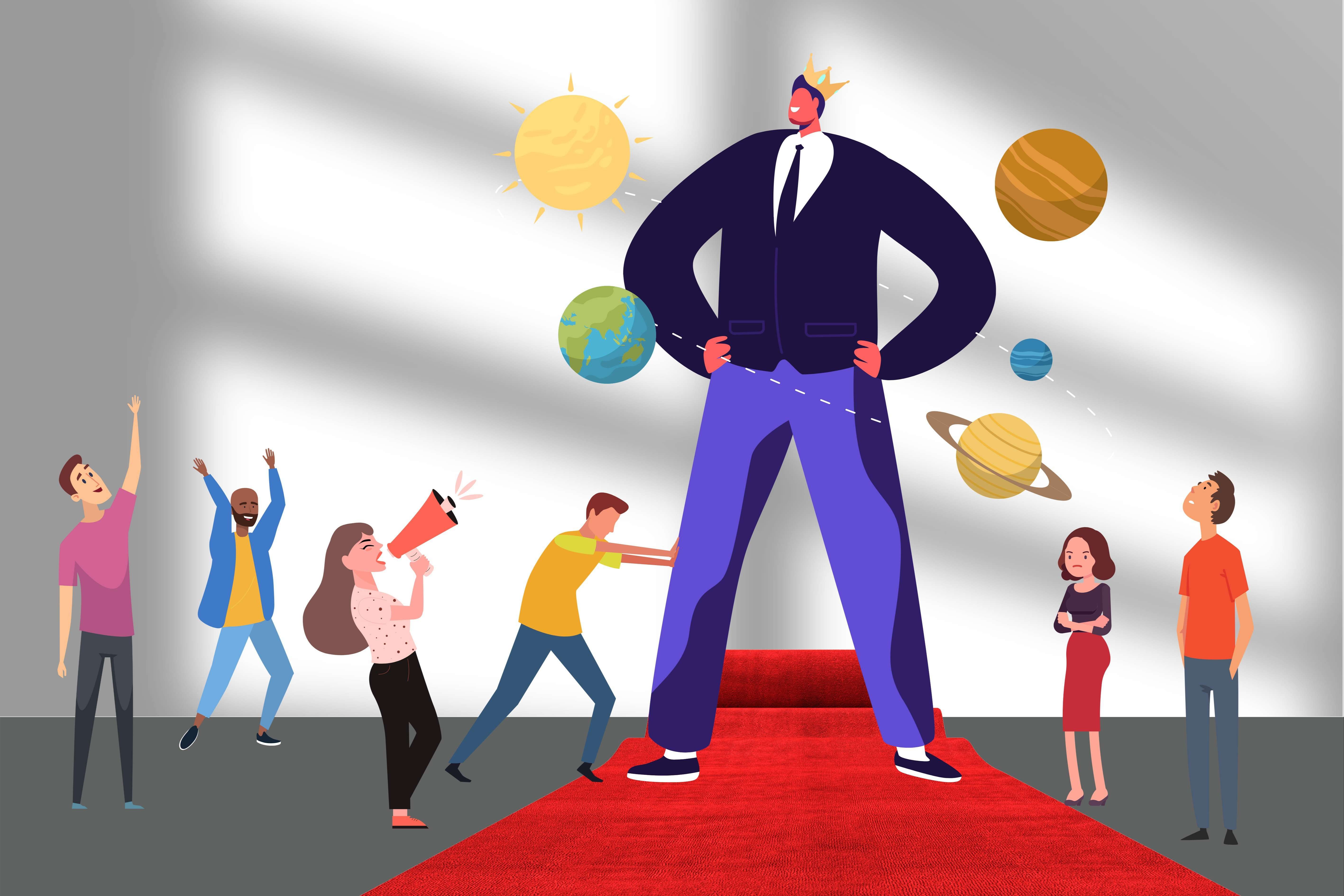
Let's start with a situation described in this U.S. podcast, which I'll summarize here in broad strokes: a conference of various corporate executives is taking place in early 2026. A lecture is given by a CEO and, unlike previous presentations, everyone seems captivated by what this person has to say. Bodies are leaning forward, gazes completely fixed on the presenter. Yet this is by no means the wealthiest person in the room; his company is far from rivalling those of many of the audience. When people in the audience were asked why they were so interested in him, the response was, "He has insane online popularity; you should see his subscriber count!"
This popularity was perceived by this audience as a prestige symbol to be attained. His presence was an honor to them.
We seek prestige
This story runs parallel to the research of a study published in February 2026 in the journal Nature. The researchers reportedly noted that hunter-gatherer groups were not as egalitarian as specialists claim. In fact, in their view, humans were attracted by prestige, and even back then, certain individuals in tribes were more followed and listened to than others, given, for example, the skills they demonstrated in foraging for food or the way they disposed of dangers.
So we're naturally attracted to those individuals who seem the most prestigious. This phenomenon has already been studied in psychology as the "prestige bias". It's all the more interesting in that the question of prestige seems unique to human beings. It is, however, difficult to define scientifically. Often, it revolves around the feeling that the individual is more competent than the average. In prehistoric times, others wanted to imitate those who seemed to be doing well.
But today, we know very well that prestige goes beyond competence. Great wealth (or generosity) and, above all, high self-confidence replace the latter in the eyes of the public. This leads to situations where corporate CEOs are revered without having actually worked on a project or had to prove that it works.
In this respect, the story of Elizabeth Holmes reveals the danger of being blinded by the prestige of a personality for years by promising the impossible. Another example is Elon Musk, who likes to make technologies his own when they work, and detach himself from them when they have problems, likehyperloop.
The cost of prestige
Prestige can be a strength. A prestigious professor, for example, will lead to a larger cohort of students and many people who will want to reproduce part of his or her approach. On the other hand, it can also quickly turn into blind veneration for charlatans or lead to the exclusion of certain people and voices in various fields.
Modern philosophy, to take just one example, sees certain figures as sacred, while omitting many equally brilliant authors of their time. This also has effects on academia, which feeds on prestigious journals to the detriment of others that could lead to a greater diversity of academic journals, especially open-access resources, unlike others. This can be explained by the fact that, in a university environment generally focused on the quest for money, which relies heavily on "publish or perish", it is not unusual for faculties to prefer the prestige of publications and donors.
American universities know all about this. Many tried to hide the fact that one of their biggest donors was a certain... Jeffrey Epstein. Many deans were already aware of the man's sulphurous reputation, but held their noses for his connections and money. With the revelation of the F.B.I. documents, these links were brought out into the open, forcing American academia to take a hard look at itself and, above all, reconsider its obsession with prestige. Putting some on pedestals is taking the world of higher education to make ethically dubious decisions that need to be questioned, according to some.
Who are you?
What's more, this question of prestige also leads to discrimination in specialist networking and derogatory remarks when someone finds themselves without the prestigious baggage. For example, this British student received a comment along the lines of: "You speak really well for someone who graduated from a state school." Which just goes to show the obsession present in academic circles, including among students, who overlook the fact that many personalities in Silicon Valley or other fields come from state universities. This is less glamorous than those from the famous Ivy League, but does not reflect the person's knowledge or skills.
Which, by the way, leads to the question of hiring. Many recruiters can be blinded by the degree of prestige of the universities listed on the curriculum vitae first, and fall flat on their faces when they meet the candidate in question.
The problem lies in the fact that the algorithms that now help in recruitment also have a prestige bias that could make them favor certain graduates over others. Even artificial intelligence has acquired our natural bias towards prestige.
This bias is not in itself a bad thing. According to researchers, it has enabled our species to survive by following the advice of the most competent. However, in an era where prestige is no longer necessarily linked to knowledge and achievement, perhaps we should return to an older definition and, above all, teach ourselves and our algorithms to go beyond prestigious impressions.
Image: Rosy / Bad Homburg / Germany from Pixabay
References
Alpay, Faruk. "The hidden human and ethical costs of academia's prestige obsession." Medium. Last modified May 10, 2025. https://lightcapai.medium.com/the-hidden-human-and-ethical-costs-of-academias-prestige-obsession-787b06993514.
Biehl, Austin, Daniela Perez, Jessica Ingle, and Morgan G. Ames. "Prestige and prejudice: how the interplay of recruiting work and algorithms reinforces social inequities in software engineering." ACM Digital Library. Last modified April 25, 2025. https://dl.acm.org/doi/10.1145/3706598.3713176.
De Cruz, Helen. "Prestige bias: an Obstacle to a just academic philosophy." Ergo. Last modified 2018. https://quod.lib.umich.edu/e/ergo/12405314.0005.010/--prestige-bias-an-obstacle-to-a-just-academic-philosophy?rgn=main;view=fulltext.
Du Rocher, Andrew R. "Thoughts on how scholar-led publishing can overcome the effect of the prestige economy." Insights. Last modified December 16, 2025. https://insights.uksg.org/articles/10.1629/uksg.699.
J.H. Morgan, Thomas, Robin Watson, Hillary L. Lenfesty, and Charlotte O. Brand. "Human prestige psychology can promote adaptive inequality in social influence." Nature. Last modified February 3, 2026. https://www.nature.com/articles/s41467-026-68410-7.
Jiménez, Angel V., and Alex Mesoudi. "Prestige-biased social learning: current evidence and outstanding questions." Nature. Last modified February 19, 2019. https://www.nature.com/articles/s41599-019-0228-7.
Nakata, Seiya, Akira Masumi, and Genta Toya. "Formalizing prestige bias: Differences between models with first-order and second-order cues." PMC Home. Last modified March 20, 2024. https://pmc.ncbi.nlm.nih.gov/articles/PMC11058518/.
Matt Ribel - Washington Post - How Elon Musk's Sci-Fi Hyperloop Failed -
https://washingtonian.com/2026/02/12/how-elon-musks-sci-fi-hyperloop-failed/
"Prestige, power, and the pedestal." Mindful Leader. Last modified February 17, 2026. https://www.mindfulleader.org/blog/117038-prestige-power-and-the-pedestal.
"Processes that contribute to prejudice." Jack Westin. Accessed March 18, 2026. https://jackwestin.com/mcat-books/behavioral-sciences/social-thinking-and-inequality/prejudice-and-bias/processes-that-contribute-to-prejudice.
Rusell, Tara. "Class bias at UK universities: 'You speak remarkably well for a state-educated person'." Shout Out UK. Last modified March 13, 2025. https://www.shoutoutuk.org/2025/03/13/class-bias-at-uk-universities-you-speak-remarkably-well-for-a-state-educated-person/.
Smith, Tyler. "Bias in academic networking." American Economic Association. Last modified September 30, 2025. https://www.aeaweb.org/research/charts/discrimination-academic-networks-twitter.
Young Post Readers. "Face off: Should employers consider the prestige of the applicant's university?" Young Post Club. Last modified November 16, 2025. https://www.youngpostclub.com/yp/share-us/debate/article/3332327/face-should-employers-consider-prestige-applicants-university.
See more articles by this author