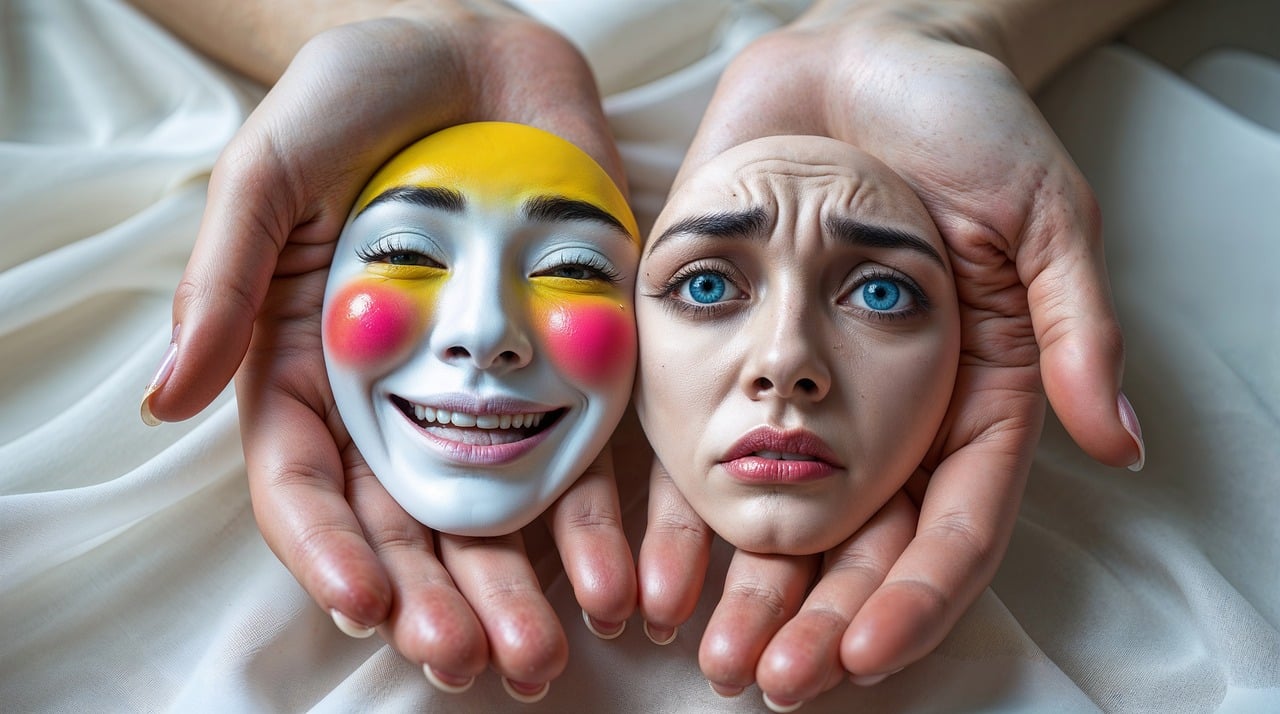
Whether passive or “living,” art is about sharing. It is an attempt by one or more human beings to reveal themselves, to communicate to others what is alive within them. Consequently, every artistic act is necessarily emotional, for emotions are precisely the outward expressions of our inner feelings.
What connections, what similarities exist between this artistic act—when it comes to taking the stage—and what happens in a classroom or training session?
Emotions, the warning lights of our daily lives
Emotions are our friends. At least, that is what Nonviolent Communication (NVC) tells us. Therapist and author Thomas d’Ansembourg compares them to the warning lights on our car dashboards. Their role is to signal a malfunction (an unmet need that can harm our health) or, conversely, a state of perfect well-being. In short, they are there to contribute to our survival, informing us that we need to take action or make a decision to restore or maintain our well-being.
Emotions also allow us to communicate with one another. A message devoid of any emotional content is difficult to understand because we cannot contextualize it by identifying the person’s intention—what they are truly trying to tell us. Only purely factual messages (“The meeting is at two o’clock”) can truly be understood without emotional elements.
When two people converse, they naturally take into account the verbal (words), the nonverbal (gestures and eye contact), and the paraverbal (tone and rhythm of the voice) to fully understand what the other person is saying. The bulk of the emotional message is conveyed through body language.
Written messages, therefore, when they are not purely factual, are interpreted by the recipient, who relies on what they know about the sender or the context of the message to fully understand it. Emojis were invented to add this emotional dimension to digital writing and thus help clarify the sender’s intent.
Emotional Resonance in Live Performance
Neuroscience, following the discovery of mirror neurons in the 1990s, explains that when a spectator watches a dancer or actor’s body suffer or jump on stage, the same motor and emotional areas are activated in their own brain. The artist’s experience is literally simulated by the spectator’s body. This is referred to as “physiological resonance.”
“With the discovery of mirror neurons, neuroscience is beginning to understand what theater has always known!” (Peter Brook)
Until recently, the audience member was considered passive. They were content to receive a work in the exact form and with the exact intention decided by the artist. This view has evolved significantly. The presentation of a work is a “sharing of the sensory,” and the audience member participates fully through what they receive, feel, and eventually express if given the opportunity.
“The viewer’s emancipation is thus the affirmation of their ability to see what they see and to know what to think of it and what to do with it.” (Rancière)
Consequently, some contemporary artists are more interested in this space to be explored—which arises between the artwork and the viewer—than in the artwork itself once it is finalized for sharing; and within this intermediate space, the laboratory focuses primarily on the dialogue of emotions—those the artist wishes to share, and those the viewer is capable of receiving and reflecting back.
Clara Edouin, for example, stages walking performances in which spectators and actors share the same space, creating an immersive experience. She explains: “There isn’t even a separation in reality between the male and female spectators and the artists, since we all share the same space.”
In theater
Classical thinkers like Diderot argued that a good actor must feel nothing if they are to make the audience feel something. Modern theories of acting (Stanislavski, Strasberg), on the contrary, seek the truth of lived emotion and advocate that an actor intensely experience what they wish to convey.
“The transmission of feelings is at the heart of an actor’s work in theater and film. (…) This work with emotions requires great mastery of physical and vocal expression, as well as a deep understanding of human emotions.” (Aberratio.fr)
For some, theater is a “mirror of the human soul” (Cours Lizart), as it allows one to feel, understand, and embody the emotions of others. Studies show that, as a school of emotion, theater helps develop empathetic abilities. It is also a school of listening that teaches one to be fully present in the moment unfolding on stage.
In singing
Marie-France Castarède explores the concept of an “enchanted” voice that resonates physically within the listener’s body, creating an immediate organic intimacy. In her metapsychology of the voice, she emphasizes—following in the footsteps of Didier Anzieu and Alain Delbé—that the voice is “the body’s most powerful emanation” and “the first stage of emotional communication before words.” She discusses the notion of a “sonic mirror.”
Using the example of opera singing, she emphasizes that hearing someone sing evokes in the audience an immediate recognition of “the identity and uniqueness of the person” on stage. The singing voice is received as an “invisible yet immediately perceptible core” that directly touches the emotions, even before the brain analyzes the text.
“Singing is the straightest, fullest, and shortest path. Emotion might lead us astray, overwhelm us: on the contrary, here we are on the threshold of a revelation. (…) The voice is our body, and it is also our soul.” (Tubeuf in L’Offrande musicale).
In the dramatic clown
One of the commonalities between singing and dramatic clowning is an immediate exposure and total physical commitment. The dramatic clown is not a fictional character as in theater. He plays with his own flaws, and the emotional connection with the audience is unique in nature. Eye contact is direct and uninterrupted.
“The clown is not a character. He is the reflection of his own vulnerability (…) One becomes a clown by stopping to play the idea one has of a clown character. It is about learning to let one’s own weaknesses exist on stage.” (Hert)
“The clown is a three-way game; there is always your clown, the pretext, and the audience (…) The clown needs an otherness that confirms his place (…) The clown looks directly at the audience, engages them, and eventually involves them. What the clown seeks through this is to share what he is experiencing in his body in the present moment, on stage; this allows him to improvise with the audience.” (Hert)
In the educational relationship
Teaching and training are also stages. The educator similarly finds themselves facing people—students or trainees—who expect them to take them somewhere, to provide them with an experience, to transform them and lead them toward new knowledge. Nowadays, perhaps even more so than in the past, it is a matter of capturing and holding attention and evoking emotions, for emotion is essential to the retention of acquired knowledge.
The educator therefore takes center stage; we sometimes even consider that they are “putting on a show.” They use humor, personal anecdotes with their accompanying emotions, as well as pauses and silence, to create a connection and stimulate motivation.
A good teacher, a good trainer, does not seek to be perfect; they seek to share their humanity, just like artists, and this is how they create a connection and gain and hold attention.
“For the question ‘how to teach?’ may not be all that relevant. The real question might be this: ‘Am I close enough to the reality created by my teaching?’ And so what if the teacher makes a mistake! Or all the better!
The ideal teacher makes mistakes just as La Callas and Yehudi Menuhin hit wrong notes and used them to create their very distinctive timbres and sounds. Managing deviations is a fundamental condition of creation. Much like clowns, who become so human by living off their mistakes and flaws. For a teacher, falling silent allows them to think about what they are saying and then say what they think” (Rousseau quoting Le Breton).
The Joy of Taking the Stage
“A place of fulfillment, experimentation, vulnerability, and creativity, the stage is no trivial place.” (Radio France)
Why would anyone want to go on stage? The stage is, more often than not, an experience that can be difficult to endure: a heart beating too fast, sweaty palms, a tight throat, the fear of not being up to the task… what we call, in short, stage fright, which Sarah Bernhardt said was inseparable from talent.
“It’s not natural to put yourself on display like that, so our reptilian brain reminds us that there may be danger in being under the spotlight like that” (Stéphane Grisard, director).
Yet, countless people dream of stepping onto the stage, and some live only for that. For those who overcome their fear and challenge themselves by putting themselves on display are responding to a need, an impulse that cannot be ignored. “A work of art is good when it springs from necessity,” said Rainer Maria Rilke in his Letter to a Young Poet.
Everyone may have their own deep-seated reasons. There are, however, fundamental elements repeatedly mentioned by many, which relate to the intensity and joy of preparation, to sharing and connection in the broadest sense—particularly the intimacy of emotions—to the physical commitment that pushes one beyond one’s limits, and, to a varying degree but for many as a secondary factor, to the recognition one receives in return.
Thus:
- For Michel Bouquet, an actor, the pleasure lies in paying homage to an author.
- For Julien Gaspard-Olivieri, actor and theater teacher, as well as for Stéphane Grisard, director and actor, the stage is the “place of the absolute present,” where time and space disappear. JG Olivieri emphasizes the importance of the body and considers that the goal is “to be at the peak of one’s abilities, in terms of the body.” He seeks the intimate within himself when it becomes shared power. He aims for a kind of fusion with the audience that leads to “breathing together.” For S. Grisard, “the more intense, comprehensive, creative, and rich the preparatory work was, the greater the pleasure on stage, because we are fully immersed in our art.”
- For Vincent Delerm, a singer, the stage is a responsibility toward the audience who trust you. The show he presents is a holistic experience. He emphasizes the importance of the relationship with the audience; he speaks of connection, and for him, “the pleasure also lies in the fact that the audience comes together as one at the end.”
- Clara Hédouin, director, finds pleasure and meaning in preparing the encounter between the work and the audience and then in observing that encounter with its unexpected moments and its expressions of life.
- Cellist and gambist Anne Gaurier explains that she “loves trying to express different emotions through playing and tells herself she has succeeded when, sometimes, people leave the concert with tears in their eyes.”
- Magician Thierry Schanen “sincerely believes that a performance is an exchange and that we all seek to gain something from it.” He notes, however, that “our ego is involved, even unintentionally. We seek a form of recognition, admiration, pleasure, the joy of being on stage… a reaction in the eyes of the audience, a smile, and finally, applause.”
Françoise Fognini, artist and life coach, sums it up this way: “The stage is about giving back to life what belongs to life.”
Many educators will recognize themselves in these motivations for taking the stage mentioned by the artists: the pleasure of preparation, that of meeting and sharing, the desire to have a group that “stands as one,” as well as the physical engagement and connection to life.
Toward a pedagogy of resonance
What if the greatest challenge for the modern educator were no longer to transmit knowledge, but to dare to resonate?
At a time when raw access to knowledge is instantaneous and digitized, the added value of the teacher or trainer no longer lies in their role as a mere disseminator of information, but in their ability to create a living experience. The analogy with live performance invites us to fundamentally rethink teacher training: beyond purely didactic contributions, what place do we give today to the development of their emotional, physical, and theatrical skills?
Daring to lay oneself bare like a clown or a singer, inhabiting the space, embracing silence, and overcoming stage fright are key relational skills. By choosing to trade the posture of the infallible expert for that of the relational artist—vulnerable, present, and vibrant—the educator no longer merely teaches a subject; they create a space of resonance. It is in this sensitive sharing that not only a moment’s attention is forged, but the deep anchoring of shared knowledge.
Are we ready, collectively, to transform the classroom from merely a place of technical assessment into a true laboratory of humanity?
Sources
- Art, a powerful means of expressing our emotions. August 2024. On Artcurhope.com:
https://artcurhope.com/art-expression-emotions/
- The emotional aspect of art and its power over viewers. On Cyanmagenta.fr:
https://www.cyanmagenta.fr/l-aspect-emotionnel-dans-l-art-et-son-pouvoir-sur-les-spectateurs/
- Belkadi, Nejiba. Education: What Role Should Emotions Play? June 2025.
https://edtechactu.com/digital-learning/formation-quelle-place-donner-aux-emotions/
- Castarède, Marie-France. The Voice and Its Spells. Les Belles Lettres, 1987.
- Hecquard, Françoise. Embodied Presence. March 2026. On Thot Cursus:
https://cursus.edu/fr/35774/la-presence-incarnee
- Hert, Philippe. Learning to Be a Clown. March 2021. On SHS-Hal-Science:
https://shs.hal.science/halshs-02062238v1/document
- Interpretation and Performance of the Singer. On cpmfrance.com:
https://www.cfpmfrance.com/single-post/interpr%C3%A9tation-et-performance-du-chanteur-l-art-de-captiver-son-public
- The art of conveying emotions on stage and on screen. Oct. 2023. On aberratio.fr:
https://www.aberratio.fr/lart-de-la-transmission-des-emotions-sur-scene-et-a-lecran/
- Le Breton, David. Living, Expressing, and Sharing Emotions. Interview with Cécile Guéret. Nov. 2024. Cairn-Info Podcast: https://shs.cairn.info/vivre-dire-partager-les-emotions?lang=fr
- The Joy of Being on Stage: Why Does It Energize Us? Grand bien vous fasse, July 2025. Radio France Podcast: https://www.radiofrance.fr/franceinter/podcasts/grand-bien-vous-fasse/grand-bien-vous-fasse-l-ete-du-vendredi-04-juillet-2025-5041450
- Can theater foster deep empathy toward others? April 2026. On Cours Lizart:https://www.cours-de-theatre-a-paris.fr/le-theatre-et-l-empathie-profonde/
- Rancière, Jacques. The Emancipated Spectator. Ed. La Fabrique, 2008
- Rousseau, Philippe. The Function of Silence in Education: A Performative Dimension. 2003. On OpenEdition: https://journals.openedition.org/eduquer/211#tocto1n4
- Sofia, Gabriele. “Theater: A Brain Stimulator.” In: Cerveau&Psycho No. 97, Feb. 2018.
https://www.cerveauetpsycho.fr/sd/neurosciences/le-theatre-un-stimulant-cerebral-822.php
- Suppa, Pierre. Singing Is Communication.
https://www.pierresuppa.com/blog/chanter-cest-communiquer
- Thénaisie, Yohann. Notes on the clown: https://yohannthenaisie.com/2021/07/13/notes-sur-le-clown/
See more articles by this author