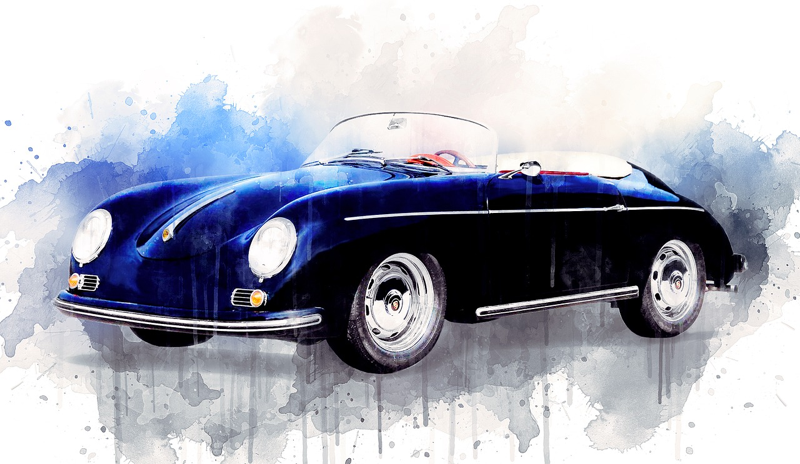
The automotive industry represents an undeniable commercial and marketing success. There's no escaping it.
Starting with a basic need (getting around), it has managed to impose itself against all other alternatives (90% of urban transport); in some areas, it has even annihilated them.
With a car, you can claim to be part of civilization... It's no longer presented as the answer to a basic need; it's now sold as an element of social prestige, pleasure or adventure...
But by transposing an element of the private sphere (the need for individual transport) into the public sphere, with the tools of the public sphere (marketing), the answer to a personal problem has become a public problem.
The average speed of a car is less than 60 km/h, and is steadily decreasing as the number of cars increases. In cities, a bicycle is faster than a car.
When you add up air pollution, urban sprawl, loss of green space, noise, accidents and injuries, overcrowding, all kinds of damage, debt, etc., the economic equation that has so far favored individual automobile transport (better transport and mobility boost productivity and collective wealth) becomes less and less attractive.
Even with more efficient and "environmentally-friendly" cars, the equation remains negative and counter-productive. Looking at the ads, roads will soon become habitats for flora and fauna.
But this doesn't stop the industry from going from strength to strength: there are still two billion Chinese and Indians who don't own a car.
An individual problem?
As in the case of smokers' responsibility, the car industry officially puts the onus solely on the individual: it encourages him or her to take individual responsibility for their transport. What's more, competition in the industry is fierce, and product quality is high. The creativity, ingenuity and resources invested voluntarily are fabulous, always with the agreement and under the pressure of individuals. Individuals pay, the oil industry collects and passes on most of the money to governments (40-70% tax on gasoline). Follow the money.
Yet this is a group (an industie) that imposes itself on the community and takes care of its political lobby as much as its marketing. The answer to the problem it has become can only come from the community, not the isolated individual. The community will gain by increasing its political control over the industry.
And education
Education follows much the same path: it is a collective response to an individual need. The state has taken responsibility for the individual: an educated society is simply a stronger one. The state determines programs, standards, etc.; it organizes the groups it pays or subsidizes.
Education has never or hardly ever done any marketing; its clientele is taken for granted, legally subjugated up to the age of 16. Individuals pay for education through their taxes (without having a choice). The government passes on to the institutions. Follow the money
Competition is reduced and, although the resources invested are colossal, the return is diminishing. It takes longer and longer to train a competent, responsible person. There is a lot of sterile debate and reform in the industry. The economic equation for education has become less favorable than it used to be.
In short, if we compare it to the automobile industry, education has almost become its opposite. It's a political class that imposes choices on individuals and the education industry that, however wise, never long remain a response to the changing context or the wishes of citizens.
Increased local responsibility would diminish its political tutelage. Distance learning and the Internet are effective means of achieving this. In other words, institutions stand to gain by increasing their autonomous revenues, and citizens by directly articulating their interests.
Take education out of the public domain? No, it's not about that. It's about balancing relationships. The way in which institutions receive money has a direct and clear influence on the power and autonomy they enjoy.
Marketing
Commuting for the sake of commuting, studying for the sake of studying... both seem equally futile. You can't promote transportation any more than you can promote education without a purpose. If the car industry has lost its way, education, thanks to marketing, doesn't have to do the same by imposing itself on people's minds. There's a happy medium between hammering and mothering. After all, between 2 and 5% of the automotive industry's revenues are spent on marketing. Imagine the effect if education did the same!
Education can learn from the automotive industry's marketing methods. The purpose of both is to transport or teach, in order to help society AND its citizens achieve their goals.
See more articles by this author