The transformation of the educational ecosystem: by competencies
If we think we're going to fund education on the same criteria as in the past, such as class attendance or age of individuals, the formula will only generate frustration.
Publish at October 09 2011 Updated November 28 2022


With the OECD tables on teacher salaries, if we put
we see that there is little relationship that holds between these variables.
Education costs rise primarily because class sizes are reduced, not because teachers' pay is increased beyond the rate of inflation.
Add to this that a significant number of teachers will soon be retiring and we have a good topic of debate here for a few years.
Countries like Finland do not pay their teachers proportionately much better and their costs per student are in the average range of rich countries. So are the number of children per class or the number of hours taught. If there are factors that explain Finland's success we should look elsewhere than in the numbers.
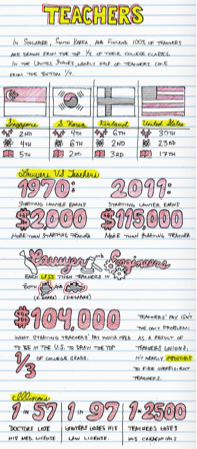 In this graphic overview
from "Online Education" we find both a portrait of the state of
education and the state of teachers in the U.S. The graphic argument provides an interesting lead: the attractiveness of the teaching career and the self-discipline of the profession.
In this graphic overview
from "Online Education" we find both a portrait of the state of
education and the state of teachers in the U.S. The graphic argument provides an interesting lead: the attractiveness of the teaching career and the self-discipline of the profession.
40 years ago a beginning professor earned almost as much as a lawyer or engineer. The professor was socially considered. Today, he earns much less and his prestige is almost absent. When one has done so much study, why go to teach and be supervised in a rigid system, criticized, etc... when one can earn more and enjoy more autonomy in many other environments that require equivalent studies. Thus the attractiveness of the profession, both financially and socially, is dropping in several countries with a consequent reduced pool of recruitment of teachers.
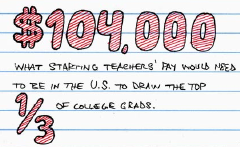
Countries such as Finland. South Korea and Singapore hire 100% of their teachers from the top third of successful students. They are offered good salaries starting and optimal practice conditions. So these students who excel become teachers.
In countries like the United States, nearly 50% of teachers are recruited from the bottom third of students completing their education: the starting pay is low and the conditions of practice...random. The one-eyed will guide the blind. In addition, it is almost impossible to revoke a teacher's license. It is the only "profession" that cannot do so.
In the past few people could teach; the teacher was both the repository of knowledge and the transmitter. Books and references were rare. With the Internet, the teacher is no longer the repository of knowledge, nor does he have a monopoly on transmission. The ability to mobilize a group of students is more powerful than he is, and whole swaths of knowledge are available at any time and in full on the Internet.
What remains of his role? What are the elements of a task that are not common, that can be the subject of a profession, and that are not found in the Internet? The answer revolves around facilitation and the conditions of learning.
Fairly, mobilizing a class or motivating individuals is a constant challenge. The creation and maintenance of interest in subjects to be learned; the contribution and enrichment of subjects, the construction of coherence in the dynamics of classes and individuals, follow-up, coaching, etc. Everything that makes school a stimulating and interesting living environment, this is the prestigious role of the teacher, the one that young people will also want to do later.
Online training can contribute to this re-conquest by unloading the teacher from the functions of transmission and repetition. The teacher retains those of animation, discussion, stimulation and accompaniment of his students. Those that really count, the human functions. As well as collaborative practices between teachers and between students. This is why it is essential that teachers accept and integrate e-learning and ICT into their practice. Class time finally used for integration rather than transmission.
You might also like:
The transformation of the educational ecosystem: by competencies
If we think we're going to fund education on the same criteria as in the past, such as class attendance or age of individuals, the formula will only generate frustration.
Dealing with the gifted in the classroom
The school and the teaching staff put a lot of effort into the students in difficulty. This is a normal reflex since they must be led to success. Meanwhile, gifted learners are bored. They have the impression of being left behind and of learning almost nothing. This can lead some to disrupt the class. Hence the importance of dealing with high achievers as well.
We create traces as soon as we do anything, in reality as well as in virtual worlds. So how do we erase our traces? There's no shortage of strategies, from obliteration to submersion, discover them all!
How can we overcome the fear of failure experienced in situations of performance stress? What are the concrete steps to success for athletes, students and professionals?
Connecting students to science
Repeated attacks by the US government and other legislators have led us to fear the worst for all areas of science over the next few years. How does a society protect itself against such attacks? By restoring a special place to science, both among the general population and among young people.