A person who rents himself out to do nothing raises questions about society, work, relationships, and social media
Publish at March 19 2019 Updated February 25 2026


Bullshit... There's no shortage of translations to evoke the "bullshit" analyzed by sociologist Harry Frankfurt and more recently by Sebastian Dieguez. Indifferent to the categories of "true" and "false", and more sensitive to emotion, sincerity and commitment, this form of communication represents a problem. But how can we fight back, when refutation barely scratches the surface of this "rubbish"?
Harry Frankfurt has been analyzing bullshit since 2005, in a very short work entitled De l'art de dire des conneries (The Art of Saying Bullshit ), written twenty years earlier with no intention of publication. His study shows that the categories of lie and truth have little relevance for those who practice bullshit.
There's no point in denying or proving the error of bullshit. Whereas the liar can only act if there is truth, and if people believe his assertions to be true, the bullshitter is indifferent to this question of truth. For Harry Frankfurt, this is what makes him even more dangerous!
"A world of responsible lies is perhaps safer than a world of irresponsible bullshit, where no one takes the trouble to measure their deceptive speech against its consequences.
The author gives examples of hollow assertions, such as that "change is inevitable" or "the situation is improving", but at such a general level that it's impossible to confirm or deny them.
Ten years after the release of L'art de dire des conneries (The Art of Saying Bullshit), and more than thirty years after it was written, the Internet has greatly expanded the production, distribution and impact of "bullshit". Faced with this outpouring of bullshit, some people spare no effort in offering explanations and more or less annoyed corrections. In vain... or almost. Sincerity, indignation and emotion are much stronger vectors of support than logical or scientific demonstration.
"Speaking with determination, persuasiveness, sincerity and authenticity take precedence over accuracy. What speaks to me, what seems true to me, is my truth".
Sébastien DIEGUEZ
Since authors don't bother with truth or consistency, efforts to disprove them are futile, if not counter-productive. If you disagree with them, that's proof that they're disturbing. And if they do, it's because they've put their finger on a scandal, a reason for indignation or denunciation.
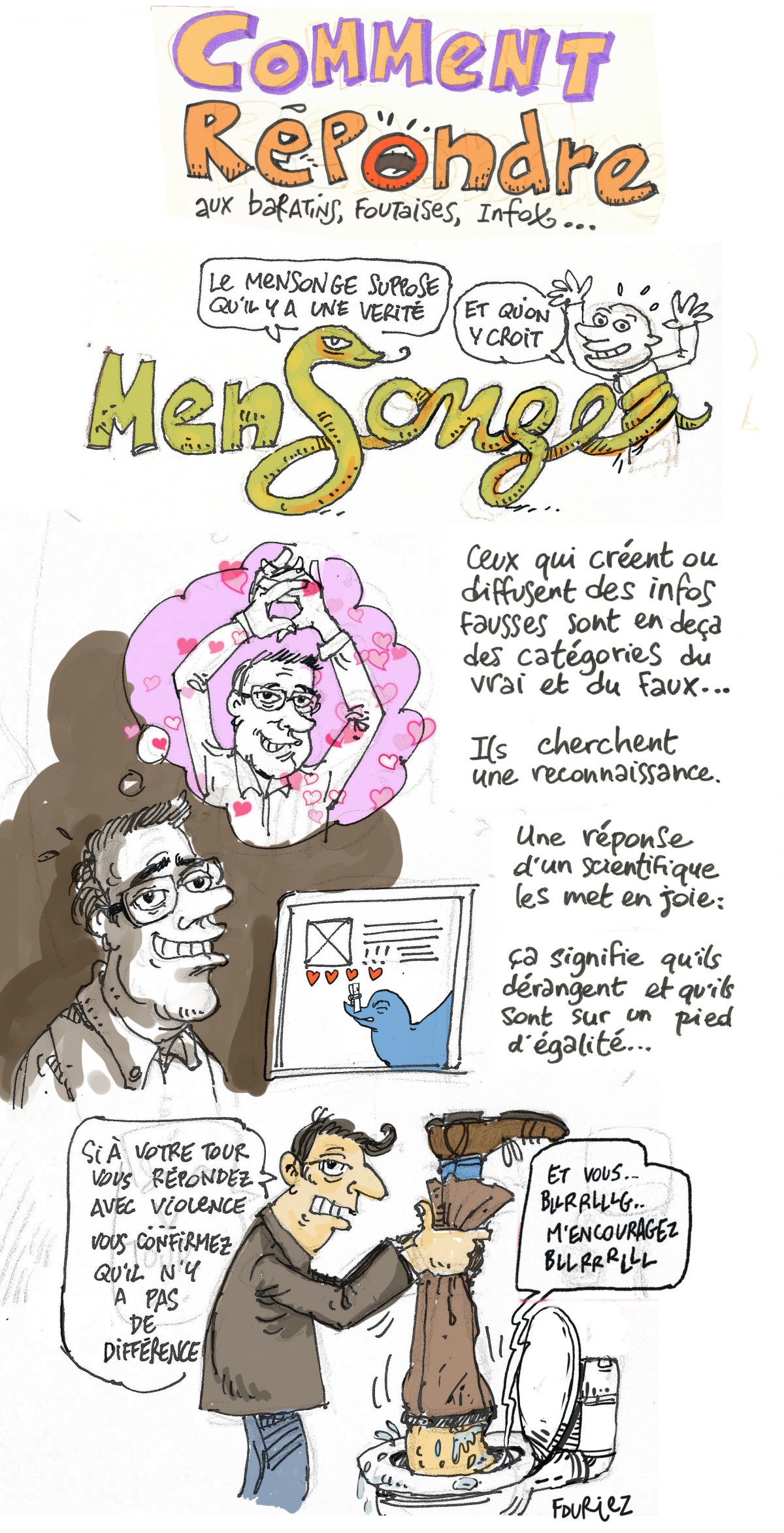
If refutation is impossible, and putting forward arguments is counter-productive, what can be done? Should we simply sit back and hope that the flood of social networks will wash away the bullshit? Sebastian DIEGUEZ, author of Total bullshit, suggests another way: humor and derision.
People who spread false and far-fetched information are often looking for recognition. Some enjoy the feeling of power that comes from spreading infox. Serious reactions only increase visibility and give importance to the people who create and relay them.
On the other hand, by ridiculing certain assertions and making them appear ridiculous, we attack the seductive power of infoxes. Among the motivations of those who spread them is the feeling of being above the rest, of giving oneself the positive image of someone who is not gullible, and who knows full well that he or she is being lied to. Humor is more effective in shaking up this self-image than rebuttals by people who would be on the defensive.
The YouTube account "la tronche en biais" uses humor and staging to promote zetetics, i.e. curiosity. The character who talks to us resembles the mad scientists of popular films and comics, but the content is precise and aims to make us intellectually more demanding.
The scientific character, aided by a protesting mop, sheds light on the cognitive biases that encourage us to believe false information. These videos are part of a broader approach, promoted by the website "la menace théoriste", which uses humor and polemics to debunk theories that have no scientific basis.

In the face of assertions that are no longer concerned with the truth, blunt answers, patient explanations and humiliating sneers have little effect. Humor without sarcasm, accompanied or not by detailed explanations, at least avoids wasting energy on sterile invective.
This technique is not new. Published in 1864, Arthur Schopenhauer's The Art of Always Being Right jubilantly dismantles all the rhetorical techniques used to argue in a vacuum. More recently, in 2014, Nicolas Tenaillon published L'art d'avoir toujours raison (sans peine), in which he gives us 40 stratagems to nail your interlocutors.
Illustrations: Frédéric Duriez
Resources
La menace théoriste - viewed on March 17, 2019
menace-theoriste.fr
La tronche en biais - viewed on March 17, 2019
https://www.youtube.com/user/TroncheEnBiais
Harry Frankfurt L'art de dire des conneries Fayard Mazarine - 2017, first published 1985
https://www.decitre.fr/livres/de-l-art-de-dire-des-conneries-9782863744413.html
Sebastian Dieguez, Total Bullshit, l'ère de la post-vérité, hors collection, Presse Universitaire de France 2018
https://www.decitre.fr/livres/total-bullshit-aux-sources-de-la-post-verite-9782130799993.html
You might also like:
A person who rents himself out to do nothing raises questions about society, work, relationships, and social media
Managing emotions and attention: being round in the land of squares
Having ADHD is a bit like "being a round man in a land of squares". The two shapes don't have the same properties and can't be calculated in the same way, but they're still geometric shapes!
Online training: boring movies or challenging course?
What do you buy when you order an e-learning course? A lot of media... and some instructional design. Without this essential ingredient, your training is likely to bore participants and fail to achieve its goal.
How digital technology is transforming the practice of history
What makes history special in the Web 2.0 era? Have historians' practices changed as the web has become increasingly participatory? Two texts provide a clearer picture of the components of this new digital history.
How judgment works and how it can be useful in relationships with others
Judgment is a form of decision, and all our decisions are in fact influenced by many parameters...