A Management Dojo
The purpose of professional practice analysis is generally considered to be to help professionals develop and step back from their experiences: in a word, to work on maintaining their professional health.
But beyond this aspect, we can highlight an "educational" aspect. Educational in the sense that, like the practice of a sport, this practice aims to have an effect on the actor's behaviors and abilities in a professional context and which will then become skills.
This type of coaching practice is close to a ritual that is repeated at each session. A ritual allows a certain number of abilities to be developed through the repetition of the same cognitive gestures. It is therefore in itself a "learning" modality that relies on a more or less explicit, more or less conscious learning model in the one who conducts this type of practice.
My experience of facilitating co-professionalization groups and supervising group facilitators often leads me to question the coherence between the method used by the facilitator and his or her intention (his or her objectives).
Is the way he goes about it, the method he implements, in the service of a conscious or implicit objective? Is he really doing what he thinks he is doing? Is he really having the effect he thinks he is? Is there really coherence between his method and his intention? This is not always obvious and there is often a lot of vagueness or unthinking in these practices.
Bottom line the question is: what effect do I have through such a practice on the behaviors and abilities of the people I am coaching? What does repetition lead to in terms of cognitive abilities?
A look at one's practice
The search for one's own coherence is undoubtedly one of the essential conditions of one's professional health and the development of one's professionalism. This is indeed the reason why supervision of professional practice supervision group leaders is an unavoidable requirement. It allows the facilitator to make explicit the coherence between his method and his intention.
In this text I propose an initial reflection on the relationship that there may be between the structure of the method used and the cognitive skills developed by the practice of this method.
This is a question that all professionals in coaching face one day or another: what is the coherence between my way of proceeding (the method I use) and the intention that presides over my action? The basic question is: How can I formalize this reflection in a research project? Not necessarily an academic research work with a scientific vocation, but rather a means of responding to the requirement of a professional who is constantly researching his own practice.
Establishing links between the steps of the method and the capacities implemented and trained
There is theoretically a certain coherence between the structure of the method and the learning model that supports it. Although this coherence is not always visible, and the practitioner aware of it, it may seem useful for a professional to put some awareness on the link between what he or she intends to do and how he or she goes about doing it.
With regard to the co-professionalization group method the structure of the method is intended to be consistent with a model of learning.
The work of analyzing each situation proposed by the participants, takes place in four moments:
FOUR WORKING TIMES
- Problem space
- Diagnosis space
- Solution space
- Synthesis of the case
Each phase represents the practice of a stage of a learning process of awareness. It is a bit like an implementation of the schema, a practice of learning to learn. The process implemented is based on a model of learning as described in the diagram below:
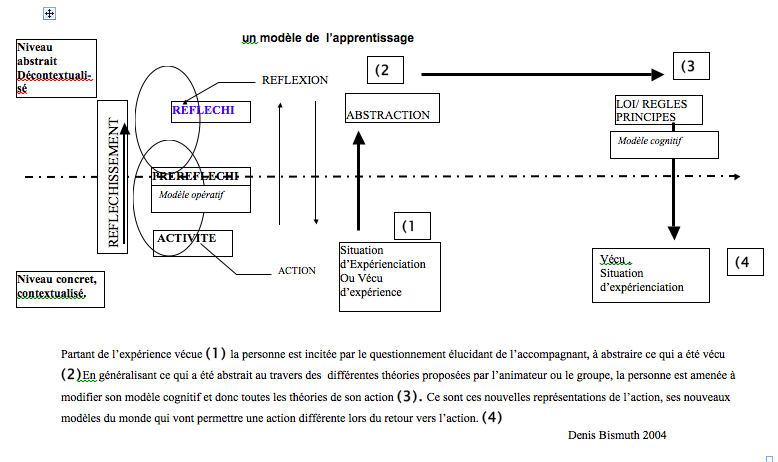
Each of the steps in the method refers to a moment in this model

Each moment can contain a learning intention and an "educational" intention.
The learning intention is clearly to have participants experience the value of taking the time to do this work with the intention of moving forward and moving others forward.
The "educational" intent is more complex to perceive: Each of the work phases contains a "silent project" of skill development, or rather of meta-competence in the sense of competence to bring skills into play. Skills necessary to regulate one's behavior in complex work situations.
I have attempted to formalize the link that can be made between each of the phases and the postural meta-competencies that can be developed through such practice, such training.
First work phase: Problem space
In this phase the participant develops an ability to elaborate a discourse on a lived experience.
While in the course of action the act remains mostly "unthought" and the situation "unconsidered". The work of elaborating a discourse on the action has the objective of allowing the person to consider what he or she has experienced. To consider in the precise sense: to take into account all the ingredients of the situation, without judgment, without a meaning oriented by a project of action or a feeling of failure. Indeed the way of signifying a problem before having worked on it is often oriented by the way one would like it to be solved or the feeling of failure of the solution already employed.
As indicated in the diagram above, the discourse on lived experience is an attempt to put into words what constitutes the pre-reflexive of the action.
In reality the subject does not speak of his action but of what he knows about it. The representation he has of it. In this sense the analysis of practices is not the analysis of the activity but the analysis of the discourse on the activity. The object of the work is not the activity, it would be necessary for that the subject is in the course of its action (in actu and in situ). Ex actu, the subject of work is the representation that the subject makes of his action.
Working ex actu the subject takes as its object his practice, that is to say the discourse on his activity in so far as it testifies to the consciousness he has of it, the representation he has of it at the moment he speaks of it.
The effort of putting into words has an effect on the representation. It modifies it and enlarges the field of perception that the subject has of this situation.
"What I say forces me to think what I was a hundred places away from thinking thinking." The effort of explicitness is a confrontation with myself (an inner forum that becomes an outer forum) that increases the reality of my awareness of the situation. One could almost say that discourse manufactures augmented consciousness.
The confrontation with the logic of the other as a "test of reality," in my effort to make myself understood by him, forces me to an effort to become aware of the non-conscious ingredients of my stances, my decisions, my meanings. What is sometimes so difficult to do and may seem like a test for the speaker can become a test in the photographic sense of the term: one of the possible representations of reality, revealed by a process.
The problematic of professionalization can be reduced to this question.
- We know (Berthoz 2001) that unconscious affective components ground all our decisions.
- We know that conscious rationality has little influence on decision-making processes in the course of action.
- We know that the basis of our professional efficiency is not the quantity of knowledge we have stored, but that which we are able to mobilize in the immediacy of the action. That which our awareness of the situation allows us to mobilize: often not much.
What will determine our professionalism is therefore the ability to become aware as quickly as possible of what is happening: that the right decision of meaning allows us to make the right decision of action. To use Berthoz's phrase "Decision-making requires first that perception faithfully reflect reality"
The detour through discourse is, of course, unavoidable. Consciousness and language being in permanent co-construction.
Cognitive gesture developed in this first phase
The effort to formalize structures the gesture of reflection.
The action of reflection takes as its working material the pre-reflection of action.
The non-conscious part of the action that allowed the Subject to regulate its behavior in actu.
In actu this non-conscious part could not be conscious, it is cognitively impossible to manage consciously the whole processes in the course of the action.
But what allowed him to manage them was his theory in act. This theory in act is the representation that the Subject has of my action and the set of criteria, values, beliefs, intentions, non-conscious that allowed to arrive at the result of his action.
In practice analysis what is at work is the content of the subject's theory-in-act.
The content of the theory-in-act is not necessarily true, rational, logical, and realistic, but it is what was used to drive the action.
If the pre-reflective allows for the management of the action, the reflective allows for the management of the pre-reflective. By taking this pre-reflective as the object of work, the reflective allows it to be validated, transformed, and made conscious. This allows it to be modified when it is unsuited to the reality of the action, which is permanent in processes of change.
This allows it to be made conscious and thus allows the actor to do the same thing but consciously, intentionally, without feeling like he is tinkering or improvising clumsily.
In fact the formalization process in its dimension of reflection is a means of allowing an ongoing elaboration of the theory of one's action, in the main purpose of theory: to make the real intelligible.
Clearly the pre-reflexive allows one to manage, to regulate action. But this pre-reflection is constantly challenged by the changing reality. It is very quickly obsolete. Reflection has the function of constantly readjusting the pre-reflexive as a tool for managing/regulating the action.
So reflection is a cognitive gesture that has two purposes:
- Develop the awareness that the subject has of his action. Thus he is aware of what happens to him and he can do what he does intentionally (in full consciousness).
- To permanently adjust his model of the world, his "ideology" in the primary sense of the term: the logos of his system of ideas and representation of the world. his theory in act said Pierre Pastré. I would say: his philosophy in act.
The elaboration of a discourse can only take place in a particular context: a protected context a space where the subject feels contained and safe in order to be able to open the door to the non-conscious level of his practice, without risk to his identity,
A protected space is a space where one is not judged (judgment is a threat to identity).
A space where the other, who witnesses my reflective activity, has no stakes. If the other has stakes, his or her listening cannot be neutral and therefore my reflecting cannot be neutral. The mirror of the psyche is disturbed by the tensions that stakes bring and like the wind on the water of the lake, the mirror becomes clouded and no longer reflects anything clear except my disturbance.
The purpose of the problem space is to allow the individual to elaborate an objectified constructed discourse: to produce thought. It is a space in which the Subject will be able to transform an emotional, confused, interior, non-conscious experience into a discourse, exterior, explicit and communicable and (somewhat) organized. To think his action in the literal sense of the term: to make it an externalized object and that one can consider as such to work on it.
He thus becomes a competent interlocutor in the relationship. A responsible interlocutor in the primary sense of: who can respond.
Experience shows that the simple act of explaining oneself with oneself by putting into words an experience has a changing effect on the representations that the subject makes of the situation. As one participant remarked: ah! it doesn't make the same sense when I talk about it!
In the managerial relationship where the leader's expectations and the collaborator's stakes are very high, where situations are complex and multilevel, where the subject is in a subordinate relationship and therefore without distance, we cannot expect that in the course of the action, at the moment when the Subject experiences a situation, he or she will be able to take distance, modify his or her representations and elaborate a reflective response.
Working in the problem space is the place for the elaboration of the discourse on the activity.
But it is also the place for learning the cognitive gestures that allow for reflection, the gesture of epoche [suspension of judgment] among other things. These reflective gestures are counterintuitive and there is no other way to learn them than to produce and repeat them.
Once the lived experience has been objectified, become thought, the work of analyzing practices in the co-professionalization groups continues with the work of making the lived experience intelligible. Beyond this aspect, the work of putting into words has the effect of making it possible to situate the action in a greater temporality. Without the support of the word, thought is an ephemeral flash. The word anchors the idea in time and in sharing. This gives it its meaning. For its action to be found in its library of mobilizable experiences, it is necessary that it has been translated into thought and fixed on the support of the conceptualized representation.
It is indeed a matter of subjecting the lived experience to the question to make it speak. And we cannot do without the gaze of the other who is elsewhere.
For we never speak only of ourselves, but could we speak of elsewhere?
The confrontation with another is in fact a confrontation with oneself. The other looks from elsewhere and,with his questions provokes, a decentration that produces meaning.
Second working time : The diagnostic space or theorizing space
After having described a situation that is to say after having put in relation objects (events time facts sayings criteria values intentions etc...) It is necessary to be able to do something with it to ask the question of the meaning of these relations. It is therefore necessary to decipher this situation, to make it speak, to make it intelligible.
Theoretical models that are at our disposal have this function of bringing out the meaning of the real or the reality of the Subject. The function of theory is not to seek the true. The theory is a tool of intelligibility of the real. That is to say that it is used to put sense of understanding on a situation. A theory is not true or false. It is useful or not to act on the understanding of its reality.
Whatever model is used to produce meaning, what matters is not so much whether it is true or not. What matters is that it is operative, useful for producing meaning.
What matters is not what I believe, but which models, which grids of analysis, are the most relevant for making reality speak.
The cognitive gesture developed in this second phase
The theorizing-decoding space is thus a moment when the Subject will develop another cognitive gesture that is important in regulating his or her action: The gesture of signification. Producing meaning is not natural and there is no other way to learn it than to do it and repeat it.
The third work time: the solution space
This work time contrary to what the title might imply is not about finding a solution.
It would be presumptuous for someone to imagine that he or she could find a solution to someone else. The solution I could imagine would be the image of what I would do if I were him as I imagine him and if I were in his place. But I am not him and I am not in his place. Therefore, speaking for the other is illusory.
On the other hand, the confrontation with the experiences of the different participants in a similar situation, can nourish the reflection that the Subject could lead in the way of bringing back to the reality of the action this work of theorization made beforehand. It is somewhere the work on: and now what do we do with all this?
In this work on the solution space we try to weave links of meaning between a situation and the different understandings that one can have of it.
The solution will not come from this but it could not come without it.
What is at work here is the link between the meaning of the situation and the reality of the situation, no longer in a dynamic of understanding, but in the dynamic of resolution.
Of course the subject can identify among the participants interesting resources or ideas of "solutions." But, the real interest of this step is to learn to reweave the link between the meaning work of the previous phase and the problem-solving project he or she is undertaking.
In fact no conscious and rational strategy will be able to elaborate a solution a priori.
It is the subject's intuition in the course of action that will propose pragmatic and appropriate solutions (in the other sense of appropriate: owned by him) provided that upstream there has been a work of reframing meaning on the understanding of the situation.
It is more effective to let intuition and the non-conscious do the work, whose power is infinitely greater than all the attempts at conscious control that we could make.
Cognitive gesture developed in this third phase
The solution space is an opportunity to work on the development of a cognitive gesture that is essential in regulating the behavior of the manager:
The identification of the structure of a problem.
This cognitive move is essential in the development of adaptability for a fairly simple reason. For an individual to be able to transfer a skill from one domain to another, it is necessary that he or she be able to identify how the new situation is similar to a situation that is in my catalog of past experience. Thus the subject can reinvest a tool from a past situation in a new situation. A new situation on which one can carry out a transfer of competence is necessarily new by its appearance, context, person. It is in its structure that it is similar to a known experience. Thus, then, the ability to adapt rests on the ability to identify the structure of a situation beyond its apparent difference.
Any problem has a content (a context, people, events) and a structure: a form.
Recognizing the form beyond the content is a rather counterintuitive cognitive gesture.
From a professional experience one can extract the structure of the problem. This is in a way what one does in phase two: the diagnostic space. We try to put the objects (the ingredients) of the problem in relation and to give meaning to this relation through a theoretical model. We give meaning to the structure of the problem.
This skill in identifying the structure of the problem conditions the Subject's ability to transfer his or her knowledge. For example: if at some point we are led to work on a concept such as the double constraint. This concept makes the analyzed situation intelligible. The participants understand the link with the situation.
But it is not uncommon for them to come back with another situation that leads us once again to identify a double constraint. They hadn't seen it. The structure of the double bind was there, but the context was too far removed from the previously worked context that was part of their library of double bind experience.
The limit of the training
This is where we hit the limit of the training. It is not so much the ability to understand a concept that gives one the competence to understand one's environment. It is the ability to identify the structure of the problem that is repeated in the contexts one encounters and the ability to find in one's toolbox of concepts (one's theory in action, or model of the world) the one that will be useful in making the situation more understandable.
It is easy to understand that a manager may have perfectly understood the theoretical concepts of manipulation or double bind in the example studied in training and at the same time be unable to realize that he or she is experiencing, such a situation or even subjecting others to it a few days later. The knowledge of the concept does not guarantee that one will be able to use it. To use it, in this case, one must acquire a cognitive gesture: to know how to identify the structure of a situation in order to refer to the concept that makes it intelligible.
In the practice of co-professionalization groups, each participant is asked in a round table to identify an experience that would be similar to the one proposed for study and to describe what he or she has tried to do, whether it worked or not.
To respond to this request, the participant produces various cognitive gestures:
- He analyzes his or her professional experience, identifies the structure of the situation through a theoretical concept that makes it intelligible (diagnosis).
- He compares his different structures of experience present in his library of experience, to the one proposed to identify the one that could correspond.
- And he presents the one that to his mind is the closest structurally to the one in analysis.
When discussing the validity of the situation he proposes, we ask ourselves the question: can we really compare the situation proposed by the participant with respect to the one that has been analyzed?
This questions each person's ability to make comparisons of situation structure. Everyone learns to criticize to identify the limit of validity of the comparison of a problem structure. An important gesture insofar as in reality, problems are never the same and it is often necessary to know how to criticize our ways of comparing problems before drawing from one's experience the transferable elements of response.
The solution space thus makes it possible to work on the link that can be made between the concepts that make up the individual's model of the world and the set of professional situations that he or she encounters.
Fourth working time : The case synthesis.
The objective of the "case synthesis" stage is to collect and share all of what the group has produced.
As each person has retained something different, it may be thought that it is necessary to share what has been retained. Indeed it is not uncommon for the person proposing a case to pay attention to only part of what is said and to sort out his or her listening according to his or her concern to find a solution to the problem.
On the other hand, the other participants were able to be attentive according to their experience, to concepts or elements of understanding that escaped him. Putting all of this together makes it possible to avoid to some extent a loss of information.
But beyond this aspect, such work has a particular interest in terms of the cognitive gestures necessary for the regulation of the manager's behavior.
Cognitive gesture developed in this fourth phase
This phase constitutes training in producing an evocation of the past.
It is understandable that the main difficulty for novice participants in such an approach is to identify problem situations.
Seeing the problems one encounters is not usually done in the course of action (there one only sees the effects of the problems: the reactions). The perception of problems is done "cold". Out of the context. This presupposes a skill in evoking a more or less recent past.
This gesture of evocation is not always present in individuals. It can be acquired through practice. When participants are asked to say what they remember from the session, their ability to evoke is solicited. One of the indicators of maturity of a practice analysis group is its capacity to evoke the session. Most of the time, in a novice group, this evocation time is reduced to almost nothing: there are barely any judgments or imagined solutions. Then, as the group matures, this time becomes longer and the feedback of the session becomes richer with the ingredients of what really happened: one moment he said that... I saw that he had reacted to such and such a word.... When we talked about this I remembered....
The participants thus show their ability to put into play in an effective way this gesture of evocation that they have acquired in the work of feedback.
Without this skill, a manager is not in a state to see the problems he or she encounters.
This cognitive action can be worked on daily by taking a few minutes after a meeting to summarize it. Or taking a few minutes each day to review the day. Even if it is illusory to "naturally" expect this from a manager who lives under the permanent pressure of work, the fact remains that this gesture of evocation must necessarily be structured to make the manager alert to the situations he or she encounters.
A manager recently confided to me that since he had participated in the groups, he took a moment every evening alone in his office and took the time to re-evoke his day to review all the important events and take the time to understand what they meant to him.
Understanding what one does
I have attempted here to describe through different experiments, the cognitive gestures involved in developing the abilities to signify an experience to produce decisions of meaning and action to be able to regulate one's behavior.
Other processes are involved in the development of meanings such as the formation or use of metaphors. But there is in my opinion not enough research work done on the meta-skills and cognitive gestures that in an informal way is developed by these different training or educational practices.
My project was to try through this text to put in comparison a learning model and the method that serves it. A way to make explicit its coherence, its internal logic.
Each method has its own structure that responds to a very specific intention. Even this intention is not always conscious in an explicit way in the coach, as shown by the work of supervision of the consultants in charge of the animation of this type of group. These distortions that appear in the supervision of facilitators lead us to believe that it is necessary for everyone to conduct a reflection on the adequacy between the method used and the explicit and implicit intention that underlies it.
References
BARBIER J.-M., dir., Savoirs théoriques et savoirs d'action, PUF, Paris, 1996.
https://www.decitre.fr/ebooks/savoirs-theoriques-et-savoirs-d-action-9782130741954_9782130741954_2.html
BARBIER J.-M., coord, ́ L'analyse de la singularité̀ de l'action a, Séminaire du center de recherche sur la formation du CNAM, coll. Education et formation, PUF, Paris.
BARBIER J.-M., coord, Savoirs théoriques et savoirs d'action -2e Èd. coll. Education et formation, PUF, Paris, 1998.
https://www.decitre.fr/ebooks/savoirs-theoriques-et-savoirs-d-action-9782130741954_9782130741954_2.html
BERTHOZ A., La Décision, Éd. Odile Jacob, 2003
PIAGET J., La prise de conscience, coll. Psychologie díaujourdíhui, PUF, Paris, 1974.
RICŒUR P., The Semantics of Action, CNRS, Paris, 1977.
VARELA F. J., What knowledge for ethics? Action, wisdom and cognition, coll. Texte l'appui/série sciences cognitives, La Découverte, Paris, 1996.
https://www.decitre.fr/livres/quel-savoir-pour-l-ethique-action-sagesse-et-cognition-9782707137487.html
VALLOT C., ́ Rôle de la méta cognition dans la gestion des situations dynamiques a, Psychologie française, tome 43, n° 2, p. 131‡ 141, June 2001.
VYGOTSKY, Pensée et langage, La Dispute, 2019
https://www.decitre.fr/livres/pensee-et-langage-9782843033018.html
WITTORSKI R., Questions posed to professionalization in the human professions in Des professionnalités sous tension De Boeck Supérieur, 2015
See more articles by this author