Publish at November 30 2022Updated November 30 2022
What are school authorities doing to attract and retain staff?
More and more teachers are resigning, which makes the shortage worse...
The
relationship to work is showing signs of profound change. Various phenomena have emerged or increased lately and among them, the great resignation, FIRE (financial independence retire early), is also felt among teachers. Analysis.
The Great Resignation
Everyone has heard about it, the phenomenon arrived from the US in a post Covid situation. Employees resigned en masse. The phenomenon became big enough that employees started filming themselves and sharing on social media the moment they quit :
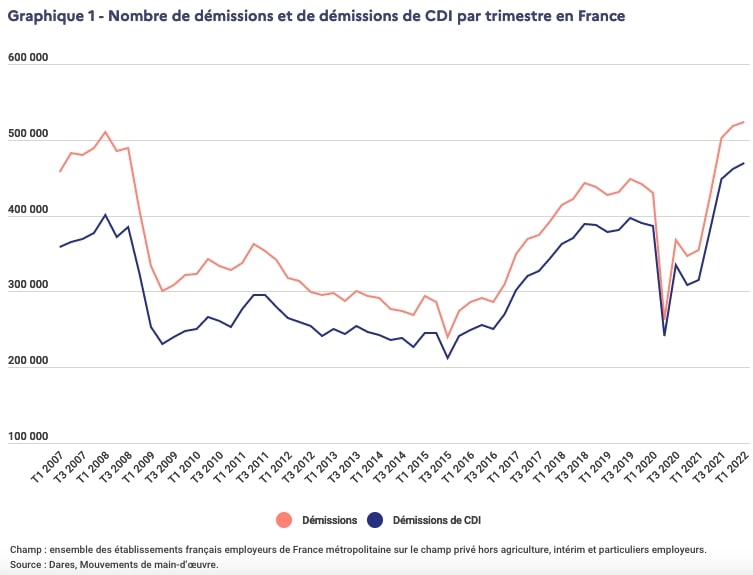
The phenomenon has crossed the Atlantic and the number of resignations has risen sharply.
Another phenomenon that joins minimalism and frugality in these times when overconsumption becomes, for some, an absurdity. The minimalism is defined as being
"intentionally living with the only things you really need.
Remove the distraction of excess possessions and de-clutter so you can focus more on the things that matter most."
FIRE, (financial independence retire early), is a movement that advocates cutting back on spending and saving so that you can retire earlier. It originated in the United States in the 1990s and has gained popularity in recent years.
FIRE adherents strive to reduce their spending and save money so they can retire earlier. They aim to achieve financial independence, which means having enough money to live without working. This allows them to retire earlier than most people and enjoy their free time as they see fit. The FIRE movement was popularized by bloggers and podcasters who shared their stories and tips on how to cut expenses and save for retirement.
The FIRE movement was popularized by bloggers and podcasters sharing their stories and tips on how to cut expenses and save for retirement.
More and more teachers are leaving the profession
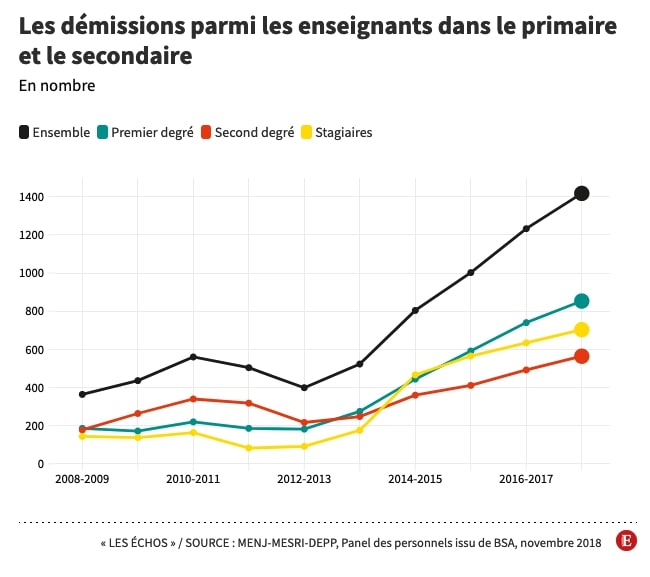
Perhaps there is only a slight connection to the big resignation phenomenon, but at the same time, the number of teachers who are resigning is also steadily increasing. As this chart shows, the number of tenured teachers leaving teaching is up sharply from 2010.
In the various testimonies of people who have resigned, there are:
Burnout:
"I knew this was my last ailment. I was already beginning to find time long and I couldn't see myself finishing my career in National Education, but I still didn't have a solution because I was so deep in depression, which led to a burnout at my last institution where I lasted three years."
"I needed a part time to rest, to recharge my batteries and I got it very hard, every time, it was refused always by the same reason: need for service".
"To that, added the work time and the crazy energy, which I put in preparing my classes and projects. Beyond the academic, there is the work on the social, on how to approach the relationship with others, with certain families in certain neighborhoods. Every year, I had to prove myself again. It wore me out."
"....a very heavy workload. "There are meetings, course preparations, master's exams and the dissertation to be done for
the end of the year. We are asked to do a lot, as soon as we arrive the load is heavy. And the more we want to do well, the more we drown."
"...degradation of working conditions, more students per class, less invested, less attentive"
" I only lasted two weeks at the school. The first, I cried in front of my class. The second, I had to see a doctor "
Submission, docility or conformism and the attitude of some directions:
"Anyway, that's how it is, in the National Education, if you do not fit into the mold, you are not well seen."
"Will come a change of direction, and Sylvie faces the hostility of the new director."
"I had a director two years from retirement who told me one day that my methods were sectarian, so it stopped. Me, I mostly saw that the sectarian side, it was the National Education in fact ..."
"My request for a conventional break (implemented in January 2020, NDLR) was rejected twice. And since I wanted to do an alternation, I had to resign."
Lack of recognition and lack of freedom that disappeared over the years:
"no recognition from the administration and the institution. The only recognition is that of the students, but over time that's not enough and there's also this lack of freedom because it's a system that infantilizes us a lot."
"she is becoming aware of the system that in her opinion, locks up, takes the students for pawns, and only sees them as heads that need to be filled in without taking them as a whole."
"a lack of recognition and a feeling of loneliness in relation to the institution"
" I felt like I was bound hand and foot to a big machine, for which I was just a file number. "
Replacements at the beginning of my career:
"I was bounced from district to district with quite a few different assignments in the Versailles academy. I did all the levels. I was every year, redoing vows, changing towns, changing establishments."
The administrative part:
"We spend an inordinate amount of time in meetings, proposing avenues of work that we are asked to do, so that in the end, nothing is retained, and the programs are prepared without us."
The teacher shortage is due to several factors. First, the decline in the number of applicants for teaching competitions. Indeed, according to figures from the Ministry of National Education, the number of candidates for the teaching entrance exams fell by 11% in 2017 compared to 2016. One reason for this decline is that the increased requirements of the competitive exam have turned off many potential candidates.
In addition, the teacher shortage is also due to the resignation of teachers already on the job. Indeed, according to a study published in 2017 by the Syndicat national des enseignants du second degré (Snes), nearly 60% of secondary school teachers said they wanted to leave teaching within the next five years.
The shortage is exacerbated by retirements: according to CNESER projections, the number of tenured teachers who will leave
teaching each year is expected to reach 15,000 by 2025.
Remedy the teacher shortage
Faced with this growing teacher shortage, the Department of Education has put in place several measures to try to address it.
Among the measures being considered are
the creation of a new teaching entrance exam for candidates from vocational and technological streams,
as well as the implementation of a special scheme to encourage students to turn to the teaching profession.
Despite these measures, the teacher shortage is likely to continue in the coming years.
Ideas for Addressing the Teacher Shortage
Based on the testimonies of those who have left, one might think it would be helpful to:
Building trust: The school world is a rigid world where everyone is watched and/or must watch.
Reduce rules: this is especially true for administrative tasks, which are often perceived as unnecessary. This point is related to the lack of trust, trust from one's hierarchy and the institution. What is the point of many administrative tasks if not to risk being caught out?
Ease the first years in the profession: older teachers are exhausted and young people are tossed from left to right. No doubt, avenues for mutual support could be put in place. For example, mentoring would be an idea to explore (mentoring but with mutual trust, not with repressive aspects). We can also think about it to avoid burn-out cases.
Recognition: The teacher has become a target; if the authorities wish to alleviate the shortage, they must ask themselves how to make the teaching profession a prestigious one again. This will take more than an advertising campaign.
What must be avoided is the conformism that sets in for fear of punishment. This leads to significant demotivation that undermines the quality of activities.
Reducing desire
In addition to resignations, which are the ultimate stage of disengagement, it must also be understood that teachers who do not want to take the risk of loss of income associated with resignation adopt other strategies to protect themselves: involvement in other activities, requested part-time work, sick leave, etc.
It seems that the school has forgotten how to adapt to new contexts and changes in society, both on the side of students and teachers. Making people want to do this job means leaving the space for it to be practiced by those who commit to it.
We know them, we see them in our homes, these schools from elsewhere. Most of them have even been established in our respective countries of origin for a long time, which means that we hardly feel that they are foreign any more. What are they like? What are their assets?
The fragility of social ties is based on illusory socialization, hyperconnection that distances us from ourselves and from others, and the disembodiment of social ties, leading to solitary behavior and a thirst for freedom that can damage the health of young users.
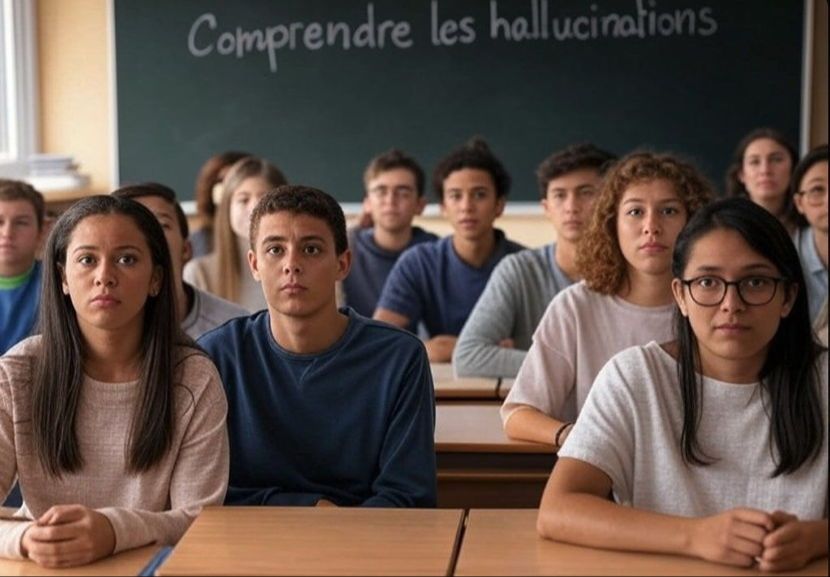
AI can generate erroneous information or "hallucinations", with repercussions in critical sectors such as healthcare, justice and education. To mitigate these risks, we need to improve training data, design accurate prompts and encourage AI self-assessment. Education and responsible use are essential to limit these AI drifts.
All the methods to become a learning territory. Little by little, each one discovers the other and understands that he or she is part of a restorative community, a community capable of building its future without depending on external subsidies.