Education is not, in principle, a competition. The idea is that everyone, from childhood to adulthood, should acquire sufficient knowledge to hold a job and be a functional citizen. However, the competitive spirit easily spreads to the educational environment. Rankings of students, schools, regions, etc. It seems we can't help but want to rank education systems. PISA remains the most widely cited, as it literally compares countries against each other on a range of subjects. It remains a benchmark for many public authorities.
As a result, when a report such as PISA highlights "weaknesses", the battle rages on behind the doors of education ministries. France has not taken kindly to the 2022 report, which showed a decline in levels across the board, particularly in mathematics. So, in the manner of a pupil seeking to improve his or her marks quickly, the focus has shifted to the country at the top of the league table: Singapore.
So it came as no surprise when Prime Minister Gabriel Attal declared in December 2023 that France would follow suit by "copying" the method that seems to be working. The idea is not new in itself. The 2018 report by Cédric Villani and Charles Torossian already advocated adopting this approach from primary school onwards. Except this time, the suggestion has become a directive that will apply from the start of the 2024 school year for kindergarten classes. But what does a Singaporean student do that deserves to be plagiarized?
From concrete to abstract
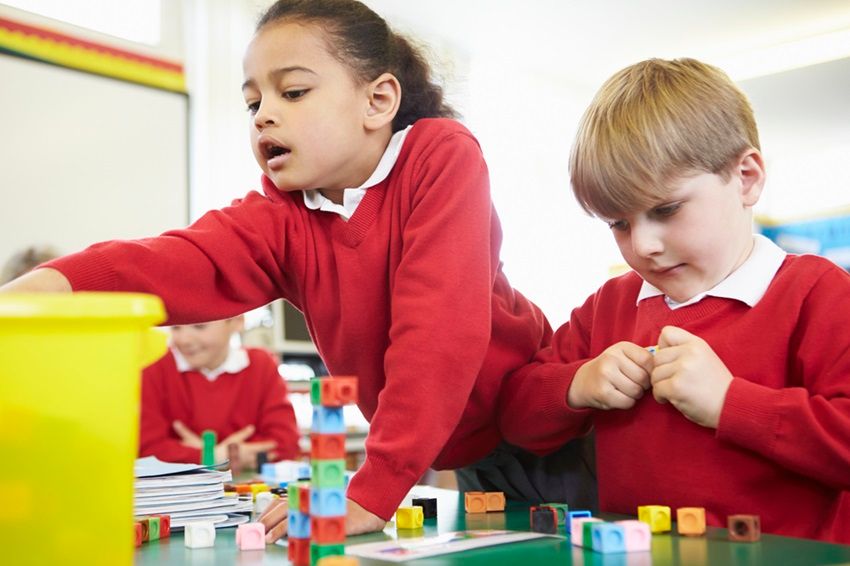
At first glance, mathematics may seem a little abstract to a child. They are presented with vague terms and concepts. Since early childhood, they've usually never heard of fractions, multiplication, division, decimals and so on. The Singapore Method helps students to concretize the precepts at the outset, gradually making them more abstract.
The method begins by using cubes or tokens to represent quantities. Later, the use of physical objects gives way to graphic representations of the same items on the blackboard on sheets of paper. Finally, once these have been mastered, we move on to numbers and mathematical symbols. The Singapore Method is a problem-solving approach in which the child is at the heart of the learning process. So, they go through a stage of manipulation, verbalizing what they see and understand to build a bridge with concepts (metacognition). This involves not only objects, but also drawing, for example, to introduce fractions and better grasp the difference between a half and a third.
In itself, the principle isn't all that revolutionary, and indeed there are already many French classes using it. However, seeing how it works in the City-State, it would be easy to believe that the approach contains within it the key to success, and therefore that it will do the same for France. After all, children there are no different...
A different educational culture
The pupils may be similar, but the systems are very different indeed. That's why some are tempering the government's ambitions to use the Singapore method as a panacea for improving the mathematical performance of young French people. Already, teacher training in this science differs greatly: 400 hours versus 80 in France. There are more teachers than in France, and their classes are smaller. There's also a culture of tutoring within the teaching profession: in 2019, 39% were serving as tutors for their colleagues who were just starting out, compared with 4% among French teachers. Even the selection of education professionals is stricter.
All the more so as this allegedly "miraculous" Eastern approach first came from... the West. Back in the 1960s, the Singapore authorities were concerned about the mathematical skills of their students. So they went looking for what was being done in Europe, America and elsewhere, in order to appropriate certain ideas and create a coherent program that follows a logical progression in mastery of this fundamental science. It's not a bad method for training good mathematical technicians, but not ipso facto mathematicians. Copying a formula that's not so revolutionary in form without taking into account everything that surrounds the rest won't work miracles.
For that, we need to adopt a logical mathematical approach and program, just as Singapore did. It also means embracing approaches that improve teachers' work. For example, Singaporean teachers receive 100 hours of in-service training a year to keep their pedagogy constantly up to date. The adoption of the PISA method in France, on the other hand, seems to be based on small, rapid training courses, keeping teachers in the same context. In the end, this strategy is likely to produce mixed results.
It's easy to copy the best student in the class. This doesn't bring the understanding needed to pass the course.
Photo: monkeybusiness / DepositPhotos
References
Boudjelal, Fériel. "Méthode Singapour: 2 jours de formation proposés aux enseignants de CP et CE1 en juin 2024." VousNousIls. Last updated: March 1, 2024. https://www.vousnousils.fr/2024/02/26/methode-singapour-2-jours-de-formation-proposes-aux-enseignants-de-cp-et-ce1-en-juin-2024-682684.
Brossault, Juliette. "What is the Singapore method, which will be adopted for primary maths?" BFMTV. Last updated: December 5, 2023. https://www.bfmtv.com/societe/education/qu-est-ce-que-la-methode-singapour-qui-va-etre-adoptee-pour-les-maths-en-primaire_AV-202312050889.html.
Cuneo, Louise. "Étude Pisa : les résultats catastrophiques su système éducatif français." Le Point. last updated: December 5, 2023. https://www.lepoint.fr/education/pisa-2022-le-marasme-du-systeme-educatif-francais-05-12-2023-2545746_3584.php.
"The Singapore Method: Je suis fan...." Pierre Carrée. last updated December 6, 2023. https://clairelommeblog.fr/2023/12/06/la-methode-de-singapour-je-suis-fan/.
"The Singapore Method." DIDACTO. Accessed March 30, 2024. https://www.didacto.com/content/47-la-methode-de-singapour.
Lecherbonnier, Sylvie. "Mathématiques : les dessous de la " méthode de Singapour " que Gabriel Attal veut généraliser à l'école primaire." Le Monde.fr. Last updated December 22, 2023. https://www.lemonde.fr/societe/article/2023/12/19/mathematiques-les-dessous-de-la-methode-de-singapour-que-gabriel-attal-veut-generaliser-a-l-ecole-primaire_6206632_3224.html.
Martinage, Xavier. "Mathématiques : la méthode de Singapour peut-elle vraiment relever le niveau des élèves français ?" Capital.fr. Last updated: December 6, 2023. https://www.capital.fr/economie-politique/mathematiques-la-methode-de-singapour-peut-elle-vraiment-relever-le-niveau-des-eleves-francais-1487778.
Mounier, Éric, and Nathalie Sayac. "Maths: is the Singapore method really applicable in France?" Slate.fr. Last updated: December 15, 2023. https://www.slate.fr/story/257805/maths-methode-de-singapour-enseignement-mathematiques-france-pisa.
"Singapore method for math: 'If Singapore succeeds, so can we'." Info.gouv.fr. Last updated March 14, 2024. https://www.gouvernement.fr/actualite/methode-de-singapour-si-singapour-reussit-nous-le-pouvons-aussi.
"Pisa and the 'Singapore' method: the little secrets of its success." L'Express. Last updated: December 6, 2023. https://www.lexpress.fr/societe/education/pisa-et-la-methode-singapour-les-petits-secrets-de-sa-reussite-4HGIWDLWZREUXBV4PZEUJC4I4U/.
"What is the Singapore method, the maths learning method to be adopted in primary schools?" Ouest-France. Ouest-France. Last updated: December 6, 2023. https://www.ouest-france.fr/education/ecole/cest-quoi-la-methode-de-singapour-cet-apprentissage-des-maths-qui-va-etre-adopte-en-primaire-f46c2e8b-82f0-45de-8014-8dfaf34fb55f.
See more articles by this author