According to a UNESCO study, millions of children around the world are dropping out of school. On top of this, the environment is one of the most worrying issues of our time. For this reason, isn't it possible to encourage these children to get involved in the fight to protect the environment?
Children are not excluded from environmental issues
When we talk about the environment, we think first of adults. However, this issue concerns children from an early age, because today's children are tomorrow's adults. It would be illusory to think of a change in attitude towards the planet if it wasn't already part of their daily lives. There are many initiatives around the world to connect children with environmental issues.
One such initiative is the International Letter-writing Competition , which gives children the chance to write letters to encourage action on behalf of the environment. The organizers believe that the children's point of view should be taken into account.
What's more, it's no exaggeration to confront children with environmental issues, as the first years of learning are crucial. It's an intense period of knowledge absorption. On the other hand, it makes sense to determine the right strategy for teaching toddlers using the codes they understand at their age, especially when the target audience is children who are falling behind at school, lacking motivation or living in an atypical context.
Why school dropouts?
The idea of reorienting children who have dropped out of school can be both theorized and implemented. The environmental issue, in addition to theory, requires practical action in the field. When we listen to children who have no interest in a course or subject, it's often because they don't see the direct need to learn it. They want to be right there, in the thick of things. So they skip class. While some still pretend to come and sit in the classroom, others are more radical and give up altogether.
The environmental issue can be brought to the fore in these people's reorientation discourse.
- First, they need to feel that they're on a mission to help the planet, that their contribution is making a difference, because if they buy into it, they'll be bursting with energy.
- Then, finding the right framework to do so, and involving environmentalists, parents and public authorities, would be the way to achieve effective results. Together, they will find the best form and channel for involving these children, especially those who have dropped out of school altogether for one reason or another.
- Thirdly, there's the question of follow-up to enable regular reporting.
- In addition, it is possible to reward those who stand out from the crowd, much as is done in the classroom: this has a positive effect on motivation.
The validity of such a program
As far as this proposal is concerned, it's quite possible that it won't be applicable in certain contexts, where financial resources are particularly limited, because dropping out of school isn't always linked to a problem of motivation. It's also possible that there are economic reasons for dropping out.
We'll have to adapt our actions to the realities on the ground. In any case, it's a program that can be superimposed on others that already exist, such as the Programme Personnalisé de réussite éducative (PPRE), which operates in France.
In the field of education, France tried to take the bull by the horns in the 80s, gradually introducing EEDD (Education for the Environment and Sustainable Development). Today, however, according to Water Family, scientific ecology no longer seems to be a topical issue at school.
In conclusion, the environmental issue as a new orientation for school drop-outs is conceivable, provided that all stakeholders work in synergy. However, the context also needs to be taken into account, because dropping out of school is not just about lack of motivation.
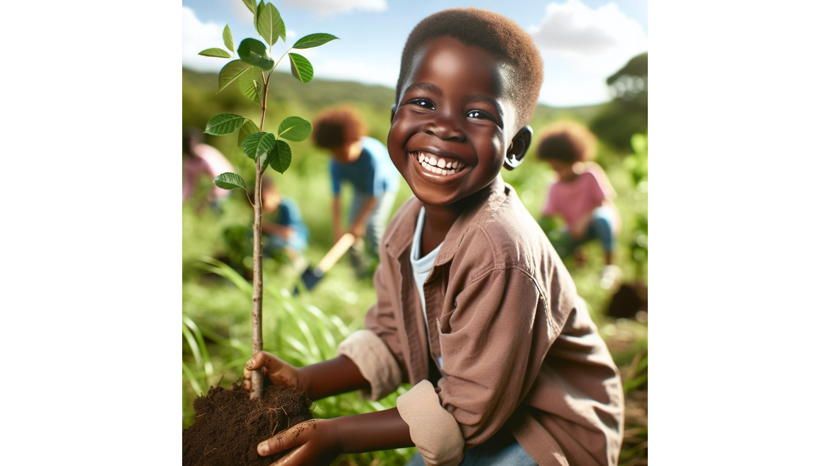
Illustration: AI-generated image - Hermann Labou
Sources
What can a school dropout under 16 do? | Service-Public.fr
https://www.service-public.fr/particuliers/vosdroits/F229
Boys dropping out of school | UNESCO
https://www.unesco.org/fr/gender-equality/education/boys
What you need to know about UNESCO's global report on boys dropping out of school | UNESCO
https://www.unesco.org/fr/articles/ce-quil-faut-savoir-sur-le-rapport-mondial-de-lunesco-sur-le-decrochage-scolaire-des-garcons
Union Postale - International letter-writing competition
https://www.upu.int/fr/union-postale-universelle/promotion-et-campagnes/concours-international-de-compositions-epistolaires-pour-les-jeunes
Children help protect the environment (lecourrier.vn)
https://lecourrier.vn/les-enfants-participent-a-la-protection-de-lenvironnement/1036488.html
Why educate children about ecology? (waterfamily.org)
https://waterfamily.org/pourquoi-eduquer-a-lecologie-des-lenfance/
The secret of children's learning | Cerveau & Psycho (cerveauetpsycho.fr)
https://www.cerveauetpsycho.fr/sd/apprentissage/le-secret-de-l-apprentissage-des-enfants-23601.php
See more articles by this author