The world of education and vocational training inherently generates situations where it is necessary to provide the right energy to increase efficiency; to regain motivation when confidence is flagging, to break out of routine or to find meaning in one's activity.
On the other hand, learning or helping others to learn can lead to excessive and unproductive stress; preparing for an exam, dealing with difficult groups or questioning one's own workings.
Research in psychology, supported by recent advances in neuroscience, is enabling us to imagine ways in which learners, teachers and trainers can better manage these situations.
Excitement, stress and their effect on cognitive performance
Psychologists Robert M. Yerkes and John Dillingham Dodson (1) proposed a link between arousal and efficiency in experiments with mice subjected to electric shocks of varying intensity: the indicator of efficiency was the speed at which they exited a maze. The bell-shaped or inverted-U curve they derived formalizes this relationship to indicate that maximum efficiency was reached when electrical stimulation was of medium level. Without electrical discharge, or if the electric shocks are too violent, the mice take longer to find their way out.
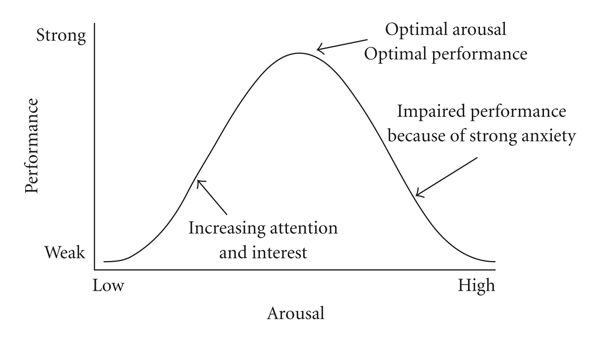
Source - Wikipedia - By Yerkes and Dodson, Hebbian - Diamond DM, et al. (2007). "The Temporal Dynamics Model of Emotional Memory Processing: A Synthesis on the Neurobiological Basis of Stress-Induced Amnesia, Flashbulb and Traumatic Memories, and the Yerkes-Dodson Law". Neural Plasticity: 33. doi:10.1155/2007/60803. PMID 17641736., CC0, https://commons.wikimedia.org/w/index.php?curid=34030428
This 1908 study is echoed in more recent research. In 2007, Sonia .J. Lupien, from the Centre for Studies on Human Stress, McGill University in Montreal, along with other scientific colleagues, published an article entitled "The effects of stress and stress hormones on human cognition: implications for the field of brain and cognition" (2). This publication shows that memory performance in relation to glucocorticoid dose produces a U-shaped curve, similar to the Yerkes and Dodge curve. Long-term memory is thus optimal when glucocorticoid levels are slightly high. It falls when levels are too low or too high.
Exhaustion in the accomplishment of a task comes both from the energy expended if the "step is too high" and from the lack of motivation if it requires no effort at all. A minimum production of adrenalin is necessary to act with less effort, but the pressure must not be too great, or you risk losing your nerve. A pupil or student on the eve of an exam is faced with this dilemma, and can burn out in either case.
"Flow and learning: an optimal state of activation for effortless performance
Csikszentmihalyi's concept of "flow", defined as an optimal state of activation, highlights several indicators of this state, in line with the research of Yekes and Dodson. Mihály Csíkszentmihályi, a Hungarian psychologist, created this concept by studying people who took pleasure in accomplishing their activities (3) (4), developing an intrinsic motivation that generated effortless performance.
The concept of flow has been studied in particular in the context of sport: "We hypothesize that increasing expectations of self-efficacy (and therefore confidence) would enable us to perceive a balance between individual resources and the challenge at hand. According to Singer (2002), one of the ways to gain self-confidence is to apply pre-competitive routines. It is therefore important to study the effects of specific psychological preparation programs aimed at increasing confidence in order to influence the perception of a balance between skills and the challenge to be met." (5).
Thus, the essential elements for the generation of this state in a learning context are of several kinds;
- Challenge and curiosity: the proposed activity must arouse the learner's curiosity, while preserving some element of surprise regarding the outcome. It must also represent a challenge worthy of the learner. Here, we return to the conclusions of Yerkes and Dodge.
- Control: the learner must retain control over his or her choices in carrying out the activity. Activities that are too narrowly defined, with too many options, can demotivate the learner.
- Fantasy: imagination, creativity and freedom are the three watchwords for generating flow. Ludopedagogy, gamification and other fun theory pedagogies are all welcome in learning, if you want to give your learners a flowing experience.
- Feedback: as Stanislas Dehaene, professor at the Collège de France and neuroscientist specializing in cognitive science (6), points out, this is one of the four pillars of learning that are essential for generating intrinsic motivation.
- Self-esteem: a good balance between self-esteem, and therefore self-confidence, and the level of difficulty of the task, enables flow to be triggered.
Neurofeedback: an innovative approach to optimizing stress
Recent advances in neuroscience have also opened up new avenues for optimizing stress. For example, neurofeedback, an exercise offered to military personnel to regulate their stress in high-risk situations, has demonstrated its effectiveness in controlling brain function (7).
Neurofeedback consists in voluntarily controlling the excessive response to stress by producing soothing mental states. Two studies support these conclusions.
A first study in 2019 (8) carried out with Israeli military personnel involved the development of a neurofeedback protocol. This protocol was organized around viewing sessions of a virtual scene from a hospital emergency waiting room. The soldiers were asked to adopt a mental state that would reduce the tensions observed in the virtual scene. The results were promising, showing a reduction in amygdala activity during the neurofeedback protocol. However, they did not lead to large-scale implementation.
A second study (9) carried out in the USA in 2019, on a population of aircraft pilots confronted with stress in a simulator, demonstrated highly conclusive responses to the efficacy of neurofeedback, but uneven responses depending on the individual. Three factors were identified as obstacles to the effectiveness of neurofeedback:
- attention span
- level of motivation,
- body awareness.
"Neurofeedback is all the more effective if the participant is attentive and motivated throughout the training."
In addition, neurofeedback requires subtle sensing of bodily or physiological changes triggered by stress. People with a low level of body awareness therefore have more difficulty controlling their brain's signals. This study has shown that body awareness can be improved through the practice of mindfulness meditation.
Avenues for learners and teachers
The three approaches highlighted here open up avenues for optimizing cognitive efficiency, whether you're a teacher, trainer or learner. They hold promise for regaining control over one's own reactions to learning situations that are demotivating or create excessive stress.
If the aim is to mobilize oneself in the face of uninviting circumstances, the first idea is to set oneself challenges, by increasing the level of complexity, execution time or using unusual means. These techniques are frequently used in musical training: playing scales with gradually increasing tempo, with eyes closed or in reverse order.
The second idea consists in integrating play into learning: it respects both the principles of Flow and what is already known in edutainment or gamification. It's possible to "play at learning" unpleasant notions by creating memo cards, for example, or a personal multimedia dictionary, or even interactive quizzes. The La Digitale website is a goldmine in this respect.
To avoid the illusion of knowledge, and thus refocus on what we think we know, a third idea would be to use Feyman's technique. This technique follows several steps: choose a known concept or model, create a simple explanatory text aimed at a novice, identify the points that lack clarity, correct the production by further simplifying it.
If the aim is to better control excessive stress in a learning situation, this could begin by applying the principles of mental preparation: mindfulness meditation techniques, self-hypnosis or sophrology.
The Conseil Scolaire Francophone de Colombie-Britannique offers a wealth of resources for teachers wishing to develop these practices with their students. Integrating these techniques into a learning environment is sure to improve concentration, attention and motivation, for greater pedagogical effectiveness.
It has also been demonstrated that feedback is a fundamental element in learning: Stanislas Dehaene and Mihály Csíkszentmihályi are eminent promoters of this approach. Developing regular feedback protocols for oneself, as a teacher or for learners, is a promising way of building self-esteem. These protocols can be set up for oneself (self-feedback), for learners or for learners among themselves (peer-to-peer feedback). An article by Jacques Rodet (2004) "La rétroaction, support d'apprentissage?" offers a comprehensive overview of techniques and examples of feedback formulation.
In conclusion, vocational education and training present unique challenges, particularly in terms of motivation and stress management. However, by taking advantage of research in psychology and neuroscience, it is possible to optimize cognitive efficiency and transform these challenges into learning opportunities.
Concepts such as "flow", the balance between arousal and efficiency, and innovative techniques such as neurofeedback, offer promising avenues for both learners and teachers. By adapting challenges to our own abilities, integrating mental preparation techniques and developing regular feedback protocols, we can not only improve our pedagogical effectiveness, but also find meaning and pleasure in learning, even when faced with daunting notions.
The future of education and vocational training undoubtedly lies in a better understanding of our brains and our reactions to stress and demotivation.
References
(1) Yerkes-Dodson's law: the relationship between performance and motivation
https://fr.wikipedia.org/wiki/Loi_de_Yerkes_et_Dodson
(2) The effects of stress and stress hormones on human cognition: Implications for the field of brain and cognition
https://www.researchgate.net/publication/6364338_The_effects_of_stress_and_stress_hormones_on_human_cognition_Implications_for_the_field_of_brain_and_cognition
(3) Flow theory - EduTech Wiki - https://edutechwiki.unige.ch/fr/Th%C3%A9orie_du_flow
(4) Csikszentmihalyi, M. (1990). Flow: The Psychology of Optimal Experience, Harper and Row, New York.
https://amzn.to/4gopPV9
(5) The concept of "flow" or "optimal psychological state": the state of the question as applied to sport
https://shs.cairn.info/revue-staps-2008-1-page-9
(6) Dehaene - The main principles of learning - 2012
https://www.college-de-france.fr/media/stanislas-dehaene/UPL4296315902912348282_Dehaene_GrandsPrincipesDeLApprentissage_CollegeDeFrance2012.pdf
(7) Neurofeedback for stress management. Cairn Info
https://shs.cairn.info/revue-defense-nationale-2023-HS4-page-129
(8) Stress and the brain: individual variability and the inverted-U
https://www.nature.com/articles/nn.4109
(9) Regulation of arousal via online neurofeedback improves human performance in a demanding sensory-motor task - https://www.pnas.org/doi/10.1073/pnas.1817207116
See more articles by this author