Impact of website color on information retrieval
The overall color of a site has an emotional effect on web users, determining their judgments, behavior and performance.
Publish at February 12 2025 Updated February 12 2025


The spectacular advances in generative artificial intelligence over the last few years have been the talk of the town. From language models like GPT-3, capable of producing text of astonishing quality, to image generators like DALL-E or Midjourney, whose graphic creations rival those of human artists have been making the rounds on the web. The creative prowess of AIs continues to push back the boundaries of what was once thought possible. Is this a sign that creativity is no longer the prerogative of human beings? That our machines are on the verge of surpassing us in a domain once thought to be the preserve of human genius?
Beyond the fascination and concern these technologies arouse, we believe it's crucial to take an in-depth look at the issues they raise. Far from being confined to the artistic sphere, the irruption of creative AI into our societies is acting as a veritable revelation, shaking an entire imaginary world of creation and inspiration, which profoundly structures our relationship with the world and with ourselves.
We're witnessing a veritable paradigm shift, and it's up to us to take the full measure of it, so as to better steer its course. In this article, we propose to explore the mutations that generative AI is imparting to the very notion of creativity and imagination, from a resolutely transdisciplinary perspective. We will draw on contributions from the information and communication sciences, psychology and cognitive science, sociology and philosophy, in an attempt to identify what is at stake with the advent of creative AI.
For a long time, creativity has been considered the hallmark of the human being, the ultimate expression of genius and uniqueness. From cave paintings to the great works of literature and art, from scientific discoveries to technical inventions, the ability to imagine and create the new has always been at the heart of the human condition and its proclaimed exceptionalism.(1) But with the recent prowess of content-generating artificial intelligences, capable of producing texts, images or music of confounding quality and originality, this anthropocentric conception of creativity is being profoundly shaken.(2)
Are we to conclude that we are witnessing the emergence of a purely algorithmic form of creativity, governed by computational processes in which we are no longer the center? It's a dizzying question that these generative AI technologies raise, and one that calls for fundamental reflection on the very essence of human imagination and inventiveness. For if creativity is no longer the prerogative of Man, if it can emerge from complex artificial systems, then a whole section of our "anthropological difference" is shaken, calling for a rethink of the contours and deep springs of our creative power in this new technological context.
However, it would be simplistic to think of generative AI as a form of creativity that is purely autonomous and external to humans. For these technologies can also be seen as formidable tools at the service of their users' imagination and inventiveness(3).
The term "augmented imagination" or "AI-assisted creativity" is used to describe the way in which these systems can stimulate, facilitate and multiply human creative processes. Whether by generating variations on an initial idea, suggesting original and unexpected avenues, or enabling the rapid testing and visualization of different hypotheses, generative AIs have the potential to greatly enrich and accelerate our imaginative capacities.
But doesn't this "augmentation" also entail the risk of a certain standardization, or even an impoverishment of creation?(4) This is a legitimate fear when faced with such powerful tools, capable of flooding the creative space with content that is certainly technically impressive, but potentially formatted and without any real added value. By relying too heavily on AI, aren't we in danger of delegating an essential part of creativity to the machine, and losing along the way the singularity of a truly human vision and sensibility?
For it is the creator's subjectivity and intuition, nourished by experience and emotion, that give a work its richness and depth. And no algorithm, however sophisticated, seems capable of reproducing this perfectly... at least for the moment.(5)
By blurring the boundary between human and artificial creativity, generative AIs are also profoundly shaking up our relationship to creation and to the figure of the creator.(6) The whole romantic myth of the solitary genius, of the artist as demiurge expressing in his work the torments and illuminations of his soul, is undermined by these technologies. Because with AI, creation tends to become a more collective, distributed and iterative process, where the individual's contribution merges with that of the machine and other users.
So how can we continue to think in terms of authorship, originality and authenticity? What becomes of auctoriality [relating to an author] in a regime of "AI-assisted creation", where anyone can generate content from the same models pre-trained on masses of data? These are crucial questions raised by creative AIs, and they call for us to reinvent our imagination of the creative act and its tutelary figures. Not necessarily in a logic of rupture or loss, but rather in a dynamic of hybridization and recomposition, where human and machine, author and collective, original and generative combine in unprecedented ways to give birth to new forms of creation.(7)
The advent of generative AIs has ushered in a new era of art and creation, one that, echoing Walter Benjamin, could be described as "algorithmic reproducibility".(8) Indeed, with tools like DALL-E or Midjourney, capable of churning out images of astounding quality from simple text prompts, the unique, non-reproducible nature of the work of art is called into question. What remains of the aura and singularity of a visual creation when thousands of variations can be produced instantaneously by an algorithm?
But beyond this loss of "authenticity", a new relationship to the image and its interpretation is emerging with these technologies. For the creations of generative AIs, however stunning they may be, retain an element of opacity and strangeness, linked to the complexity of the computational processes from which they emerge. Deciphering a Midjourney image means not only analyzing its apparent content, but also trying to trace the intentions of the prompt that generated it, to understand how the model "interpreted" and recombined its training data to produce this result. A new hermeneutics [system of interpretation] of images is thus emerging, somewhere between semiology [system of signs] and reverse engineering, in an attempt to unravel the mysteries of this "artificial imagination".
Faced with the power and opacity of creative AIs, should we fear a form of dehumanization of art, which would become nothing more than the cold product of statistical calculations and optimizations? It's a risk that can't be ruled out, but it seems to us that emotion and empathy will remain, as a last resort, the unsurpassable horizon of truly human creation. For if there is one thing that algorithms cannot simulate (at least for the time being), it is that intimate, vibrant bond that unites a work of art with its viewer, that unspeakable resonance of affects and percepts in the depths of our being.(9) As long as creation retains this power to move and make sense of other subjectivities, it will remain irreducibly human, beyond all the artifices of technology.
But the promises and perils of "artificial creativity" are not limited to the artistic and cultural fields alone. In fact, generative AIs raise broader societal and ethical issues that we need to take into account in order to think clearly about their use and regulation(10).
The first of these issues concerns the biases and stereotypes that these technologies can reproduce, or even amplify.(11) This is because creative AIs simply digest and recombine the data they are given as input, data which themselves reflect the dominant representations and inequalities that run through our societies. What happens when we train a model on a corpus of texts or images that convey, even unconsciously, racist, sexist or discriminatory prejudices? We run the risk of seeing the emergence of a standardized and problematic imaginary, governed by the most hackneyed stereotypes and the most retrograde visions. There is therefore a major democratic stake in ensuring the diversity and inclusivity of the data used to "feed" creative AIs, but also in putting in place ethical safeguards to prevent abuses.
For it is an imaginary world potentially "under influence" that is emerging with these technologies, whose power and opacity can serve problematic instrumentalizations. What would happen if malevolent actors used generative AI to produce deepfakes or massive disinformation campaigns?(12) How can we ensure that "artificial creativity" remains at the service of the general interest and the emancipation of all, rather than the prerogative of the few? There is a real issue of sovereignty and democratic control at stake here, to ensure that the development of these technologies is not to the detriment of our fundamental freedoms and values.
Finally, the advent of creative AI raises crucial questions about the future of work and creation as a human activity. What will become of the creative professions, already weakened by casualization and globalization, in the face of the increasing automation made possible by these tools? How can we value and remunerate creative work at a time when anyone can generate content with just a few clicks? This is a major socio-economic challenge, which calls for an in-depth rethink of how we produce, distribute and promote works of the mind and imagination in the age of AI.(13)
At the end of this reflection, it appears that generative AI acts as a veritable catalyst, revealing and accelerating profound mutations in our relationship to creativity and imagination. By shaking the very foundations of our creative exceptionalism, these technologies are pushing us to redefine the contours and driving forces of human inventiveness, in a dynamic of hybridization and recomposition with the machine. They open the way to new imaginaries and new creative processes, between augmentation and standardization, singularity and reproducibility, auctoriality and interpretation.
But they also call for greater vigilance and reflexivity, to ensure that the development of "artificial creativity" remains at the service of human beings and their fulfillment. This requires ethical and societal reflection on the issues of inclusivity, sovereignty and the valuing of creative work in the age of AI, but also a reaffirmation of what makes human creation unique: its ability to move, to make sense and to resonate at the deepest level of our subjectivities.
It is only through this critical reflexivity and reaffirmed humanism that we will be able to make creative AIs true allies of our imagination and power to act, rather than competitors or threats, so that machine creativity enhances and liberates human creativity, rather than replacing or enslaving it. This is the promising yet demanding horizon that these technologies represent, and which it is up to us to bring about collectively.
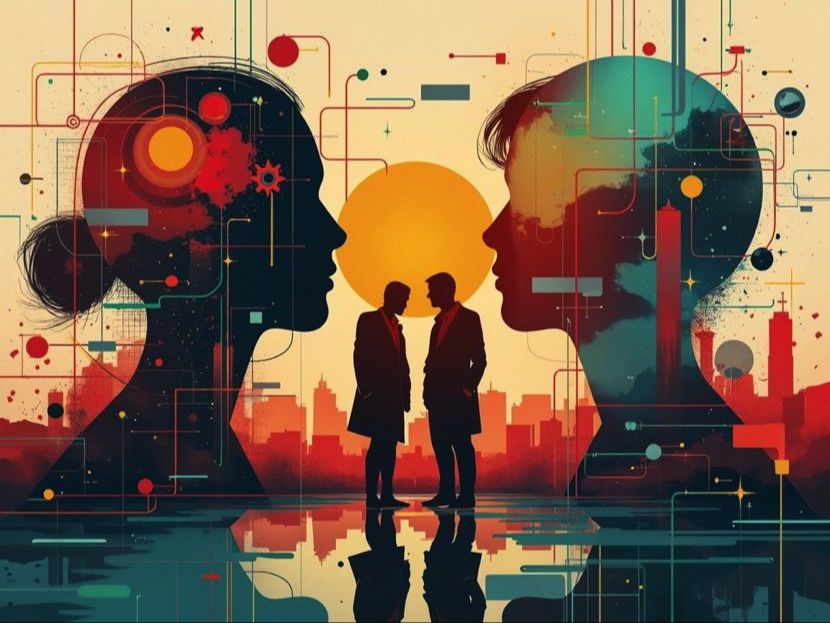
Illustration: AI-generated - Flavien Albarras
References
1-TARSWELL, Emma, 2023. The future of the human being. CIFAR [online]. June 6, 2023. Available at: https: //cifar.ca/fr/cifarnews/2023/06/06/lavenir-de-letre-humain/ [Accessed February 1, 2025].
2-Usbek & Rica - L'AI générative sonnerera-t-elle la fin de la créativité humaine [no date]. [online]. Available at: https: //usbeketrica.com/fr/article/l-ia-generative-sonnera-t-elle-la-fin-de-notre-humanite [Accessed February 1, 2025].
3-Et si l'intelligence artificielle libérérait la créativité, 2023. France Culture [online]. Available at: https: //www.radiofrance.fr/franceculture/podcasts/le-biais-d-aurelie-jean/le-biais-d-aurelie-jean-chronique-du-mardi-07-novembre-2023-1427243 [Accessed February 1, 2025].
4-L'AI et l'avenir de la créativité humaine, 2024. Planeta Formación y Universidades [online]. Available at: https: //www.planetaformacion.com/fr/blog/lia-et-lavenir-de-la-creativite-humaine [Accessed February 1, 2025].
5-Without human creativity, AI would not be, [undated]. [online]. Available at: https: //usbeketrica.com/fr/article/sans-creativite-humaine-l-ia-ne-serait-pas [Accessed February 1, 2025].
You might also like:
Impact of website color on information retrieval
The overall color of a site has an emotional effect on web users, determining their judgments, behavior and performance.
In search of the world's oldest language
What is the oldest language in the world? Is it still spoken today? Is it easy to determine this antiquity? In search of the oldest language in the world, beyond continents and history, awaken the "archaeolinguist" in you!
Where does the long road to success begin?
The road to success may be long, but the satisfaction of making progress is well worth the effort.
No God, no master, no certification!
Slipping into molds turns you into a tart. A critical article on the standardization movement that is currently affecting the training world
Resourcefulness is a quality to cultivate in order to learn, undertake and innovate
Resourcefulness, mètis, jugaad, and DIY speak to us of human aptitudes to bounce back in all circumstances, how to cultivate them? Resourcefulness encourages a pedagogy of action in which we commit ourselves.