It's not all good news, but it does seem thata war on science is being waged in several countries. The United States is the most striking example, with the abolition of the Department of Education and, above all, the appointment of one of the most outspoken critics of vaccines, epidemics and the like as head of the Department of Health. At the time of writing, for example, NBC was reporting that a major transmission of E. Coli in 15 states had taken place without the FDA warning the public, resulting in one death and 88 serious illnesses, including a boy who nearly died of kidney failure.
Repeated attacks by the US government and other jurisdictions suggest that the worst is yet to come in all fields of science. In response, the world of science is mobilizing. Some researchers are going into exile in more open places, such as Canada or France. But how does a society guard against such attacks? By restoring a special place to science, both among the general population and among the very young.
Breaking down initial conceptions
We all start school with a certain experience of the world. Our vision has been shaped by what we have seen, heard and imagined in our environment. Obviously, this approach is fragmentary and imperfect; it serves to fill the need for knowledge while we wait for the school system to provide more consistent pieces. These may change over time with scientific advances, but they remain closer to reality. It's a process over a shorter period of time than that experienced by mankind: phenomena have been associated with the supernatural or with deities, and finally, over time, we've managed to understand and even reproduce them.
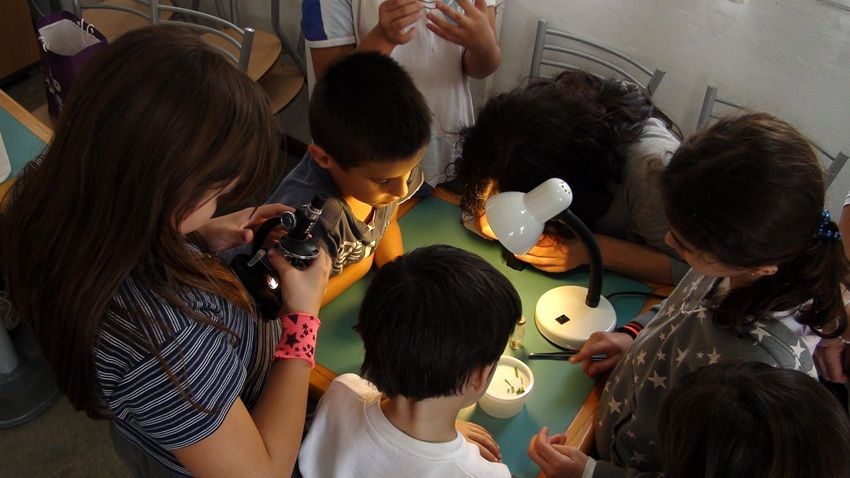
As this dissertation reminds us, science lessons therefore serve to undo, in part, initial conceptions, and she can achieve this above all through experimental investigation. Indeed, the danger of science didactics is to fall into a litany of theories dictated as great truths without the learners being able to see it for themselves. This may partly explain the extreme skepticism of some adults. Being far removed from the scientific process, they end up accepting conspiracy theories and other flights of fancy, without realizing the implications of a flawed scientific process.
This American article proposes a triangular approach to teaching science in education.
- The first point concerns scholarly literacy, using approaches such as narrative to explain a phenomenon, critical debates and the use of images and texts by researchers to better understand the vocabulary used and how science is written.
- Next, courses could look at data with everyday graphs, simulations and virtual labs, and data visualization to understand how research works. What is evidence? What's the difference between correlation, causation and fate? How can specialists and technologies analyze the information gathered?
- Finally, the article suggests experimentation stations so that learners can test different phenomena. It also addresses the whole question of exploration in nature.
Science is everywhere
Many observers note that a large part of the process of revalorization involves contact with nature. Because while some science is done in the laboratory, researchers are not always isolated, far from concrete reality. Most have to go out into different environments, whether natural or human, to test their theories. This contact with natural elements enables them to notice concepts in their school environment or close to home, to imagine hypotheses, to make links with what they already know or what they have learned in class. These are all postures that researchers adopt in the course of their work.
What's more, it can be very interesting to keep physical evidence of the stages of experimentation and reasoning. Mental maps, diagrams, scribbles on scraps of paper - these should all be recorded, at the very least, so that you can see the progress of an experiment, a research project, etc. This gives you the opportunity to grasp in a concrete way the stages of experimentation and reasoning. This gives you a concrete idea of how thinking changes from initial hypothesis to conclusion. It's a job that specialists do too, whatever their field. Analyzing data, noting questions raised and so on are essential elements to inculcate in a classroom.
Some schools, such as the Commission scolaire de Montréal (CSSDM), offer a variety of ways of introducing this philosophy, through travelling workshops, in-school activities, turnkey teaching materials for teachers, etc. Through the repetition of the scientific method, we hope to see the birth of generations who will learn to reason and to distrust absolutes professed with nothing to back them up.
Image: Patricia Lacolla from Pixabay
References:
Acchione, Kristin. "A triangular approach to science instruction." Edutopia. Last updated February 11, 2025.
https://www.edutopia.org/article/getting-elementary-students-engaged-science/.Berardi, Laurie. "Transforming students' initial conceptions of science through an experimental inquiry approach." DUMAS. Last updated 2024.
https://dumas.ccsd.cnrs.fr/dumas-04801603v1/file/BERARDI_m%C3%A9moire_PE_23-24.pdf.Diffenbaugh, Polly. "Sparking student curiosity through nature journaling." Edutopia. last updated November 8, 2024.
https://www.edutopia.org/article/sparking-student-curiosity-through-nature-journaling/.Dubois, Laurent. "Revaluing science at school: experimentation, nature and sensory immersion for transformative education." LinkedIn. Last updated November 2, 2024.
https://www.linkedin.com/pulse/revaloriser-les-sciences-%C3%A0-l%C3%A9cole-exp%C3%A9rimentation-nature-dubois-oicte/.Khimm, Suzy. "A deadly E. Coli outbreak hit 15 states, but the FDA chose not to publicize it." NBC News. last updated April 18, 2025.
https://www.nbcnews.com/news/us-news/ecoli-bacteria-lettuce-outbreak-rcna200236."Elementary science and technology at CSSDM." Cybersavoir. Last updated February 10, 2025.
https://cybersavoir.cssdm.gouv.qc.ca/stprimaire/."Making student thinking visible in high school science." Activate Learning. Last updated: April 18, 2024.
https://activatelearning.com/making-student-thinking-visible-in-high-school-science-education
See more articles by this author