Social disadvantage and the educational pathways of individuals
Far from "equalizing" opportunities, education can be a powerful engine of social selection.
Publish at November 05 2025 Updated November 05 2025


Until now, intelligence has been measured by a mixture of information processing capacity (reasoning, deduction, ordering, prediction, decoding, comprehension, calculation, estimation, etc.) and knowledge (working memory, visual memory, musical memory, etc.).
For over a century, numerous IQ tests have been devised to measure this, each with their limitations, and these tests have always generated a certain amount of dissatisfaction: seemingly balanced, pleasant, well-integrated, high-achieving people were undervalued, and others, almost unattractive, were sometimes classified as super-intelligent when, obviously, there were important things they didn't understand. Measuring our way of relating to the world is not just a matter of processing the data measured by tests.
That's why we've begun to consider different types of intelligence: Gartner has defined nine:
And Spearman six:
Not to mention those that popular culture has adopted, such as Daniel Goleman's emotional intelligence, and others that can be integrated into the blur of various stated intelligences.
In addition to processing capacity and memory capacity, the other essential condition of intelligence is the capacity for discernment (in technical language: resolution), the ability to discern details, at the basis of our categorization and classification faculties.
Discernment is both a technical ability (a short-sighted person can see little from a certain distance) and a processing and memory ability (an ignorant person recognizes only what he knows; he sees the engine, but cannot see the alternator or crankshaft; they are just blurred protuberances). A blind person will have to establish his understanding from other channels of perception.
Measured intelligence is directly affected by the ability to discern, as it is impossible to process blurred or absent information. There is only one relationship we can make with what we don't know: that of recognizing that we don't know.
Some people have a very limited perception of the importance of social relationships, others of the importance of diet to their health. This kind of occlusion can be found in almost every person, such as "I'm rubbish at math" or "languages don't appeal to me", etc... Through various mechanisms of selection or blindness, we are able to limit our capacity for discernment and, as a result, appear stupid in this field, not through a lack of capacity but through a filtering in what is processed. Hence the weakness of tests, incapable of measuring this kind of bias.
A human being is not defined solely by his or her intelligence: a less intelligent human being is no less human than a highly intelligent one. Supposedly intelligent beings have turned out to be tyrants, and debonair kings have turned out to be poles of balance and prosperity for their people, because they knew how to surround themselves well. So, when it comes to defining intelligence, we can do so without fear of affecting our human essence. Even if artificial intelligence displeases our vanity, we can define how it is superior to us, and where its limits lie in relation to our humanity.
The basic formula for intelligence is as follows:
Effective intelligence = processing capacity x mnemonic capacity x perceptual channels x resolution
Any one of these elements affects the result: a high processing capacity enables us to rapidly process a large quantity of accumulated information (experience - memory) compared with a large quantity of information actively perceived by different channels, with great precision. All this can be completely handicapped by the presence of biases and filters in each of the terms: processing, memory access, perception channels and resolution.
We've all experienced the limits of our brain's processing capacity, overwhelmed by too much information, the limits of our ability to remember essential information, or the strength of our intuitions when we can't clearly state a conclusion. We also know the effect of wearing glasses or using binoculars to acquire more information with better resolution, the effect of listening to a heartbeat through a stethoscope or simply touching, smelling or tasting to acquire information that will be immediately compared with what we know and recorded for possible future use...
Defined in this way, artificial intelligence is superior to our own:
It sees what we see, such as 50 years of X-rays or satellite photographs, 200 traffic cameras simultaneously, 100 million Instagram accounts, etc., but its higher resolution and memory enable it to make connections that are inaccessible to us.
However, it is incapable of reconciling more than three or four intentions simultaneously, such as attracting clicks, making money, preserving the environment and ensuring our collective happiness. We're not so much able to do it better, but we're sensitive to it and try to respond through communication and negotiation. We feel the effects of our decisions and communicate them. Through our mediation, the A.I. can then "become aware of it" and integrate it into its treatments.
In this measure of our sensitivity, the A.I. becomes an extension of our humanity, provided its "perceptions" are not selectively hindered or blocked. What measures our humanity is as much our sensitivity as our intelligence, and the same criteria can be applied to A.I.
Objectively, A.I. deals only with 0's and 1's. A human, a horse, an automobile, an ocean are reduced to categories and sets of 0's and 1's, which are as characteristic as proteins or ocean currents. The whole game of intelligence consists in finding similarities, differences and identities between the sources of information (perceptions) and those of memory (experience, classifications, importances, qualities), and from there deducing priorities and conclusions corresponding to the intentions and context of application.
The human being remains responsible for programming intentions. What even an A.I. should be able to understand: it doesn't feel anything, it needs us to make sense of it.
An A.I.'s intelligence is ultimately determined by its sensitivity to the effects it generates, a sensitivity that we, as humans and as living beings, can provide.
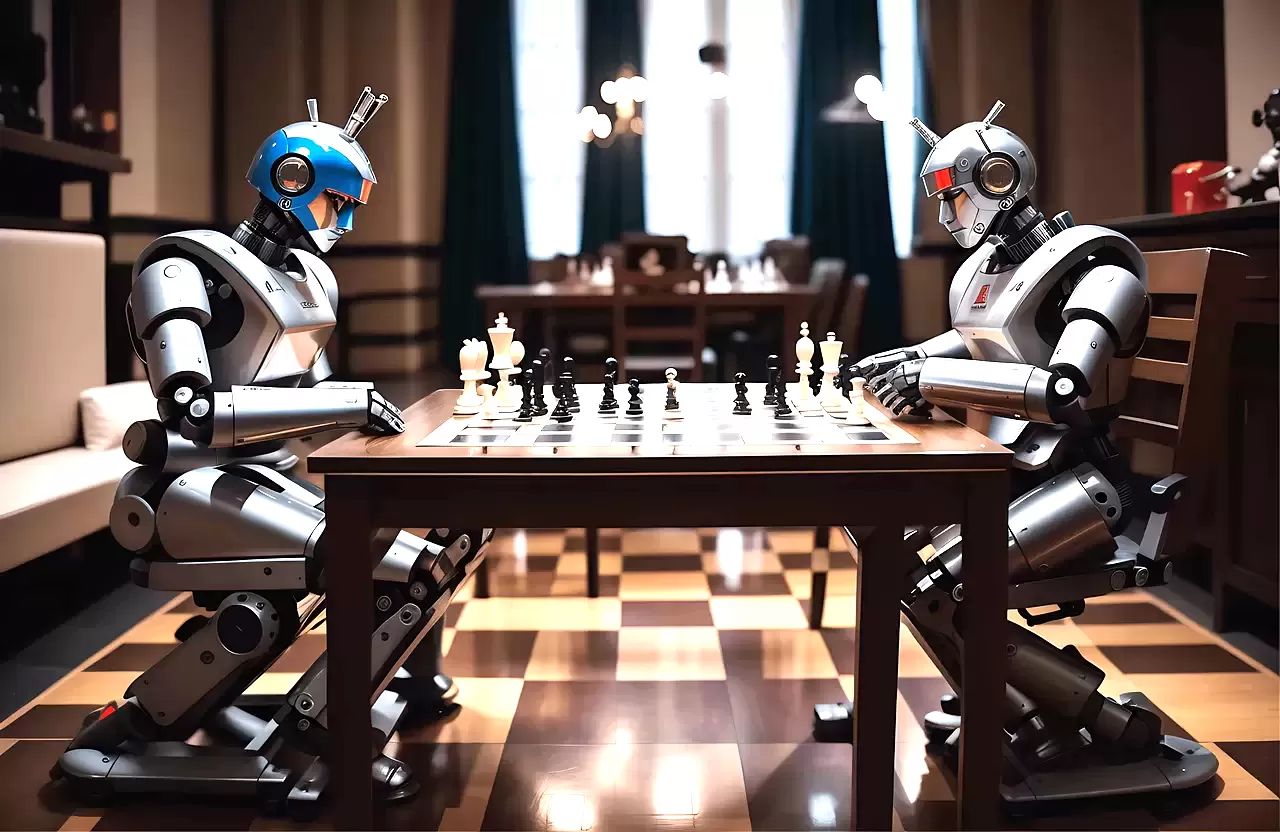
Illustration: Wilfried Pohnke - Pixabay
References
Measures of intelligence - Introductory Psychology at Washington State University (WSU)
https://opentext-wsu-edu.translate.goog/psych105/chapter/7-6-measures-of-intelligence/?_x_tr_sl=en&_x_tr_tl=fr&_x_tr_hl=fr&_x_tr_pto=rq
Theory of multiple intelligences - https://fr.wikipedia.org/wiki/Th%C3%A9orie_des_intelligences_multiples
Charles Spearman - https://fr.wikipedia.org/wiki/Charles_Spearman
g-factor - https://fr.wikipedia.org/wiki/Facteur_g
Emotional intelligence - https://fr.wikipedia.org/wiki/Intelligence_%C3%A9motionnelle
Daniel Goleman - https://www.danielgoleman.info/
Emotional intelligence - Daniel Goleman - https://www.leslibraires.ca/livres/intelligence-emotionnelle-l-daniel-goleman-9782221082843.html?a=1302
Intelligence tests - Google - https://www.google.com/search?num=20&q=tests+d%27intelligence
You might also like:
Social disadvantage and the educational pathways of individuals
Far from "equalizing" opportunities, education can be a powerful engine of social selection.
The distorting mirror: when structure prefers narrative to reality
Behind the rhetoric of benevolence, some institutions sacrifice their best people to preserve a certain internal comfort. Girard, Freyd and Dejours shed light on this mechanism: the scapegoat is chosen, the slander validated, the competence denied. The real institutional manipulator is not the one who lies, but the one who chooses to believe it.
Reform of training and the nursing profession in France
Nursing training and the nursing profession in France are being reinvented, with university education, nursing science and digital health all on the agenda. An ambitious reform to shape the nurse of tomorrow, a reflective professional with a developed critical and scientific mind, well-versed in new technologies and a key player in a fast-changing healthcare system.
Theoretical versus applied training
Applied or theoretical training may seem equally valid on paper, but they stem from 2 different types of practice, which will create different types of professional. The voice from the middle is perhaps a solution.
Staying in a Toxic Relationship: When Suffering Becomes Part of Who You Are
Staying in a toxic relationship isn't a sign of weakness but rather the result of three deep-seated mechanisms. Understanding these mechanisms isn't enough to make you leave, but it's often the first step on a journey that takes time.