
Internet connection: schools in the midst of a paradox
Of the 6 million schools worldwide, almost half have no Internet access!
Publish at December 10 2025 Updated December 10 2025


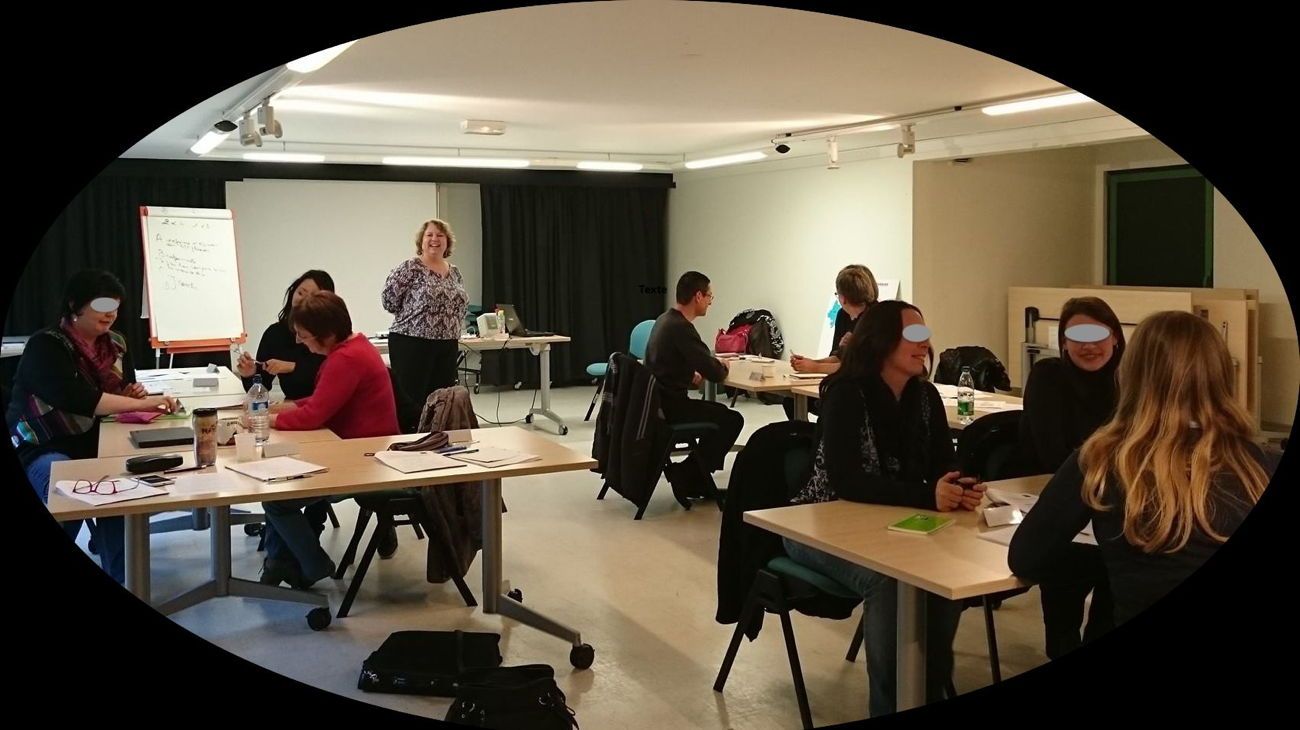
The importance of physical contact and proximity between human beings is very often neglected in our contemporary social organizations. Physical contact and proximity can even be seen as a nuisance or even a danger to be protected from! We saw this most starkly during the COVID period, which brought with it an explosion in mental suffering and feelings of loneliness, without, strangely enough, the link always being made with the physical isolation imposed on individuals.
The digital craze accentuates the tendency to distance ourselves physically from one another. Some even imagine that a life totally separated physically from others is possible.
In the field of training in particular, people believe they can replace all types of training with e-learning. We're even going so far as to offer online training in caring for grandchildren or the elderly, training for trainers, mediation training... all of which are essentially based on human contact.
Physical proximity enables a kind of human relationship that is impossible through a screen. The question here is whether learning is really fully effective in contexts where this kind of relationship cannot be established - in other words, distance learning.
In the Hall pioneered the notion of proxemics in the 60s, in other words, the effects of physical distance on relationships between human beings. In his words, "distance creates relationship". The further away we are from someone, the less easy it is to get to know and understand each other, and therefore to communicate.
Exploring the effects of proxemics on relationships sheds light on the possibility and impossibility of mutual understanding, depending on the physical distance between individuals. Four types of distance (measured in centimetres and then in metres, the first two varying slightly according to culture and personality) have been identified:
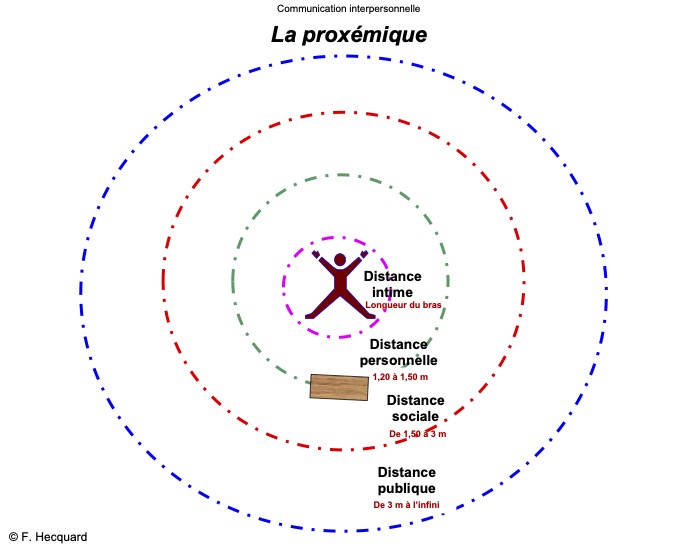
Intimate distance is reserved for close friends and family, and therefore does not apply to training, except in a few very specific situations requiring physical proximity (e.g. one-to-one tutoring in the context of computer training in front of a screen). In personal distance, we get to know each other and exchange ideas between peers. In social distance, each person represents a function (e.g. trainer or teacher and trainees) and communicates via formalized processes. In public distance, each person exists in parallel with the other, without necessarily interacting.
Distant is the greatest possible distance (i.e., public distance) because, from the brain's point of view, people behind a screen or telephone are considered to be at a very great distance from oneself. In other words, it's virtually impossible to create a close relationship allowing for more personal exchanges when we talk via a screen, unless we already know each other.
Some studies show that purely digital learning is more easily forgotten, because it lacks the emotional aspect to engrave it permanently in the memory. In fact, it's the same part of our brain that manages memory and emotions.
Any seasoned trainer knows that he or she must propose teaching sequences involving emotions (e.g. surprise, joy, doubt and even anger, which leads to debate), if he or she wants the content shared to leave traces in trainees' memories. If all the content transmitted is the same, with no emphasis on some rather than others, if the course of the session doesn't offer more or less intense moments, if the exchanges don't give rise to debate and few questions, there's a good chance that the training itself will be quickly forgotten.
Close human interaction generates emotional, and sometimes even affective, reactions that require solid communication and group dynamics skills on the part of the trainer. However, it is these emotional reactions that guarantee the memorization of content.
In remote training, with everyone well protected behind the screen, the emotions experienced are more tenuous, and group dynamics more difficult to implement. If the training does not include any exchange of ideas, and takes place solely via a platform offering pre-constructed digital content, the emotional dimension is non-existent, and memorization is more difficult and more temporary.
Studies have explored the deleterious effects of too much video on the individual. The brain has difficulty maintaining concentration, the eyes tire, the voice is often forced as if on the telephone to try to cover the great distance perceived by the brain, the body is frozen in a fixed sitting position that progressively blocks the proper functioning of the breath and blood circulation. In short, you become exhausted.
In face-to-face training, you take breaks, you move around, your gaze isn't fixed because there's so much to see (the trainer, the presentation, the other trainees, the room, even the view from the other side of the window, etc.). Attention is not required at all times, and you can leave yourself free to focus on more varied activities (listening, but also writing, reflecting, intervening, practicing, talking with others in sub-groups...), activities that are far from being available in all distance learning courses.
Neuroscience and the study of human physiology show that the production of certain hormones triggered by touch is essential to physical and mental well-being. As touch requires intimate distance, it does not fall within the scope of initial or professional training, unless the skills to be acquired imply it.
Nevertheless, in the face-to-face environment, we sometimes greet each other by touching cheeks or hands, we sit close to each other, we easily brush against each other as we pass a document or pencil, and these contacts, however discreet and subtle, add to each other's comfort and well-being.
When it comes to public speaking or live performance, "presence" refers to the ability to attract and regulate attention through a solid body posture and intelligible, audible vocal expression. Presence also simply means being fully present, reacting to others' requests, looking at each other, paying attention and listening.
All trainers know that they need to work on their presence if they are to keep the attention of their groups of learners, but also to arouse their interest and buy-in. For trainees, when the learning process is a little laborious, when you're wondering about your ability to grasp the content transmitted, the presence of others is supportive, their questions and their glances are helpful. But what about the presence of others through a screen? Isn't it considerably limited?
E-learning affects many dimensions of human communication.
Remote training also removes the need for collective breaks, when people get to know each other better and talk about more personal matters. These breaks make a major contribution to the cohesion and understanding of the training group. Can we really do without these moments of conviviality when we're trying to create an atmosphere that's completely conducive to learning (safe, benevolent, respectful)? Will learners remember with the same clarity and emotion what they have experienced via e-learning platforms and webinars? Is it not also hypocritical (or unconscionable) to believe that certain skills involving human interaction and bodily engagement can be imparted using only digital modalities?
There is no single, clear-cut answer to the questions posed here. Since the COVID period, digital learning platforms have proliferated, and new habits have taken hold, aimed in particular at limiting costs by cutting down on travel and optimizing the time spent on training. What remains to be seen is the long-term effectiveness of these new skills development methods.
Resources
Bois, Chantal. La présence, élément participant à la création de l'alliance pédagogique. OpenEdition Journals, 2023.
https://journals.openedition.org/dms/9176#tocto1n3
Boizumault, Magali. La relation pédagogique sous le prisme des communications non verbales : construire sa présence corporelle en classe. OpenEdition Journals, 2022. https://journals.openedition.org/rechercheseducations/13072
Fernande Fernande. The power of touch: how it influences our emotions and relationships. Nouup, March 2025.
https://nouup.fr/le-pouvoir-du-toucher-comment-il-influence-nos-emotions-et-nos-relations/
Hall, Edward T. The hidden dimension. Points Essais, 2014.
Issaadi, Sofiane, Jaillet, Alain. Learning proxemics. OpenEdition Journals, February 2017.
https://journals.openedition.org/edso/1960
Lamontagne, Denys. Zoom fatigue and virtual meetings: management mode. Thot Cursus, April 2023.
https://cursus.edu/fr/27591/zoom-fatigue-et-reunions-virtuelles-mode-de-gestion
Paquelin, Didier. Distance: questions of proximity. Cairn Info, May 2012.
https://shs.cairn.info/revue-distances-et-savoirs-2011-4-page-565?lang=fr
Peraya, Daniel, Paquelin, Didier. Between society and training institutions: the meanings of presence. Innovation pédagogique, October 2023.
https://www.innovation-pedagogique.fr/article16295.html
Quai des savoirs. What's the right distance to meet? Sciences en Occitanie, December 2020.
https://www.sciences-en-occitanie.fr/articles/quelle-est-la-bonne-distance-pour-se-rencontrer
Roberge, Alexandre. Distance and presence, evolving notions in distance learning. Thot Cursus, January 2016.
https://cursus.edu/fr/10527/distance-et-presence-des-notions-en-evolution-en-formation-a-distance
Roberge, Alexandre. Creating empathy at a distance. Thot Cursus, June 2021. https://cursus.edu/fr/22771/creer-de-lempathie-a-distance
You might also like:
Internet connection: schools in the midst of a paradox
Of the 6 million schools worldwide, almost half have no Internet access!
The right to school: rights go hand in hand with duties
We are immersed in the law on a daily basis, but many rules are acquired by reflex or imitation, without any knowledge of their social, legal or conventional basis. At school, we can take advantage of courses or discussions during which rights and duties are put into perspective.
Businesses that are connected to themselves and not just divided into functions. The study of systems from the metaphor of nature implies understanding the interactions between the elements that make up a natural system. In a methodical way, here is how it is possible to proceed...
Research and development and pedagogical innovation
It is ideologies and beliefs that produce ruptures in the ways of learning and teaching
Thinking together is not about collecting ideas or extracting the best one. Thinking together is the fruit of a confrontation, a spark that springs up like that of flints being rubbed together. To want to avoid confrontation is to deprive oneself of the fruits of cross-fertilization.