The Spine Race is often described as one of Europe's toughest ultra-marathons.
- In 2019, in Wales, it was won by British runner Jasmin Paris, who completed her 430 km in 83h12m, becoming the first woman in history to win the event.
- In 2023, American Camille Herron broke the 48-hour world record, including men, with 435 kilometers covered (2).
"On September 17, 2019, breast cancer survivor Sarah Thomas became the first person to swim the English Channel four times in a row. A 54-hour performance!"(3)
The bias of scientific research
Strength, power and explosiveness often remain male-dominated domains in sport. But as soon as we venture into the realms of extreme endurance, precision or resilience, the hierarchy changes.
High-level sport has long been designed by and for men, relegating the female body to a "reduced" version of the male model. While scientific studies on women's sport remain in the minority, a biological reality is emerging: while explosive strength is the prerogative of men, extreme endurance and metabolic adaptability are the real superpowers of women.
In 2021, only 6% of sports medicine studies will focus on women (4). Historically, training protocols have ignored women's hormonal and metabolic specificities for lack of sufficient data. Applying methods based on male muscle hypertrophy to women is a physiological mistake. Without a detailed understanding of the energy cycle and utilization, we limit the potential of female athletes and increase the risk of injury.
These specificities are well known. Guillaume Millet, a researcher at the Laboratoire Interuniversitaire de Biologie de la Motricité (LIBM) at the University of Saint-Etienne, who specializes in these issues, suggests that the female metabolism could make more efficient use of fat as an energy source. He and his teams have also directly tested the hypothesis that women are more resistant to fatigue and muscle damage.
Without knowing exactly why, it's possible that women's muscle fibres are more resistant," explains the researcher. A second explanation could lie in the fact that muscle fibers specialized for long-duration efforts, and which tire little, occupy more space in women than in men, compared to so-called fast fibers, solicited during sprinting, for example." (5)
Fat metabolism in women gives them superior endurance
A team of American researchers (Oleg Varlamov, Cynthia L.Betea, Charles T. Robert Junior) has shown that men and women do not consume energy in the same way, mainly due to their hormones (estrogen in women, testosterone in men) and genetics (6).
Women are naturally programmed to store fat more easily (under the skin, particularly on the hips and thighs) to meet the energy needs of pregnancy and breastfeeding.
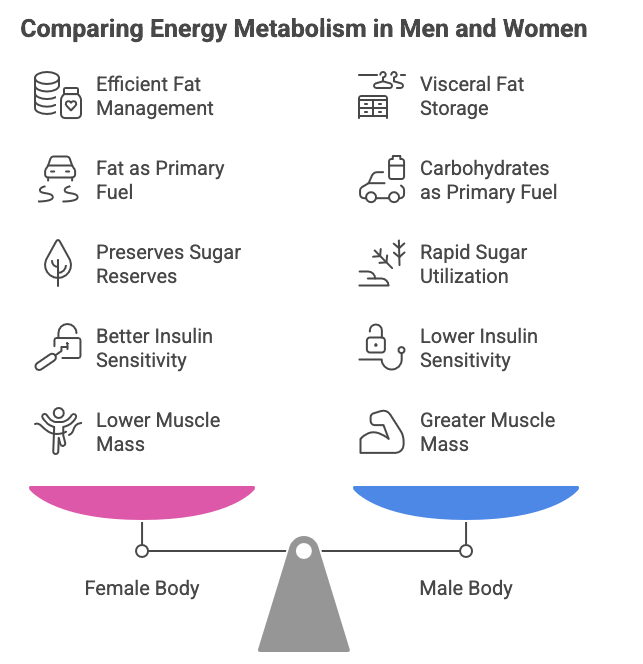
They use fat more efficiently as a fuel and preserve their sugar reserves (glycogen) for longer. Men, on the other hand, tend to store fat around the belly (visceral fat) and use carbohydrates (sugars) more during intense physical effort.
The female body is optimized for efficient fat management and insulin sensitivity, while the male body is more focused on rapid sugar utilization, with greater muscle mass.
Thanks to their greater capacity to oxidize lipids, women are often more resistant to fatigue on very long events (ultra-trail, long distances), as they deplete their glycogen reserves more slowly than men. As insulin sensitivity is generally better in women, their bodies process nutrients more efficiently after exercise, which can influence the speed of muscle recovery.
Female plasticity: a definite advantage for better adaptation
The female body is biologically designed to survive and adjust to intense physiological stress (pregnancy, fasting, hormonal variations).
Three types of physical flexibility are usually distinguished:
- functional flexibility, which enables dancers to do a splitstep,
- muscular flexibility, which enables them to withstand high-intensity efforts, and
- joint flexibility.
In women, the latter is more important than in men.
Joint suppleness, enhanced by the presence of oestrogen, favours both performance and recovery in women," says Miho Tanaka, a specialist in sports medicine.
However, this elasticity can increase the risk of injury, particularly to the joints: an issue made all the more sensitive by the fact that women's specific medical care is still rare. At the same time, female adipose tissue stands out for its ability to store or release energy, offering a valuable reserve in the event of increased metabolic needs, such as during extreme exertion or weight fluctuations."
For a paradigm of sports training differentiated between men and women
Women's strength lies in their ability to adapt to energy-intensive challenges and, ultimately, in their more dynamic resilience. Women are not "less strong" men, but athletes with a different motor, optimized for duration and survival.
This research opens up exciting avenues for a "tailor-made" approach to female performance that exploits their superiority in energy management and resilience. Specific training methods could then be developed to improve efficiency (8).
Illustration:Shutterstock_2546383197
References
1 Jasmin Paris- Wilipedia- https://fr.wikipedia.org/wiki/Jasmin_Paris
2 Courtney Dauwalter, Camille Herron, Tara Dower - September 3, 2025- U-Trail- https://www2.u-trail.com/courtney-dauwalter-camille-herron-et-maintenant-tara-dower/
3 Breast cancer survivor, an American woman swims the English Channel four times without stopping- Sciences et Avenir- September 17, 2019- https://www.sciencesetavenir.fr/sante/cancer/une-americaine-traverse-quatre-fois-la-manche-a-la-nage-sans-s-arreter_137327
4 "Invisible Sportswomen: The Sex Data Gap in Sport and Exercise Science Research" - Human Kinetics Journal- September 21, 2021 https://journals.humankinetics.com/view/journals/wspaj/29/2/article-p146.xml
5 ARE WOMEN MORE ENDURING THAN MEN? CDOS Loiret - January 2026- https://sportloiret.fr/2026/01/26/les-femmes-seraient-elles-plus-endurantes-que-les-hommes/
6 Sex-specific differences in lipid and glucose metabolism - Oleg Varlamov and others Oregon National Primate Research Center, Beaverton, OR, USA- January 2015 - FrontiersIn https://www.frontiersin.org/journals/endocrinology/articles/10.3389/fendo.2014.00241/full
7 Women were thought to have less stamina than men... science proves the opposite! - Passeport Santé - January 2026- https://www.passeportsante.net/magazine/sport?doc=endurance-feminine-femmes-revelent-force-resistance-longtemps-insoupconnees#souplesse-du-corps-feminin-et-adaptabilite-tissulaire
8 Filles agiles et garçons fragiles - Thot Cursus- September 2022- Sandra Minobe- https://cursus.edu/fr/25054/filles-agiles-et-garcons-fragiles-these