Germany and Denmark are separated by a strait of just 20 km, but getting from one country to the other by land involves a 160 km detour. Of course, a ferry can cross the strait in 45 minutes, but all heavy goods and rail transport has to make the detour, not to mention the fact that the ferries are used to their maximum capacity.
As the Strait is not very deep, it was felt that a submerged tunnel would be the better solution than an excavated tunnel, like the one under the English Channel between France and England, which would cost much more, or a bridge, which would have pushed the technology to its limits, and with a much higher risk due to the depth and length of the Strait and the intense maritime traffic.
How to build 18 km of submerged tunnel
A submerged tunnel is simply laid on the seabed. The technology is very different and the expertise much rarer than for excavated tunnels.
The parameters of the project were quite clear: 18 km in length, double rail tracks, two double road tracks and exemplary safety requirements. The solutions chosen were both innovative in terms of engineering and organization, and offered the best guarantees of success.
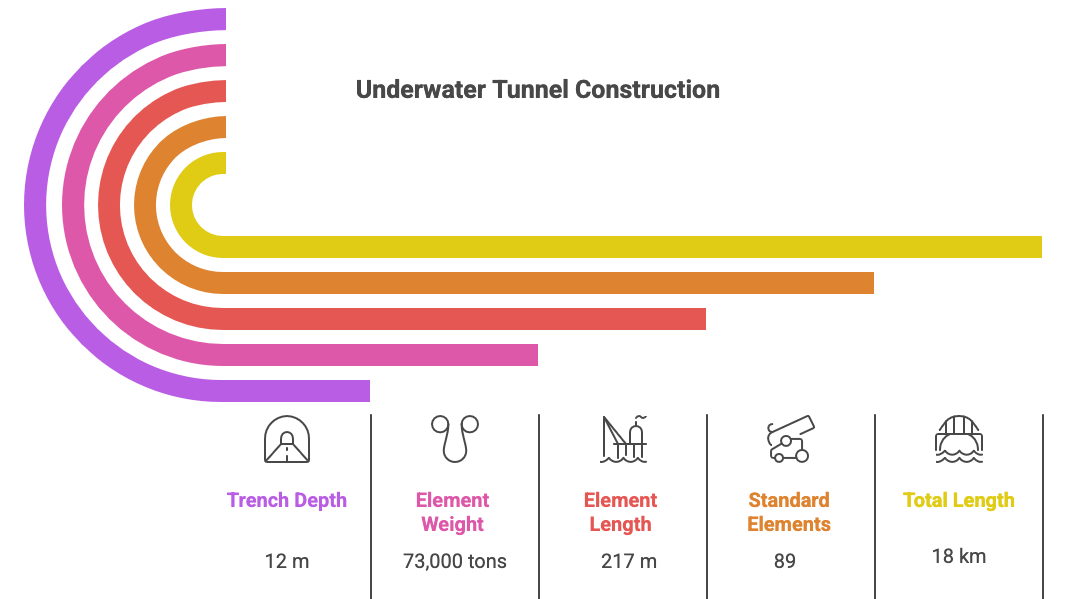
By dividing the 18-km course into 200-metre blocks, which seemed a manageable size, the engineers were able to define the dimensions of the standard elements, i.e. 89 elements 217 metres long, 10 metres high and around 30 to 35 metres wide depending on the section, for a total of 19.3 km including accesses.
The materials used, essentially steel and concrete, mean that each section weighs "no more" than 73,000 tonnes, even though they are mainly made up of voids: 2 tubes for the train, two tubes for road traffic and one tube for maintenance.
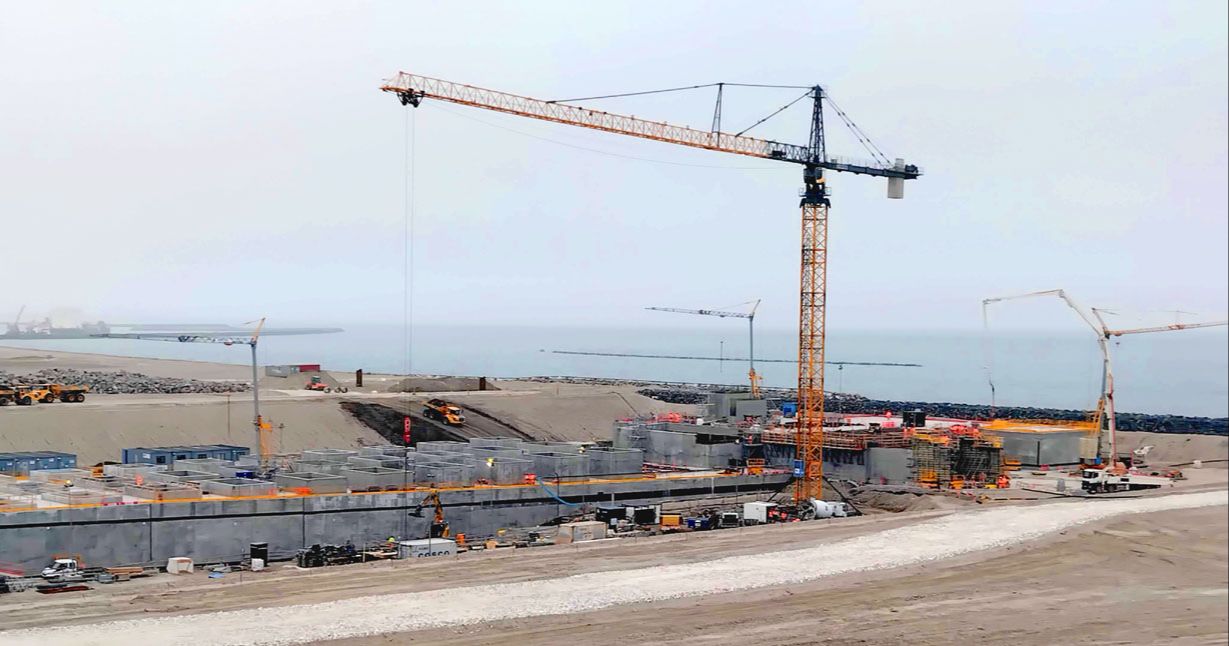
The solution for transporting the 73,000-tonne, 217-metre-long blocks was obvious: float them and tow them to the place where they could be submerged. So, to build them, the site was set up on the water's edge, like a shipyard with dry docks that can be filled and emptied as required.
What about the environment?
To bury the 10-metre-high sections, it is necessary to dig a trench at least 12 metres deep, both to create a relatively smooth bed and cover it with gravel to accommodate the modules, and to provide an additional thickness to cover the tunnel flush with the seabed.
Digging such a trench over 18 km generates over 20 million cubic metres of rocky and sandy debris. To give an idea of the volume, this represents around 8,000 Olympic-sized swimming pools. Since spreading this debris on the seabed was out of the question, the builders used it to create beaches and land near the dredging zones.
Unusual depth
The depth of the strait is close to 35 metres in many places, with a further 12 metres to dig. This represents an unusual challenge, and there are few dredgers capable of operating at such depths. Specialized dredgers were therefore called in, as only a few ports in the world need to dredge to such depths, most of them guaranteeing depths of 16 meters, a far cry from 35 meters.
At the end
Once built, the tunnel components are towed in, submerged and assembled one after the other to a precision of just a few millimeters. Then the ballast tanks are emptied of their water and the pressure permanently glues the sections together. Finally, the tunnel is covered with rocks and sand to blend in with the seabed.
Construction of the tunnel by Ramboll began in 2021, but was preceded by 14 years of planning, discussions, legal battles and legal, financial, political and administrative considerations.
By 2026, dredging is almost complete and the first sections of the tunnel are installed in the northern section. It is hoped that it will be operational in 2029 or 2030, once the connections with the road and rail networks have been completed.
Illustration: By M.lundwall - Own work, CC BY-SA 4.0
Sources
Ramboll - Fehmarnbelt: World's longest immersed tunnel
https://www.ramboll.com/projects/transport/fehmarnbelt-worlds-longest-immersed-tunnel
Fehmarnbelt tunnel - https://femern.com/
An efficient European transport corridor
https://femern.com/sustainability/an-efficient-european-transport-corridor/
Building the tunnel - https://femern.com/the-construction/building-the-tunnel/
Fehmarn Belt fixed link - Wikipedia - https://en.wikipedia.org/wiki/Fehmarn_Belt_fixed_link
Vision génie - Dossier Thot Cursus https://cursus.edu/fr/dossiers/19434/vision-genie