Assessing what's really valuable
Beyond rankings and sterile competitions, rethink school assessment to value the full range of skills developed by students.
Publish at February 11 2026 Updated February 11 2026


The city of Portland, Oregon, is known for developing a non-violent, creative and humorous form of protest aimed at circumventing or defusing repression, particularly in the face of Donald Trump's authoritarian rhetoric, which had labeled the city a "war zone".
In October 2025, a 25-year-old activist named Seth Todd became famous as "The Antifascist Frog". He demonstrated outside ICE offices wearing an inflatable frog costume. (1) Seth Todd was part of a group of protesters who formed in front of a migrant detention center. An immigration officer sprayed the suit's air intake fan with a chemical agent, and this recorded scene quickly made the rounds on social networks.
" Mr. Todd's outfit was nothing out of the ordinary for Portland, a city renowned for its offbeat culture and left-wing events that cultivate the absurd: 80s-style yoga and aerobics classes in public, and groups of naked cyclists. The city's unofficial motto is "Keep Portland Weird".
Already, during Trump's first term, the "Moms Wall" had become a symbol of non-violent resistance to authoritarianism. These moms in fact demonstrated dressed in yellow T-shirts and sometimes helmets and gas masks to calm tensions between protesting demonstrators and police (2).
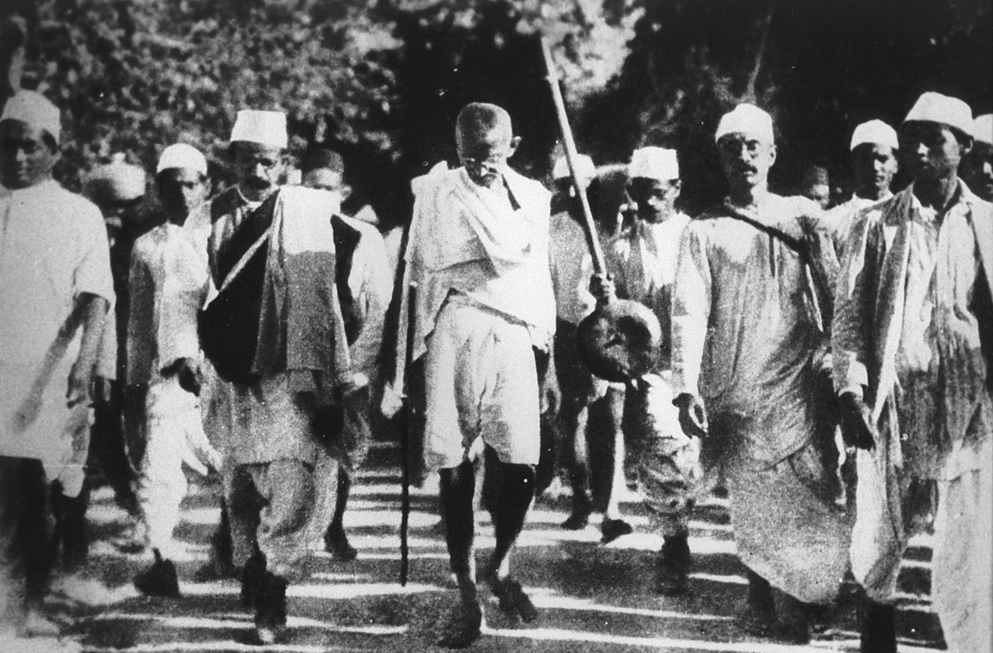
In an oppressive regime, opposition does not necessarily translate into violence. The example of the Salt March, led by Gandhi in India in 1930, is a perfect illustration of how peaceful but determined civil and fiscal disobedience can have a profound and lasting effect.
This form of resistance is based on a posture of critical thinking: it calls into question the lies or dominant ideas imposed by power or the community. It thus becomes a subversive but non-violent act, enabling resistance without aggression.
History is full of similar examples. By presenting and explaining them to children, parents and teachers can offer them concrete tools to develop their critical judgment, an essential skill to protect themselves against the excesses of authoritarian regimes or the manipulations of social networks.
Hans Scholl and Alexander Schmorell, students in Munich, founded the White Rose movement in the spring of 1942. They distributed thousands of leaflets denouncing the Nazi regime. Their strength was not military, but moral. They used verifiable facts and quotations from great philosophers to break the monopoly of state thought (4).
The Solidarnosc movement and the samizdat press in Poland in the 80s remain an emblem of resistance to a totalitarian communist regime that led to the fall of a system.
In Ukraine, China and Iran, "illicit" press organs, blogs and forums are pushing this strategy of factual and rationality to counter political and ideological lies, often at the risk of their authors' freedom or lives. Untruths asserted with tweets or thunderous speeches are one of the weapons of authoritarian regimes and systems. Not accepting this noise in contexts of violence seems to be an indispensable survival strategy.
Drawing inspiration from these reactions in less violent, more devious and more invasive contexts, such as the dissemination of information on social networks or the generation of information by unscrupulous AIs, takes on a dimension of mental equilibrium that is essential for establishing a critical mind.
Without becoming permanently distrustful, at the risk of falling into the trap of conspiracy theorizing, we need to learn to doubt when we need to, i.e. when panurgism (following like Panurge's sheep), authority bias or attempted manipulation become too obvious. Verifying the source of information must become a reflex, the courage to assert "It's not true. And that's why I'm saying it", a powerful and instructive act.
In Argentina, under the military dictatorship, when all meetings were forbidden, mothers of the disappeared began marching silently around a square, wearing white scarves. Their simple physical presence and silence became a cry heard around the world. For more than 40 years, these women marched every week to demand the identification of the tens of thousands who disappeared during the "dirty war" between 1976 and 1983 (5). In 1983, when the dictatorship fell, the Argentine state recognized 11,000 victims, but many others have yet to be located and identified.
The "Nuit debout" movement in France in 2016 (6), whose name was inspired by Étienne de La Boétie's "Discours de la servitude volontaire ou le Contr'un" (7), remains emblematic of peaceful opposition solidarity, even if it was marred by violence that was apparently foreign to it, but which it was unable to control.
"They are great because we are on our knees".
Following on from the Indignés movement in Spain and the Syntagma Square movement in Athens in 2011, Nuit Debout confirms that citizens are fed up. The triggering, installation and maintenance of this movement remains an example of a spontaneous collective work that aimed to change the model of society, even if, in the end, Article 49.3 allowed the government to force through the Labor Law.
Faced with the pressure of a dominant opinion, the liberating reflex lies in the collective: not remaining isolated, but opening up to other points of view, questioning one's own prejudices, exchanging, arguing and counter-arguing. This dialogue frees speech and, through its breadth, ultimately produces a real effect.
In 1978, writer Václav Havel wrote "The Power of the Powerless" under the Communist regime in Czechoslovakia, after the 1968 Prague Spring uprising and the repression that followed. The system demanded formal obedience: patriotic posters, slogans, public declarations of allegiance, even if nobody really believed them. Society then lived in an institutionalized lie: everyone played their part, out of fear, conformity and survival. Havel uses the image of a small greengrocer to illustrate his vision of resistance
"Let's imagine a small greengrocer who, one morning, decides to remove from his window the poster 'The Party guides the people to happiness'. He doesn't do it to start a revolution, or even to oppose the regime. He did it simply because he didn't believe in what he was displaying. This is a revolutionary act, because it breaks the system of lies." (7)
Matching one's actions to one's values remains a principle of life that predisposes one to strength of thought, whether in decision-making, commitment or opposition. Here, Václav Havel speaks to us of this dimension deployed in the smallest details of his life.
Not laughing at a demeaning mockery, opposing manifest stupidity or dangerous laxity, daring to speak out when the majority is silent, deciding on a small gesture to defend injustice - these are all great acts that establish his identity and ultimately, by mimicry, enable a global awareness closer to what Humanity should be.
"The power of the powerless is the power of truth, dignity and conscience. (7)
Education in critical thinking is not an injunction to rebel against adults or authority, but an apprenticeship in autonomy. A child who knows how to say "no" with discernment is an adult who will know how to protect democracy and his or her own convictions and values. Silence is a breeding ground for extremes, and correct judgment for tolerance.
Illustration: Salt march - Ghandi - Wikipedia CC
1 "How frogs went from right-wing meme to anti-ICE protest symbol" BBC- December 28, 2025- https://www.bbc.com/news/articles/cn987yqnee9o
2 "Portland-born 'mommy wall' spreads to US protests" Courrier International- July 29, 2020 - https://www.courrierinternational.com/article/antiracisme-le-mur-des-mamans-ne-portland-se-repand-dans-les-manifestations-americaines
3 "Salt march" Wikipedia https://fr.wikipedia.org/wiki/Marche_du_sel
4 " The White Rose " Wikipedia " https://fr.wikipedia.org/wiki/La_Rose_blanche
5 "Mothers of the Plaza de Mayo" Wikipedia- https://fr.wikipedia.org/wiki/M%C3%A8res_de_la_place_de_Mai
6 " Nuit Debout, le mouvement du ras-le-bol français? - Full documentary - AMP " https://youtu.be/JKxjlIh6EhY?si=gZdgLHlmsJB9ib1O
7 "Is voluntary servitude still with us?" Cafés Philo - 2014 https://cafes-philo.org/2014/06/la-servitude-volontaire-est-elle-encore-de-notre-temps/
8 Václav Havel " Le Pouvoir des sans-pouvoir ", p. 15 - édition du Seuil 1986
You might also like:
Assessing what's really valuable
Beyond rankings and sterile competitions, rethink school assessment to value the full range of skills developed by students.
AI and pedagogical creativity: who takes the initiative?
In the age of artificial intelligence, educational creativity is no longer about producing something new, but about giving new meaning to the act of learning. Faced with machines capable of generating everything, the challenge for education is to preserve human initiative: to teach discernment, slowness, responsibility and the freedom to think differently.
Being close to your learners at a distance
Loss of human contact, poor quality of exchanges, many fears animate trainers who launch into distance learning. But what if distance learning could create stronger links with our learners? By taking into account a few specific parameters of distance learning, the trainer can encourage the creation of links within the group.
The ecological challenge of digital schooling
Digital technology has a heavy environmental cost that is too often ignored. From the earliest age, schools need to raise awareness of the hidden impacts of our digital uses. This is vital if we are to build a more sustainable digital society.
The library, our space for cultural transmission
The cultural transmission strategies of museums serve as an inspiration and many university and school libraries are taking the same path. They evolve into cultural spaces and assume in the best way the role of cultural transmission. An imposed culture wears like a scar, a favored culture shows itself as a pride.