Drawing up a list of courses, making a daily schedule of tasks to be carried out, writing a message to a loved one: all these tasks, which are so simple today, can be automated by applications, or even by certain forms of artificial intelligence, which dispense us from a less expeditious writing exercise than the use of digital tools.
These new habits are not limited to the preparation of everyday tasks. Even in schools and places of service, digital writing has taken over from handwriting. This phenomenon is so widespread that, in some schools around the world, cursive writing has ceased to be taught, as in Finland and some American states. So, what does the future hold for writing among teenagers? What are teenagers' digital writing practices? What impact does digital writing have on them? How can we keep young people writing?
The future of writing
The omnipresence of digital writing among young people has become a societal issue, so much so that the dependence of young people on digital devices is creating a public fear of the disappearance of this skill among those who indulge to their heart's content in automating their writing.
This fear led to a CREDOC survey, commissioned by the association Lecture Jeunesse and carried out in 2022 among 1,500 young people aged 14 to 18, which revealed that, despite the strong presence of screens, writing practices are not disappearing.
What's more, as Claire Joubaire, head of studies and research at the Veille et Analyses department of the Institut français de l'Éducation (IFÉ) points out, "the rise of digital technologies, far from reducing written communication, has on the contrary strengthened and diversified writing practices".
Beyond simple communication, the written word is also a vehicle for thought and emotion, transmitted via a variety of channels: text messages, e-mails, memos... In fact, according to this survey, while 87% of young people aged 12-18 own a smartphone, the practice of writing by hand or digitally is still very common among 14-18 year-olds. Thus, 92% of 14-18 year-olds write sometimes on a daily basis, and 60% write regularly.
Writing, whether on paper or digitally, is part of young people's daily lives, and fulfils a number of functions: making proposals or organizing events (23%), carrying out administrative tasks (34%), succeeding at school or work (43%), putting thoughts to bed (19%), writing a letter to an employer (17%) or writing love notes (19%).
From the point of view of family socio-economic status, a gap in the use of the written word can be observed between the children of executives (70%) and those of blue-collar workers (50%). Not to mention the fact that habitus plays a decisive role, with 62% of young people whose parents write saying they do so very often, versus 42% of young people whose parents write very little. Clearly, writing is not about to bow out, despite the invasion of digital tools and even AI. However, it remains interesting to question the writing practices that emerge from digital use.
Digital writing practices in question
Far from the hypernormative framework of school or academic writing, digital forms of expression are proving to be a response to socialization based on freer, unambiguous enunciative foundations. As Elisabeth Schneider points out, this goes hand in hand with a use of language that is closer to the spoken word.
However, their characterization is not limited to this trait alone. We are witnessing the disappearance of an exclusive enunciation situation in which we cannot really mobilize all our senses, particularly sight and hearing, as in a traditional face-to-face communication situation, which can provide access to non-verbal language. By way of compensation, a system of interaction where play in all its forms is paramount is strongly present: "word play, play with others, play with oneself, expression of I/phantasmic play, play with norms..." (Béatrice Mabilon Bonfils, 2012).
From that moment on, to get a message across, interlocutors draw on metalinguistic resources such as tone and humor. They push back the boundaries by setting up new operational communication codes, such as lol (laughing out loud) and mdr (mort de rire) to replace laughter, icons and smileys to simulate facial expressions, and member lists or brb (be right back) to signal presence and absence on the chat, all of which make sense within the community.
We can also define phonetic writing and graphic lengthening, which consists in repeating the same grapheme beyond doubling for emphasis, as in "POUAAAAAAAAAAAAAAAAAAAAAAH", "BRAVVVVVVVVVVOOOO!!!", "etttttttttttttt...", or colloquial use of language, as in the phrases: "j'te dis", "tu l'as vu?", without respecting spelling rules. It's easy to see why: teenagers are overflowing with ingenuity when it comes to written communication. However, the same cannot be said for the use some of them make of AI.
As for AI-assisted writing, we immediately notice the erasure of the right to make mistakes, by abstaining from trying, as this system which is supposed to assist us completely replaces certain young people who don't want to make any effort. In fact, according to a new study conducted by Preply in collaboration with the Censuswide institute, 83% of 18-24 year-olds in France admit to having used AI to write for them.
We can understand them: writing is not as easy a process as it seems. The three pillars - planning, drafting and revising - demonstrate the effort required to produce a text. We therefore agree that, if we cede our tasks to AI, this process is short-circuited in favor of the shortcut of a precise, concise prompt, which dictates to the AI the actual desires of its user. It's easy to see why, in the quest for freedom and the limitation of constraints, teenagers end up becoming advocates of the least effort. So what impact does this writing practice have on their development, and even on their ability to write?
What impact does digital writing have on learners?
Despite the fact that the digitization of writing is a daughter of its time, it appears that writing by hand remains just as beneficial for young people as it is for adults. Indeed, it enables learners to develop the fine motor skills needed for other mundane daily tasks, such as tying shoelaces.
And while it's true that writing by hand is slower than typing on a keyboard, it enables students to invest more time in learning, by synthesizing information during a lesson, for example. According to Grégoire Borst, Ph.D. in psychology, handwriting retains more information than writing on a computer.
What's more, engaging in this exercise not only enables students to memorize the spelling of words, but also to learn how to read, since these two activities go hand in hand. It's clear, then, that digital writing, when introduced too early in a child's schooling, hinders the development of fine motor skills and the ability to synthesize information, and is an obstacle to memorizing words and mastering reading. The question is: how can we transmit all these important skills to children without cutting them off from reality?
There are a number of possible solutions, such as raising awareness of the secondary use of AI after a text has been produced, so that it corrects the form rather than the content, as well as raising awareness of the importance of reading specialized and non-specialized books, so as not to forget the spelling of words as a result of expressing oneself in trivial written language. After all, the brain needs training, and writing by hand is more authentic and personal than typing on a computer.
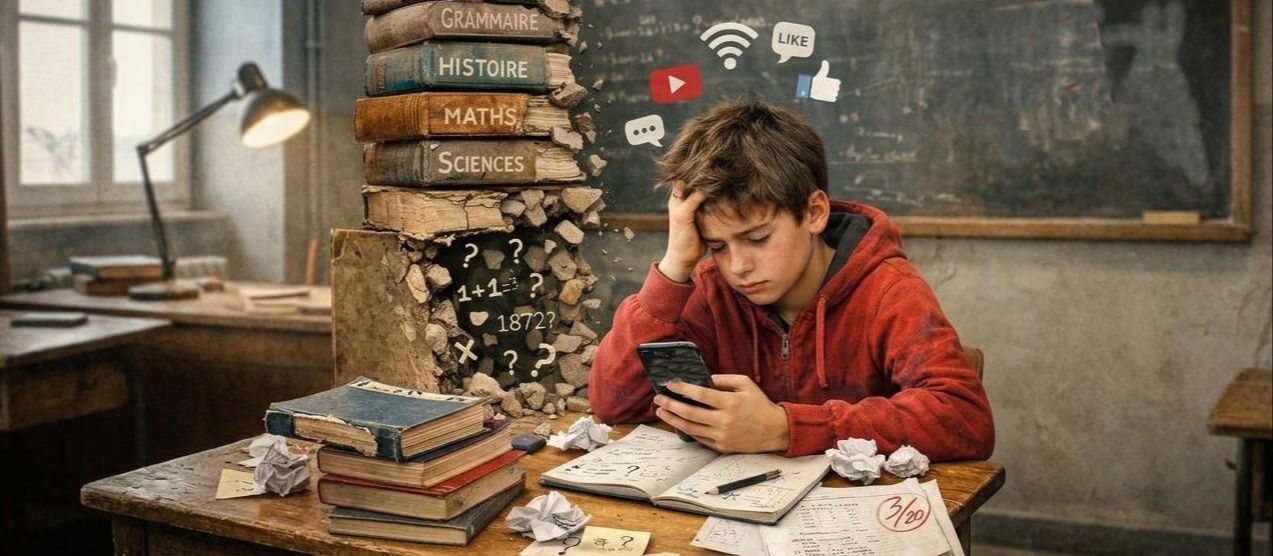
Illustration: Gemini, a young learner who accumulates gaps due to excessive use of his smartphone.
References
Ewen Hosie, 2017, "The uncertain future of handwriting", online: https: //www.bbc.com/future/article/20171108-the-uncertain-future-of-handwriting
Grandmont Véronique, Santha Caron Josiane, "Handwriting in the digital age", online: https: //www.youtube.com/watch?v=izAQIq32N1g
Joubaire Claire, 2018, "(Re)écrire à l'école, pour penser et apprendre", Dossier de veille de l'IFÉ, 123, online: https: //hal.science/hal-01791154v1/document
Kaci Mohamed, 2023, "Nouvelles technologies: l'écriture cursive est-elle encore tendance?", online: https: //information.tv5monde.com/international/video/nouvelles-technologies-lecriture-cursive-est-elle-encore-tendance-2666198
Miller Audrey, 2026, "Écriture numérique et AI: comment garder le cap sur l'apprentissage?", online: https: //ecolebranchee.com/ecriture-numerique-ia-garder-cap-apprentissage/
Schneider Elisabeth, 2014, "Comment l'écriture avec le numérique renouvelle la question du sujet adolescent : vers une géographie de l'écriture", online: https: //labo.societenumerique.gouv.fr/fr/articles/le-num%C3%A9rique-ne-d%C3%A9tourne-pas-les-jeunes-de-l%C3%A9criture/
RFI, 2025, "Écrire à la main à l'ère du numérique?", online: https: //www.facebook.com/RFI/videos/%C3%A9crire-%C3%A0-la-main-%C3%A0-l%C3%A8re-du-num%C3%A9rique-/25167538316215485/
Traverso Vittoria, 2025, "Ère numérique : voici pourquoi il faut continuer d'écrire à la main", online: https: //www.nationalgeographic.fr/sante/coordination-memoire-cerveau-cognition-ere-numerique-voici-pourquoi-il-faut-continuer-ecrire-a-la-main
See more articles by this author