The value of performance is valued more than ever. We shine the spotlight on those who break records, those who invent new technologies, those who dominate their professional environment, and so on. Effort only seems to be emphasized when it leads to spectacular results.
Social networks generally showcase all the wonderful moments of life, travel, family encounters, sports activities, models with perfect physiques. As a result, others live with the guilt or shame of not achieving these levels of performance, when "all you have to do is want to" according to these influencers and personalities. To get there, some will even pay for "training" to become a better entrepreneur, able to juggle professional and family roles with ease, to gain charisma, etc.
This vision of the consumerist approach was very well described by author Daniel Pennac when talking about school:
[...] today's students are highly corrupted by clientelism. [Since the mid-1970s, barely a hundred years after Jules Ferry, the child has been returned to adult society, no longer as a worker, but as a customer. From the cradle, children are instrumentalized by consumerism. Installing a television in the home is effectively introducing marketing. There's no doubt about it. [...] Day after day, we stimulate children's desire to consume in areas identical to those of adults: clothing, food, locomotion, electronics, telephony... In this way, the child acquires a commercial legitimacy that makes him or her an indispensable cog in market society, and places him or her on an equal footing with the adult world.
This obsession with consumerism and turning pupils into good little consumers has also led, in parallel, to great pressure to excel. As a result, these children start to live for the grade and develop performance anxiety.
Fear of failure
This anxious feeling arises when a child or teenager is afraid of failing an exam or schoolwork, or of not meeting expectations. Some students place almost unhealthy importance on results at school. Nevertheless, recent years have seen anxiety rates climb impressively. Between 2008 and 2018, in Quebec alone, the number of children affected is said to have doubled.
In 2020, even before the pandemic, 65% of Quebec high school students studied suffered from moderate to high levels of performance anxiety. Girls were more affected than boys, particularly in the area of mathematics. In France, nearly one pupil in two experiences this anxiety, according to a report by Cnesco (Centre national d'étude des systèmes scolaires) published in 2023. Several individual, family and environmental factors could explain the development of this disorder. These include
- Fear of failure: the risk of failure creates immense pressure for some;
- The pressure of expectations: real or imagined expectations from loved ones, teachers or oneself add to the mental load;
- Lack of self-confidence: some are still marked by criticism or previous failures, giving them the impression that they can never be good again;
- Environmental factors: a poorly laid-out classroom or an environment full of stimuli can make some students fear that they won't succeed because they can't concentrate.
Ironically, this anxiety is detrimental to performance, as it eats up the child's energy, creates physiological symptoms (headaches, stomach aches) and causes insomnia in many young people. As a result, they find themselves in a vicious circle: they worry about failing, they then make mistakes, this confirms their anxiety and the loop gets stuck.
Taking the pressure off
There's nothing wrong with wanting to succeed, but making yourself sick of it is counter-productive. So how can we get children with the beginnings of performance anxiety out of this kind of thinking?
Teaching children to manage their emotions seems to be a first step. By teaching them to take the time to satisfy basic needs, and to observe, accept and express the feelings they have about different situations, they will become less trapped in their condition and will be able to let go of it more quickly. With practice, they'll also understand how to react better to these stressful moments, and how to draw out what's good and what's not, in order to get the job done or pass the exam.
The whole question of climate and the relationship with grades is an important one. The mini-guide produced by the Fondation Jeunes en tête makes this point several times. It seems essential for the teacher to calm things down. Of course, this doesn't mean that all assessments should be taken lightly. But there's a big difference between stressing the importance of an exam, and especially of revision, and asserting things like "failing this test will lead to unemployment", for example. Children, and especially teenagers, are already under insane pressure to "choose their future path" when they don't really know themselves.
What if evaluation methods were to change? Indeed, in our meritocratic world, the numerical mark still seems to be highly prized. Yet, as these two professors from the Cégep de Sherbrooke explain, it doesn't tell the whole story. Saying that a person got 80% on an exam means nothing if we don't look at their background:
An 80% mark may be the result of a strong student who has experienced health problems that have disrupted her session; or that of a weak student who has worked hard and made clear progress between the beginning and end of the session; or that of a student who is passionate about the subject, but is struggling with an undiagnosed learning disability. There are dozens of learning scenarios for the same grade.
The whole issue of grades, averages and even honor rolls unfortunately facilitates the performance anxiety that becomes almost the rule for everyone when it comes to higher education. All the more so since, as the authors' examples clearly show, learners sometimes find themselves confronted with events and factors beyond their control that will inevitably have an effect on academic results. Is it really fair to freeze in time an exam that may have been taken as part of a bereavement or in the excitement of an upcoming trip?
Even the Cnesco, in its report, is interested in different approaches to evaluation, noting a considerable drop in performance anxiety in these pilot projects. Changing the model in which mistakes are penalized when in fact they are part of the learning process would be a huge step towards reducing the overall pressure on learners, from primary school to the end of a doctorate.
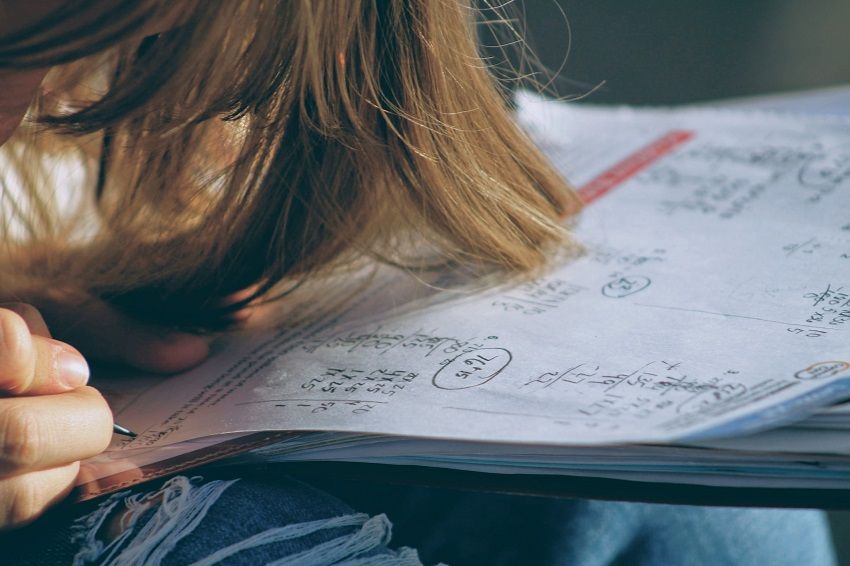
Photo: Joshua Hoehne / Unsplash
References
Bancaud, Delphine. "How to reduce the pressure on grades for students?" 20minutes.fr. Last updated: March 16, 2023. https://www.20minutes.fr/societe/4028071-20230316-education-comment-reduire-anxiete-eleves-vis-vis-notes.
Côté, Mélanie. "Quand l'anxiété s'invite dans la vie d'un jeune." Le Soleil. last updated February 5, 2023. https://www.lesoleil.com/2023/02/05/quand-lanxiete-sinvite-dans-la-vie-dun-jeune-838591679e9af4ab5f953204cd1d94ef/.
Delfly, Camille. "How to cope with academic performance anxiety?" ChallengeU. Last updated April 21, 2023. https://www.challengeu.ca/blogue/comment-faire-face-lanxiete-de-performance-scolaire.
Dion-Viens, Daphnée. "Deux ados sur trois souffrent d'anxiété de performance en première secondaire." Le Journal De Québec. Last updated: January 22, 2020. https://www.journaldequebec.com/2020/01/22/lanxiete-est-un-fleau-en-premiere-secondaire.
"Demystifying school performance anxiety." La Presse+. Last updated September 4, 2023. https://plus.lapresse.ca/screens/53b7ec97-64c6-41dc-85cc-884a21b87365%7C_0.html.
Flamand, Dr. Hélène. "The increasing prevalence of anxiety disorders in children and their treatment." TA@l'école. Last updated May 11, 2023. https://www.taalecole.ca/troubles-anxieux/.
Langlois, Philippe, and Akli Ait-Eldjoudi. "Non, les notes ne sont pas une loi de la vie." Le Devoir. Last updated: January 24, 2023. https://www.ledevoir.com/opinion/idees/778986/idees-non-les-notes-ne-sont-pas-une-loi-de-la-vie?.
Laplante, Coralie. "Girls suffer more impact from performance anxiety than boys." Noovo Info. Last updated: October 8, 2023. https://www.noovo.info/nouvelle/les-filles-subissent-davantage-dimpacts-de-lanxiete-de-performance-que-les-garcons.html.
Parent, Nathalie. "Outiller les ados pour diminuer l'anxiété de performance." Éditions Midi Trente. Last updated: January 21, 2022. https://www.miditrente.ca/fr/blogue/outiller-les-ados-pour-diminuer-l-anxiete-de-performance.
Piechota, Salomé. "Performance Anxiety Mini-Guide for Schools." Fondation Jeunes En Tête. Fondation Jeunes En Tête. Last updated: September 6, 2022. https://fondationjeunesentete.org/2022/08/29/mini-guide-anxiete-de-performance-special-ecoles/.
Venskus, Penelope. "Performance Anxiety in the School Context." Mon-Tuteur.ca. Last updated May 2, 2021. https://www.mon-tuteur.ca/blogs/news/lanxiete-de-performance.
See more articles by this author