I wanted a car
30 years ago, I calculated in detail the costs associated with owning a car: purchase, maintenance, gasoline, insurance, license, parking, etc. The conclusion I came to was that, in Canada, where I live, for a single working person, a car is not as economical as a cocktail of transportation services, including rental. The conclusion I came to was that, in Canada, where I live, for a single working person a car is not as economical as a cocktail of transport services, including car rental when there are no other means, such as when vacationing in a remote region. Bus, train, cab, car rental, home delivery - you can take advantage of efficient services for every eventuality, without the headache of owning a car.
But if two people share use and expenses, costs are about the same and a car starts to become desirable, if only for its availability. At three people to a car, it becomes an economically profitable choice. Obviously it involves a few detours to transport one or the other person and sometimes coordination, but overall, from three, it was good.
In 2023
I've redone all my calculations using today's prices. Surprisingly, the conclusion still holds when it comes to cost. So cars are still being sold just as much, if not more. So, if we want to respond to environmental concerns and reduce the number of cars on the road, the economic argument is not a major one for an individual but...
... 30 years ago, there weren't as many cars, or as much congestion. The environment was not so much a concern. Nuisance-related health data were fragmentary. Dependence on oil was no longer a major concern, and our societies' dependence on the car wasn't even on the radar. Today, these realities have caught up with us, and the electric car isn't going to change a thing (1).
Reasons to change your mind
More expensive
Worldwide, the proportion of cars per capita continues to rise. Even in countries well endowed with cars, it continues to rise (2, 3). Apparently, the cost of a car is not a major obstacle. In response, countries like Singapore have decided to take the bull by the horns: the acquisition of a car will have to be economically justified: a 100,000-euro acquisition permit makes it a "think about it" and suddenly makes public transport much more attractive. Apparently, this permit, which has cost 33,000 euros since 2018, was not enough of a deterrent (4).
London, with its ULEZ zones (Ultra Low Emissions Zones - 9 million inhabitants concerned)(5), New York (5 zones, 9 million inhabitants concerned)(6) and several others apply an entry fee of €15 to €20 per day in these zones for vehicles... Three main arguments support the implementation of these tolls and enable politicians to move forward despite the grumbling of users:
- Quality of life for local residents
Reducing sources of pollution and improving quality of life are among the significant effects brought about by these measures. Even if these effects take more than a year to be appreciated by the population, once they are perceived, voters are less inclined to want to go back. Health benefits such as noise reduction, improved air quality and reduced traffic risks are well worth €20 a day.
- Reduced traffic congestion.
Paradoxically, the experience of using the car is improved. With traffic reduced by around 20%, the pressure on the network almost disappears. Smoother, less stressful journeys, faster deliveries - benefits for everyone. If you earn more than €20 per hour, the time saved on a faster return trip already pays most of the tax, in addition to fuel savings. (7)
- New source of revenue for cities.
This is the most strategic element. For London, for example, we're talking about 1 billion euros (5). The more dynamic a city is, the more it's possible to monetize its appeal. So is an attractive city. Coming to and living in a pleasant city has a cost. Once the money is in the city's coffers, the next politician to be elected will find it difficult to deprive himself of this source of revenue; he'll have the choice between cutting services to citizens, raising taxes or... keeping the measures in place.
Cheaper and more accessible
Another cost-related strategy used by many cities is not so much about the car as about alternatives: making public transport cheaper and more attractive.
Many small towns and even villages are adopting free or low-cost community transport policies: subsidized shared vehicles, certain free transport lines, subsidized customer groups, park-and-ride facilities, etc. Many formulas are used, always with the aim of making public transport more attractive. Many formulas are used, always with the aim of increasing accessibility and reducing the number of cars on the roads. Trains, buses, minibuses, cars, scooters, bicycles, scooters, all means are used (8). We're also trying to make the transportation experience more pleasant and efficient, with low-floor vehicles, covered waiting stations, reserved bus lanes, supervised bicycle parking, car-sharing and more.
For example, in Quebec City, whose topography has always limited bike use due to the cliff separating Upper and Lower Town, the city launched its bike-sharing system with a fleet of electric bikes; no unassisted bikes are offered. The result: all usage targets are smashed year after year (9).
Strategic planning and policies
Zoning
When a zoning bylaw prohibits the establishment of shops and businesses in a dormitory suburb, it literally forces the use of a car and the construction of expressways. In addition to encouraging urban sprawl, this type of land-use planning forces the concentration of businesses in shopping centers, and huge parking lots are required, resulting in more travel, more distance to cover, fewer local businesses and less social interaction. Changing a single zoning bylaw can transform a city's transportation dynamics and development. Finally, the low population density in these neighborhoods prevents the economical use of public transit.
In these neighborhoods, the construction of bike lanes, reserved lanes or carpooling incentives bring little change to habits, since the very design of the neighborhoods does not allow for other behaviors. Schools, workplaces and shops are too far away (11).
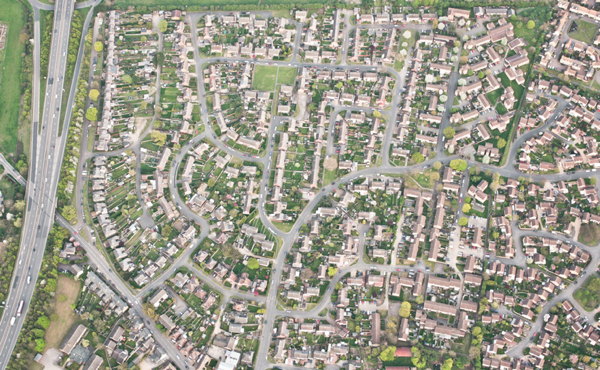 Nor is it possible to cross these neighborhoods, as there is no efficient way to do so.
Densification policies are one thing, but they need to be complemented by policies on places where people can interact with each other: it's essential to be able to work, shop and socialize close to where you live - that's what cities are all about.
The concept of dormitory suburbs was born with the car and needs the car to exist. A sustainable transport policy intervenes in this type of development and encourages the multiplication of uses and functions in a living environment, as this reduces travel distances and the need to resort to the car.
Safety
The safety of more densely populated neighborhoods is an area of intervention appreciated by residents. By limiting the speed of cars through physical or regulatory measures, we reassure pedestrians and force through-traffic to use fast lanes, avoiding slower areas.
A parking sticker system for residents and parking quotas in a zone encourage the use of public transit to come to these neighborhoods. Less traffic, less pollution, a better quality of life, a greater sense of security - these conditions in turn lead to more active transportation. When it's more pleasant to walk or cycle, we walk and cycle, with all the benefits that come with it.
Advertising
Freedom of expression is a fundamental value, and we can't limit it without provoking a series of detestable consequences. Stimulating socially undesirable behavior such as smoking, drinking, gambling or promoting hatred, however, is not desirable, so we limit this freedom of expression in specific contexts.
This kind of regulation could be adopted for the promotion of certain types of vehicle recognized as environmentally harmful in large numbers. Who really needs large, ultra-powerful vehicles? Those who do know where to turn, and there's no place for advertising such vehicles to the general public. The media also have a role to play.
The place of the car
There is an optimum number of cars in an economically and socially dynamic society.
- This optimum is not the same in high-density cities as in the countryside, but chronic congestion is a clear signal that the optimum has been exceeded.
- When average travel speeds fall below 20 km/hr, we don't need vehicles that can do 140 km/hr. Modern alternatives are more efficient.
- The average number of passengers per vehicle is around 1.1 to 1.2 in both Europe and America (10). When it comes to transporting 1 person weighing 65 kg, you don't need a vehicle weighing 2 tonnes, even if it's electric (1).
- Cars are parked 95% of the time and use over 70% of public space. Other uses of the land are economically and socially more interesting; a better balance certainly exists (12).
- The car represents a bigger budget item than food for most families - isn't that revealing? (13)
We can certainly do more and better with less; not only would it be profitable for everyone, it would also be very feasible.
Illustrations: trgowanlock - DepositPhotos
atercorv.gmail.com - DepositPhotos
References
- The electric car: "a greenwashing operation" - Vincent Rességuier - Radio-Canada
https://ici.radio-canada.ca/nouvelle/2022431/voiture-electrique-ecoblanchiment-pollution-castaignede - List of countries by number of vehicles per capita
https://fr.wikipedia.org/wiki/Liste_de_pays_par_nombre_de_v%C3%A9hicules_par_habitant - Fewer cars in Quebec Fitzgibbon persists, Legault moderates - Tommy Chouinard - La presse
https://www.lapresse.ca/actualites/politique/2023-08-16/moins-de-voitures-au-quebec/fitzgibbon-persiste-et-signe-legault-tempere.php - In Singapore, the certificate to own a car now costs 101,000 euros - Géo - Sacha Caron
https://www.geo.fr/voyage/singapour-certificat-pour-posseder-voiture-coute-desormais-101000-euros-permis-circulation-pollution-216955 - In London, the controversial extension of the polluting vehicle tax comes into force - Euronews
https://fr.euronews.com/2023/08/29/a-londres-lextension-controversee-de-la-taxe-pour-vehicules-polluants-entre-en-vigueur - New York plans congestion charge in 2024 - Peter Hutchison - AFP - La Presse
https://www.lapresse.ca/international/etats-unis/2023-08-07/embouteillages-et-pollution/new-york-prevoit-un-peage-urbain-en-2024.php - TomTom congestion index - https://www.tomtom.com/traffic-index/
- Public transport: come on, it's free! - Taras Grescoe - L'actualité
https://lactualite.com/societe/transport-en-commun-allez-cest-gratuit/ - àVélo shatters RTC forecasts with over 350,000 mid-season trips - Dominique Lelièvre - Journal de Québec
https://www.journaldequebec.com/2023/08/08/avelo-pulverise-les-previsions-du-rtc-avec-plus-de-350-000-deplacements-a-la-mi-saison - What is a car's occupancy rate? Futura-Sciences
https://www.futura-sciences.com/planete/questions-reponses/automobile-taux-occupation-voiture-1019/ - Getting around by car: alone, with others or carpooling? - French Ministry of Ecological Transition
https://www.ecologie.gouv.fr/sites/default/files/DE_4p_covoiturage-v4-050722_SH_OK.pdf - Aberrant findings on vehicle and road use - AQTr - Catherine Morency - Association québécoise des transports
https://aqtr.com/association/actualites/constats-aberrants-lusage-vehicules-routes - Let's not be afraid of demotorization! - Véronique Laurin and Blaise Rémillard - La Presse
https://plus.lapresse.ca/screens/8fa0eeca-eb53-44a6-85a1-5bfb8af29c17%7C_0.html
See more articles by this author