Even though we live in an environment that has never been so safe and secure, the breeding ground for our fears remains fertile... and our imagination does the rest! Yet our chances of dying in infancy have melted away, those of taking part in armed conflict are minimal, the likelihood of suffering severe deprivation is marginal in most countries, and paradoxically the level of collective anxiety remains high.
We are living longer, but we are effectively reminded of the fragility of our lives. And the longer we live, the more we have to worry about, apparently. The natural reflex is to go from day to day; this way, our probability of seeing the next day always remains high, and is a good way of avoiding the problem.
If the image of the earth seen from space has had a masterly effect on human consciousness, other images have also had collective effects at least as powerful but less positive: The more recent images of burning forests, melting glaciers, flooded territories, oceans of waste, advancing deserts, hurricanes and tornadoes sweeping across entire regions - all of which the media are particularly fond of, given our seemingly insatiable morbid curiosity. All the more reason to worry about tomorrow.
On the positive side, major technological advances continue to be announced, social behaviours are evolving, the birth rate is falling (4), agricultural practices are improving... Behind these realities, both positive and negative, forces are feeding on our energies and we can influence them. Human inventiveness is not often taken into account when assessing risk.
Always in balance
Evolution of the world population from -10,000 to the year 2000".
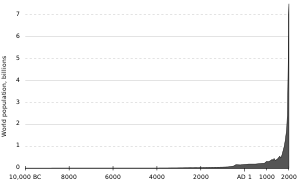
When one of the forces in equilibrium is displaced, a new equilibrium is created, at a higher or lower level. For example, when we eradicated a disease like smallpox, which killed over 300 million people in the 20th century alone (1) (before its complete eradication in 1980). Within a few years, millions more people had children, and humanity entered a period of rapid expansion (4). The public health policies of the late 19th century had already set the ball rolling.
An exponentially expanding humanity occupies more territory and mobilizes more resources until a new equilibrium is created, which should stabilize within the next twenty or thirty years. In the face of such success, how can we not have confidence in humanity? Collectively, we have a lot of potential... But we are also capable of abysmal stupidity.
Priorities
The history of mankind is a long succession of remarkable civilizations, all of which have nevertheless disappeared (2, 3). Asian, European, African and pre-Columbian civilizations sometimes dissolved within a few decades, swept away by the scarcity of an essential resource, generally caused by a prolonged drought, or by an invader who took advantage of a weakness or a chaotic political situation.
While the likelihood of an armed invader is relatively low today, since the balance of arms is assured by an industry that looks after its own interests - Ukraine, the Middle East, Sudan and Congo are good examples - the combined likelihood of climate change (CO2), groundwater depletion, the collapse of fish stocks and the loss of biodiversity, is far more serious. The agricultural, fishing and renewable resource industries in general have no intrinsic opposition: always more at the best price to meet demand.
We depend on these resources to feed our population. We may run out of oil, but not of food. When all we have to eat is grasshopper meal, and grasshoppers only have prairie grasses to eat, our civilization will be long gone, unless we set about changing our practices and setting our priorities.
On the agenda
We can look at the problem from several angles: political, economic, social, ideological, technical, etc., and we'll probably have to consider all of them simultaneously; so it seems preferable to direct our efforts towards the goal to be achieved, and leave it up to each individual to choose his or her contribution and means.
- Renewability
Sustainable development seems a good integrating concept, but rather than talking about development, which implies a progression, a change of state with no defined limit, it would be preferable to talk about equilibrium. We know when an equilibrium has been reached: how much fish we can catch, how much water we can take, how much wood we can cut, and so on.
In the current situation, several limits have been crossed: we are deforesting too much, fishing too much, withdrawing too much water from the water tables, depleting the land and the sea... ( 5,6,7). The idea of quotas to ensure every equilibrium necessarily entails equilibrium in prices - real prices, not the price of plunder.
- Non-renewables
The oxymoron of the "perennial non-renewable" implies creating closed loops from extraction to recycling.
For example, we use so much phosphorus or nickel per year, some of it is lost, some is recovered, we need to extract the difference. The greater the recovery, the less we need to extract again. If we also replace non-renewable resources with renewable ones, such as steel with cellulose or oil with hydrogen, we can eventually reach a balance based on population and its needs. If the population stabilizes, equilibrium can be envisaged in the relatively short term. The idea is to seek balance.
- Assimilable and transformable
Nature's capacity to assimilate is immense and evolving, but it is not infinite. At present, we are saturating and diminishing it.
Habitat loss, deforestation, bio-diversity depletion, air, water and soil pollution, noise and light pollution, soil compaction, drainage, watercourse detour, dyking, dredging, paving... spaces not developed by humans - in other words, the territory of the other inhabitants of this planet - continue to shrink at a rapid pace, and with it the capacity of natural systems to balance.An average temperature of 25° under the canopy of the Amazon rainforest, even though it lies on the equator, gives us an idea of nature's capacity for equilibrium. No human system is capable of cooling millions of km2 (8).
But globally, we have already exceeded the natural capacity to absorb heat, CO2 and degrade organic pollution; entire zones are now hypoxic (lack of dissolved oxygen in the water, preventing the survival of fish) (9) and the ph (acidity) of the water is increasing (10) to the point of wiping out calcareous-shelled corals and invertebrates. The degradation capacity of plastic is marginal, that of certain chemical components almost non-existent, etc.
Overall, the solution lies in reducing pollution pressure and increasing absorption capacity, not reducing it. We can put many little biological factories to work: there's one in every seed, in every plankton, in every fish, insect, animal or plant on earth. The important thing is to set the table, not raze the restaurants and choke the chefs. Biodiversity is vital (11).
The supposed risk
It's often said that the only language big industry seems to understand is that of money. But even with a price on carbon, water or land, the price is always below the overall value and does not change the current logic. The beauty of a landscape, the freshness of a forest, the dance of insects or a starry sky cannot be monetized, and yet they are all part of the pleasure of life. Big industry" is not an interlocutor, but only a logic of materialized thought, entirely created; we can direct it more positively. Nature is our ally, not our enemy. The real risks are in failing to understand this and doing nothing about it.
We can be master builders as well as gravediggers, creators as well as destroyers. From our position in education, we can direct what we teach, make the right choices and support the creativity of those who will have to face the challenges of the present. The trades we need are linked to our environment, both natural and social.
Simple indicators in all fields can help us measure the impact of our policies and solutions. The answers will necessarily be varied, but the results very observable: a planet full of life and inhabitants happy to live. Everyone can understand that.
There's no risk in aiming for balance.
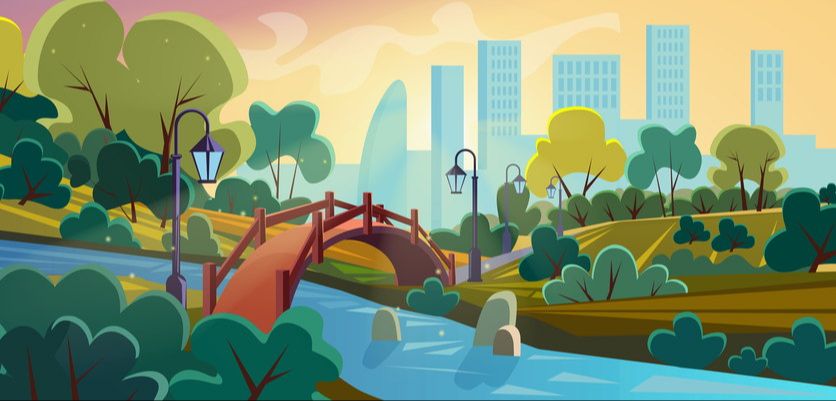
Illustration: Lembergvector - DepositPhotos
References
1- Life and death of smallpox - P. Berche - La Revue de Biologie Médicale
https://revuebiologiemedicale.fr/images/Biologie_et_histoire/BIOLOGIE_ET_HISTOIRE_Variole.pdf
2- Great disappeared civilizations
https://fr.wikipedia.org/wiki/Grandes_Civilisations_disparues
3- Eight civilizations that have mysteriously disappeared - Céline Deluzarche - Futura Sciences
https://www.futura-sciences.com/sciences/questions-reponses/histoire-8-civilisations-ont-mysterieusement-disparu-15696/
4- World population
https://fr.wikipedia.org/wiki/Population_mondiale
5- CO2 levels in the atmosphere break a 3-million-year-old record - Arnaud Sacleux - National Geographic
https://www.nationalgeographic.fr/environment/2019/04/le-niveau-de-co2-dans-latmosphere-bat-un-record-vieux-de-3-millions-dannees
6- Groundwater: making the invisible visible - Unesco
https://www.unesco.org/reports/wwdr/2022/fr/node/163
7- Will we no longer be able to eat fish in 2048? - Oceanographic Institute
https://www.oceano.org/ressources/2048-la-fin-des-sushis/
8- Amazonia
https://fr.wikipedia.org/wiki/Amazonie
9 - Breathless oceans - Warren Cornwall - Science
https://www.science.org/content/article/breathless-oceans-warming-waters-suffocate-marine-life-disrupt-fisheries
10- What is ocean acidification? Joanne Liou - IAEA
https://www.iaea.org/fr/newscenter/news/quest-ce-que-lacidification-des-oceans
11- Why biodiversity is important - ONU
https://www.un.org/fr/climatechange/science/climate-issues/biodiversity
See more articles by this author