Publish at December 06 2023Updated December 06 2023
Managing emotions and attention: being round in the land of squares
Is attention the educational and managerial challenge of the future?
In the 21st century, attention is seen as a major cognitive ability. Attention is the process by which we obtain, encode and process information. At school and in adult life, attention is a basic skill that is indispensable to individual development.
It is increasingly called into question by technologies and their attentional hyper-stimulation. There is even talk of "programmed captology", i.e. the programming of applications and their algorithms with the aim of capturing the maximum attention of users, who then develop forms of addiction! (Source Sandra Boré)
At the same time, the wave of "Attention Deficit Disorder with or without Hyperactivity" (ADHD) seems to be gaining momentum. Should we fear a tsunami?
ADHD is usually best known for its most noticeable symptom, hyperactivity. Indeed, it's hard for a hyperactive person to go unnoticed. A few decades ago, hyperactivity went untreated, appearing in childhood only to fade in adulthood (Source: Le Devoir).
ADHD, is it really reasonable?
In his work on the educational paradigm, Ken Robinson, in a 2006 TED talk(L'école tue la créativité ), followed by the more detailed and illustrated"draw my life" talk:"Du paradigme de l'éducation", expresses reservations about this "contemporary epidemic, both untimely and imaginary".
This bias seems to have a direct bearing on his research into the role of creativity in education. To carry out this research, he questioned artistic development. For example, he met and interviewed choreographer Gillian Lynne about the birth of her talent.
In the 1930s, there was no such thing as a diagnosis of hyperactivity. Gillian Lynne had the opportunity to express herself fully thanks to the intuition of a doctor. He had the good sense to advise Gillian Lynne's mother to enroll her in a dance class. Gillian immediately felt at home there, and in a mode of expression that suited her!
Ken Robinson's criticism is based on the alarming observation that if Gillian Lynne had met actual doctors, she would most likely have been treated with ritalin, not dance!
Ken Robinson's reservations are easy to understand.
"In 1998, he led an English inquiry into creativity, education and the economy. His report, All Our Futures: Creativity, Culture, and Education, highlighted some of the most important issues facing the 21st century economy. This report should cause every HR director and CEO to bang their fists on the table and demand new action in this area" (Source wikipedia ).
The augmented brain?
Despite its 100 billion neurons, the human brain is designed to perform only one task at a time. Regardless of gender! The brain is NOT multi-tasking. It works in conjunction with our physical abilities.
Trying to do several things at the same time (e.g. driving a car and answering the phone, walking down the street paying attention to traffic and sending a text message) represents "cognitive overload" or "mental load".
Neural networks direct our attention, for example, to what is salient (a color in the street), what can generate pleasure, what goals have been set. A single circuit will dominate depending on the situation.
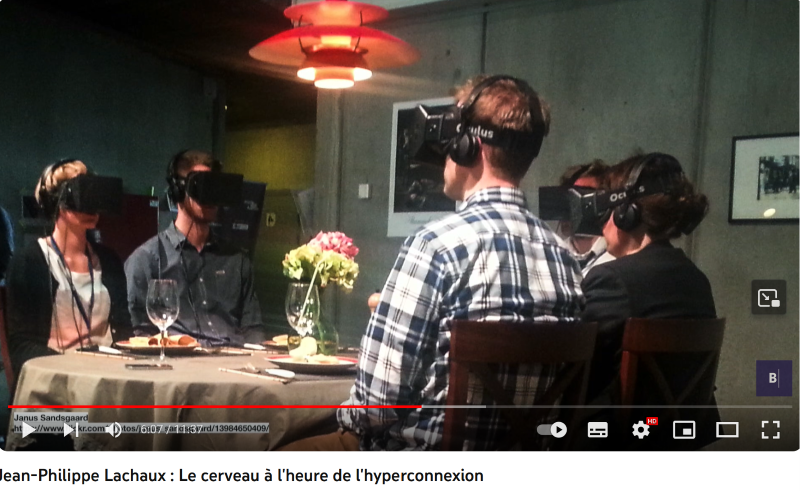
Phone applications (e.g. notifications) constantly challenge our reward system. Jean-Philippe Lachaux speaks of "attentional gluttony", like a child in a candy store with infinite, accessible and free distribution.
Here's a screenshot of Jean-Philippe Lachaux's illustration of a family dinner in the future...
In contrast to this gluttonous hyperconnection, JP Lachaux advocates "calm attention, focused on one thing at a time", which provokes a state of immense pleasure and is entirely focused on the task in hand.
This state of consciousness is reminiscent of the state of flow, or that described by the TPV, the Poly Vagal Theory mentioned by Sandra Boré.
"The augmented brain is the brain of the person who has learned to understand and react to the forces that jostle his or her attention, and who is capable of having a sense of attentional balance" JPh Lachaux
Nothing could be simpler than determining the PIM of an action you intend to carry out. PIM is 3 things: Perception, Intention and Manner.
The researcher proposes a "form of resistance" to hyperconnection: the ATOLE program. AtOle as in "attentive, à l'écOle". ATOLE is a neuroscience-based attention training program that is spreading in France.
The aim of the program is to:
"enable the next generation to choose and experience the pleasure of being truly connected to what they do, whatever they do, and to the people they are with".
In the land of neuro-atypics and biodiversity
I recently learned that I have a "winning combo": HPI / ADHD / autistic traits, all in the feminine!
I overcompensate for a lot of "lacks" of learned skills, i.e. those that are not "naturally" integrated - this is known as a "compensatory burden". Of course, when I'm tired, the ADHD and autistic traits come rushing back!
I have a tree-like way of thinking (HPI - High Intellectual Potential), facilitated by the jitteriness of my attentional inconstancy (ADHD), and have developed a mind that synthesizes, that brings things together to make sense (my HPI, I suppose).
My perceptive hypersensitivity (noise, sound, light) increases with age (and the drop in energy, I suppose), which doesn't please those close to me, who are obliged to adapt...
The environment is a source (an ocean, I should say!) of multiple perceptions and potential stress. This is a characteristic of HPI, also known as"latent inhibition deficit".
Not so long ago, someone close to me pointed out that when I enter a room, I literally "scan" my surroundings. Even if it's a perfectly familiar room in my daily environment. I thought this was "normal"!
What goes on in the brain of an adult with ADHD? The video below explains it very clearly.
ADHD is a peculiarity of brain function that affects only 4.4% of the world's population, half of whom remain undiagnosed. Even less so if they are not identified by "hyperactivity"!
For those who benefit from this "particularity", the mental load is greater, which often manifests itself in chronic fatigue (I had "tension drops" since childhood, and learned to treat myself differently in adulthood, notably by taking into account my energy level and its circulation (acupuncture, qi-gong)...).
An ADHD brain is very forgetful, confused and impulsive (I often compare it to my "erupting volcano"). On a biochemical level, in the ADHD brain, two neurotransmitters, dopamine (motivation and focus) and noradrenalin (the filter that allows you to put aside what's less relevant), don't always play their role, their "regulation is very random".
It's a "compensatory burden" that "costs extra time and energy to compensate for ADHD symptoms".
You bet! At certain times of the day, when I speak, the words come out like a machine gun, which is not practical for teaching! As the person in the video so aptly put it, being ADHD is a bit like "being round in the land of squares". The two shapes don't have the same properties and can't be calculated in the same way, but they're still geometric shapes!
Psychiatrist Philippe Narang, a specialist in neuroatypics, talks about biodiversity. It's very poetic and rather benevolent!
The issue of discipline in education has never ceased to obsess teachers. Some argue for a return to more sanctions and strict rules. Others, on the other hand, advocate a more sensitive approach to the student, asking for an understanding of what causes bad behaviour. Some schools even go so far as to have no rules at all...
Did you enjoy following in the footsteps of Professor Langdon in The Da Vinci Code? You'll love trying your hand at these unsolved cryptographic mysteries. Will you follow through with the intentional or unintentional approach of their authors in trying to decipher them?
Which organization, which key competencies and which management to rebuild after the crisis? The organizations that were presented as examples of success a few months ago are no longer so, employees' aspirations are different and teams are dispersed when it is necessary to work as a group... Many employees have made a thirty-year technological leap in two months!
Learning another language in a context where its use is a minority is not easy. Whether it is Welsh in Britain, Basque in Spain or French in Canada, the courses given do not necessarily lead to greater use of the language. What if mainstream language was used in learning rather than immersion?
More and more, applicants will have to seduce the machine before the recruiter. Indeed, algorithms are able to sort out in a very short time the different candidates applying for a job. They are even able to analyze the answers during interviews. Will we have to learn to please artificial intelligence?