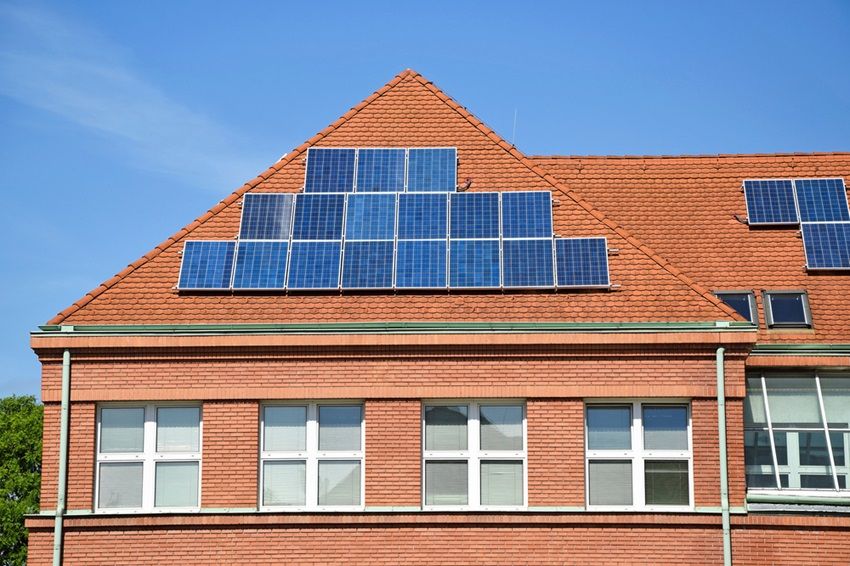
Climate change is no longer a phenomenon to come - it's here and now. The question, at the time of writing, is rather to estimate the intensity of these changes. For the time being, the anticipated trajectory does not suggest much optimism. Nevertheless, succumbing to cynicism will achieve nothing, especially as the climatologists themselves believe that significant action can be taken. So it's best to focus on what can be done at all levels, including schools.
Younger generations are already much more aware of climate and environmental issues than their predecessors. School curricula all deal in their own way with these major issues, which are bound to have an effect on their future lives. This awareness can lead to decisive changes in mentality and even militancy; climate marches are good examples of this.
But is all this awareness-raising taking place in an environmentally significant location that has reduced its carbon footprint? In fact, the school building itself can contribute to carbon dioxide emissions. Whether through the use of polluting materials, outdated insulation that increases energy requirements, or electricity from non-renewable sources, there are many aspects that make schools just as problematic as industries or residences. The issue of carbon-neutral buildings is therefore starting to gain ground.
Canada's green shift...
In recent years, Canada has been particularly affected by climate change. It is not the only country in the world in this situation. Various islands and territories around the world are also witnessing climate change, including Iceland, Vanuatu and others. Nevertheless, the world's second-largest nation is feeling the effects of a changing climate. The polar vortex, normally held more tightly in the Arctic, is now descending more steadily to the south of the country. It is also affected by more frequent storms, droughts that have led to intense forest fires and flooding in other regions...
So it's not surprising that the Canadian school world has begun to think about schools that are not only more resilient to hazards, but also reduce their carbon footprint. For some years now, teachers and schools have been pushing the idea of reducing greenhouse gases (GHGs). For example, this teacher from Valcourt, Quebec, has been working for over a decade to limit his school's GHG emissions. He is trying to achieve carbon neutrality by planting trees, composting and reducing electricity use, among other initiatives.
In Quebec, in February 2019, an event called "La planète s'invite à l'école" brought together 750 participants from 150 organizations, including 110 schools. The aim was to form a pact to promote the ecological transition of schools. Those behind the event have since created theLab22 association, which supports numerous Quebec schools in their efforts to reduce their carbon footprint. The idea is to guide teams in these transformations, so that they are aligned with local needs and realities. Lab22 does not come up with a one-size-fits-all solution. Each environment has its own advantages and challenges when it comes to reducing GHGs. This also applies to school reconstruction projects, such as the Curé-Paquin school in Saint-Eustache, which was built to LEED Gold environmental standards, with solar panels, radiant floors and a geothermal heating and cooling system.
Among higher education establishments, the desire to reduce their ecological footprint is becoming increasingly apparent. The Université de Sherbrooke, for example, aims to achieve carbon neutrality by 2030 in terms of direct GHG emissions and indirect emissions from purchased energy. The Cégep de Rimouski, along with four other Quebec institutions, has been awarded nearly $25,000 in 2023 to initiate a drastic reduction in carbon dioxide emissions.
Université Laval, meanwhile, has been expanding its environmental program since 2015, with initiatives at every level, from buildings to food and transportation, and, of course, numerous environmental courses and programs. It was the first in Canada to propose a sustainable development strategy (.pdf), which has continued to grow.
However, the first entirely carbon-neutral school in Canada would be John Paul II Secondary School in London, Ontario, which has become completely self-sufficient in renewable energy such as solar (2700 panels in the parking lots) and geothermal. The project began in 2019 and was completed in November 2021. As a result, the ecological footprint should be close to zero, eliminating 277 tonnes of carbon dioxide from the atmosphere.
...and examples of action
As John Paul II school officials will tell you, this achievement shows students that the ecological transition is possible, and that they too can make it. What's more, they're not the ones who are going to stand in the way of this ecological shift.
In the United States, high school students are fighting politically to obtain a"Green New Deal", i.e. a national policy to ensure that the country's economic efforts are turned towards the ecological transition, including schools. Some American schools have already achieved carbon neutrality, and most major universities are working towards eliminating all or almost all carbon emissions within the next few years.
The same is true of the UK, where an ecological transition is about to begin in schools from primary to university level.
But how do we get there? It generally starts with a clear resolution to reduce greenhouse gas emissions. This is followed by an analysis of emissions and the critical points to be addressed, and a budget can then be estimated for the work to be done. In many cases, this will involve more effective insulation, with better adapted windows to evacuate heat in summer and conserve it in winter. Better control of room temperature will also help avoid wasting electricity.
This second point is also crucial: schools need to source their energy from clean, renewable sources. Most carbon-neutral establishments to date have achieved this by becoming self-sufficient with solar and geothermal energy, among others. The use of biomass is less and less prescribed, as studies tend to show that this solution remains polluting.
Community involvement in the project is also essential. Firstly, because it can provide some of the funding, but also because the school green transition can be a cornerstone in the transformation of a neighborhood, a city and eventually a region in the elimination of GHGs.
It also seems important to adapt solutions to the environment. In a number of low-income countries, such as Sierra Leone, authorities are more inclined to design schools with an aesthetic and structure similar to those in America and Europe, without taking into account local climatic conditions. Involving local forces in the design and construction of the carbon-neutral school will be an effective way of sowing the seeds of transformation elsewhere in society.
The school is a starting point for the ecological transition that is long overdue elsewhere in the world.
Photo: majorosl66 / DepositPhotos
References
Bisaillon, Véronique. "Carbon neutrality in Quebec universities." L'éveilleur. Last updated: September 5, 2021. https://leveilleur.espaceweb.usherbrooke.ca/la-carboneutralite-dans-les-universites-quebecoises/.
Bouffard, Caroline. "L'école Curé-Paquin: Un exemple en matière de carboneutralité." Genium360. Last updated April 11, 2022. https://blogue.genium360.ca/article/innovation/lecole-cure-paquin-un-exemple-en-matiere-de-carboneutralite/.
Bresnick, Peggy. "Higher Ed makes strides toward carbon neutrality, sustainability." Fierce Telecom. last updated April 24, 2023. https://www.fiercetelecom.com/leadership/higher-ed-makes-strides-toward-carbon-neutrality-sustainability.
Cournoyer, Amélie. "Projet carboneutre à l'école: le devoir de Nicolas Busque." Unpointcinq. Last updated: August 27, 2021. https://unpointcinq.ca/sinspirer/carboneutralite-le-prof-qui-plante-des-arbres-pour-inspirer-ses-eleves/.
"Cégep de Rimouski: vers une école carboneutre." Le Laurentien. Last updated: October 26, 2023. https://www.lelaurentien.ca/article/2023/10/26/cegep-de-rimouski-vers-une-ecole-carboneutre.
Forbes, Catriona. "Low-carbon schools to mitigate climate change and improve learning." Global Partnership for Education. Last updated November 9, 2022. https://www.globalpartnership.org/fr/blog/ecoles-sobres-carbone-attenuer-effets-changement-climatique-ameliorer-apprentissages.
"Green New Deal for Schools." Sunrise Movement. Last updated November 7, 2023. https://www.sunrisemovement.org/fr/campaign/green-new-deal-for-schools/.
"How can you make your campus net zero carbon?" Tate + Co. Last updated June 22, 2023. https://tateandco.com/answers/how-do-we-make-a-net-zero-carbon-campus/.
"The importance of low-carbon education in schools." Logopsycom. Last updated September 1, 2023. https://logopsycom.com/the-importance-of-low-carbon-education-in-schools/.
"Canada's first carbon-neutral school is in Ontario." Radio-Canada. Radio-Canada. Last updated: November 3, 2021. https://ici.radio-canada.ca/nouvelle/1836857/ecole-carboneutre-london-premiere-canada-energie-soliare-geothermie.
Masse, Nathalie. "The movement for eco-responsible schools in Quebec continues." Savoir Magazine. Last updated: December 18, 2020. https://www.magazine-savoir.ca/2020/12/18/le-mouvement-en-faveur-dune-ecole-ecoresponsable-au-quebec-se-poursuit/.
"Net-zero carbon school buildings." Education Business. last updated July 23, 2019. https://educationbusinessuk.net/features/net-zero-carbon-school-buildings.
See more articles by this author