The ability to evaluate is valued in many professions and contexts. Making decisions in our daily lives requires this know-how. Without the ability to evaluate, we wouldn't even be able to cross a street unaided. Making judgements would be a good thing if we didn't believe that these judgements were necessarily objective and rational. Making judgments about others, in particular, is particularly risky and often not very fruitful.
We can judge things, situations and people. We can even judge ourselves, our thoughts, actions, skills and personality. We can judge positively or negatively. We can also judge to act or to reassure ourselves. This judgment reflex is so deeply rooted in our human habits that we generally don't ask ourselves whether judging is always really useful, and if so, what.
Judgment is a form of decision, and all our decisions are in fact influenced by many parameters, such as the context in which they are made and our understanding of it, our state of fitness at the time and, above all, our emotional state. What's more, our decisions have consequences, and when it comes to judging others, these consequences are sometimes deleterious to relationships.
Emotions and brain function
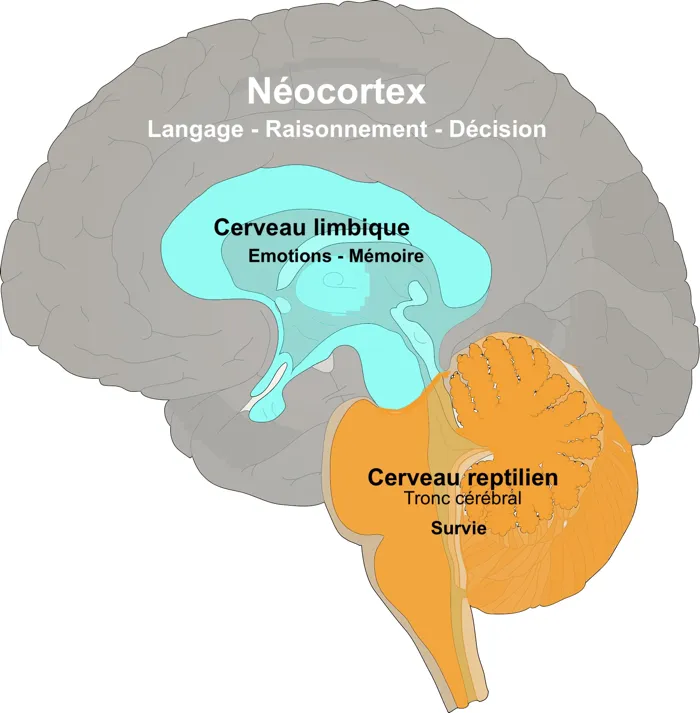 In the 50s and 60s, neurobiologist Paul Maclean introduced the model of a triune human brain, later popularized by Arthur Koestler in The ghost in the machine (1967):
- The Reptilian Brain, linked to survival: driving instinctive behaviors.
- The limbic system, linked to emotions and memory, which drives memorization and learning.
- The Neocortex, linked to thinking and reasoning: responsible for higher cognitive functions such as language and critical thinking.
With advances in neuroscience, this vision has subsequently been challenged, without being totally denied. It has the merit of facilitating a schematic understanding of human brain and emotional functioning.
In this model, these three parts of the brain interact in harmony, but have different speeds of action and therefore do not intervene simultaneously. The fastest of the three is the reptilian, whose basic role is to ensure survival. It reacts to stimuli of danger and pleasure, and ensures safety and the satisfaction of needs. As it functions on the basis of survival reflexes, it generates defense automatisms and can, in contexts deemed dangerous, be the main driver of decision and action.
In fact, studies show that the brain focuses its attention for longer on a stimulus considered threatening (e.g., an angry voice or gesture) and that this attention is mobilized much more quickly than when the stimulus is not considered threatening (e.g., an expression of joy).
The limbic system, then the neocortex, are successively slower to intervene, all things considered on the scale of brain function. Consequently, to avoid reacting only in defensive mode, we need to allow time for decision-making - and therefore judgment - which presupposes being sufficiently relaxed to be able to take into account elements other than the fear aroused by the situation or person.
Faced with any emotionally stimulating situation, there are usually multiple potential ways of reacting. Finding alternative solutions requires creativity and time for reflection. In fact, when stimulation is too strong and emotions overwhelm us, we all tend to systematically react in the same way, because the neocortex - and therefore reasoning - doesn't have the material time to play its regulatory role.
The good news is that the last twenty years' discoveries about the brain show that it is neuroplastic. In other words, we continue to build neurons well into adulthood (brain maturity is estimated at 25 years), provided we keep learning. We can also evolve our neuronal connections and change our habits of thought and behavior, but this requires a bit of work when it comes to modifying our automatisms (for example, breathing differently) or our defense systems (for example, ceasing to judge negatively people whose behavior we don't understand).
Judging in relation to others
The place of emotions
Emotions and feelings color our view of the world and influence our thoughts and actions. As neuroscientist Antonio Damasio has shown, being rational, contrary to what mankind has believed for centuries, does not mean cutting ourselves off from our emotions.
"The brain that thinks, calculates and decides is no different from the brain that laughs, cries, loves, feels pleasure and displeasure.
Antonio DAMASIO, Descartes' error.
Our relationship with others cannot be dissociated from our relationship with our emotions.
"More generally, it is our perceptions of reality, necessarily limited by our senses, our way of feeling things, which lead to difficulties in our relationships with others and our ways of communicating.
Paul Watzlawick, Faites vous-même votre malheur, Ed. du Seuil, 2024.
When we meet someone for the first time, our brains quickly make an initial judgment about our ability to trust that person, which is then very difficult to change. Even before a verbal interaction has taken place, this assessment is essentially based on observing the non-verbal attitude of the person in question. We are generally unaware of all the non-verbal elements we take into account when communicating between human beings.
"Non-verbal communication plays an essential role in understanding thoughts and emotions. Our brains constantly process and interpret non-verbal signals, such as facial expressions, gestures and tone of voice. These elements can significantly influence our thoughts and decisions".
The brain and thoughts: how does it work?
90% of our emotions are expressed by the body. Contrary to what many of us believe, words have far less effect in our communication than what is expressed by the body and the voice. So, in cases where the body or the voice seem to contradict what the words say, it's the body's message that will be listened to first. This is how our perception of lying works, for example, by comparing what a person says with their body and what they say with their words, even if we're not aware that we're doing it. And we're very good at detecting lies in people who haven't been specifically trained to lie. To see this, all we have to do is carry out an exercise in which an unknown person tells us two stories about their life, one true and one false. Experience shows that it's very easy for most people to distinguish the false from the true in this case. In this respect, the work of psychologist Daniel Goleman, author of the first major book on emotional intelligence in the 90s, and that of scientist Paul Ekman (who inspired the American series Lie To Me) on the facial expressions of emotions, is fundamental and very enlightening.
Knowing that, until further informed, we are unable to read the thoughts of others, the judgment we make of others is therefore potentially biased by the interpretation we make of their behaviors and by the emotional impact these behaviors have on us.
Distinguishing between strategy and need in behavior
We may have to judge someone in a professional context, because we're a teacher or a manager, for example. We may also have to judge another person because a behavior seems immediately admirable or detestable. The question we need to ask ourselves is whether this judgment of others is reliable, in other words, whether it enables productive action for one, the other or both.
Non-violent communication (NVC) teaches us that all human behavior has its origins in the need to satisfy needs. These needs can be related to survival (e.g. being safe, eating), to relationships with others (e.g. being part of a group, being appreciated), to identity (e.g. being recognized for who you are or what you do, feeling useful) and so on.
The quest to satisfy a need can lead to behaviors (called "strategies" in NVC) that have an unpleasant effect on others. NVC therefore encourages us to distinguish between the strategy implemented and the need the person is seeking to satisfy. Unfortunately, when we judge others, this distinction is usually not made, and worse still, there is often confusion between the person (who they are) and their actions (what they do). What's more, as explained above, this judgment is much more likely to come from the feelings the behavior provokes than from factual observation of what happened.
Distinguishing observation from judgment
One of the first things we learn from NVC is the ability to distinguish between observing facts and evaluating them. It's about being able to look at the situation at hand with the distance that simple factual observation provides, and only then come to the feelings it generates. If, for example, you describe a colleague as "decidedly touchy", you need to go back to what led to this conclusion, starting with the facts (what did she do? what did she say? and how often?) and leaving aside the emotions provoked by her behavior.
You'll soon realize that getting back to the facts isn't that simple in this type of situation. We realize that we're generalizing about circumstances that may only have occurred a few times, and that we're basing our judgments on a systematically interpreted version of reality (our own), without taking an interest in the other person's way of experiencing things.
If I say, for example, that a person has behaved violently, I'm referring above all to the fear his behavior has generated in me, but I'm saying nothing about his real actions, and I'm not interested in the intentions behind them. My judgment is therefore doubly biased. Can it be considered reliable in this case?
Cognitive bias
The notion of cognitive bias was introduced in the early 1970s by psychologists Daniel Kahneman and Amos Tversky.
"Cognitive biases lead the subject to attach different importance to facts of the same nature". Wikipedia.
Cognitive biases are the automatic mechanisms our brains use to manage complexity. They have a profound influence on the way we perceive reality and make decisions. Numerous cognitive biases have been identified and categorized. Judgmental biases in particular have been identified. Judgment is a form of decision-making, and any decision involving emotions is naturally more exposed to certain biases.
One such bias, for example, is the concept developed by Transactional Analysis (TA) known as "life positions". According to TA (Eric Berne), there are four possible life positions:
- I consider others to be superior to me,
- I consider myself superior to others,
- I see myself and others as potentially worthless,
- I see myself and others as potentially capable.
Each life position obviously has a major influence on the relationships we can establish with others (rejection, flight, impasse, cooperation). According to TA, we all adopt one or other of these positions, either systematically or according to circumstances. It's obvious that my judgement of others' actions and words, depending on whether I consider myself to be inferior or superior to them from the outset, null or capable like them, will not be the same.
Another example of cognitive bias in our relationship with others is the "allergy" that their behavior generates in me. This analysis model developed by Dutch coach Daniel Ofman deals with situations in which we find a person unbearable. If we try to take a more factual look at what's going on in the relationship, we'll realize that what we can't stand, in reality, is that she's doing better than us in an area where we'd like to be better.
For example, she knows how to express her disagreements without embellishment, which, in the "allergic" version, means "She's a loudmouth who doesn't care what other people think". Or she knows how to emphasize her abilities, which, in the "allergic" version, gives "She doesn't think she's just anybody".
The judgment we make in this case is therefore strongly biased by an unconscious desire (jealousy) to be like the other person. It's easier to criticize that person than to recognize your own weakness (or perceived weakness).
Empathy
We talk a lot about empathy. We even demand it of others, which is rather paradoxical when you think about it. It's true that, without empathy, human society would quickly become unliveable. Empathy is the ability to understand others, their feelings, their problems and their way of seeing the world. The brain is basically built for empathy. It's thanks to these so-called mirror neurons that we learn from others and are able to relate to them.
Empathy is based on the ability to recognize or understand emotions in others, via their verbal, non-verbal, para-verbal expressions, etc., without necessarily experiencing the same emotion ourselves in the context of the other person.
We would add to this first approach that empathy is often confused with :
- Sympathy: sharing the same feelings or emotions on many subjects, having affinities and thus getting closer to the other person.
- Emotional contagion: experiencing what the other is going through, physically feeling their emotions.
- Compassion: wanting the other person's good before your own.
What does this have to do with judging others? When we understand the motivations behind a person's actions, the needs that lie behind their behavior, it becomes very difficult to judge them, whether positively or negatively. What's more, when you want to support someone, help them to survive and move forward, you soon realize that judging them is of no use whatsoever.
If I'm a teacher, for example, will it be more helpful to my pupil if I tell him "you've botched your work", or if I tell him directly and factually what needs to be rectified (check his documentation, develop his examples etc.)?
If I'm a parent, will it be more helpful to my child if I say "you're really lazy" or point out that I'd like him to help me put away the groceries or do the dishes more often?
Of course, we can point out that, to indicate to my pupil that his examples need to be developed, I have to use my ability to judge. That's true. But in this case I'm not judging my pupil but his work, which is very different.
What's the point of judging others?
That's the question you may end up asking. Judging others takes energy, whether you say it out loud to the person concerned or not. Dealing with the conflicting feelings these judgments generate can weigh heavily on a person's life, making it far less happy.
This mental burden, sometimes extremely invasive, prevents other, more serene and warmer energies from unfolding. The day we decide to stop judging others, and a fortiori if we also decide to stop judging ourselves, a huge weight is lifted from our shoulders. And we all know how pleasant it is to be with non-judgmental people.
References
Berne, Éric. What do you say after you say hello? Tchou, 2013
The brain and thoughts, how does it work? April 2025.
https://psychologie-positive.com/cerveau-pensees-fonctionnement/
Cuddy, Amy. Show them who you are. Marabout, 2016
Nonverbal communication. Wikipedia article.
https://fr.wikipedia.org/wiki/Communication_non_verbale
Damasio, Antonio R. Descartes' error. Odile Jacob, 2021
Goleman, Daniel. Emotional intelligence (unabridged). J'ai Lu, 2014
Hall, Edward Twitchell. The hidden dimension, Points Seuil, 2014
Hecquard, Françoise. Relational skills and power over oneself. In: Revue Argus, vol. 41, n°1, 2012
Hecquard, Françoise. Observe or evaluate? Mai 2024.
https://dynamiquesdechangement.fr/2024/05/01/observer-ou-evaluer/
Hecquard, Françoise. Sympathetic or competent? Jan. 2017.
https://dynamiquesdechangement.fr/2017/01/01/sympathique-ou-competent/
Ledoux, Joseph. The brain of emotions. Odile Jacob, 2005
Loumé, Lise. Brain, why do we easily blame others? Dec. 2015. - https://www.sciencesetavenir.fr/sante/cerveau-et-psy/cerveau-pourquoi-nous-blamons-facilement-les-autres_104355
Rosenberg, Marshall B. Words are windows (or they are walls). La Découverte, 2016
Wittezaele, Jean-Jacques. L'homme relationnel. Seuil, 2003
See more articles by this author