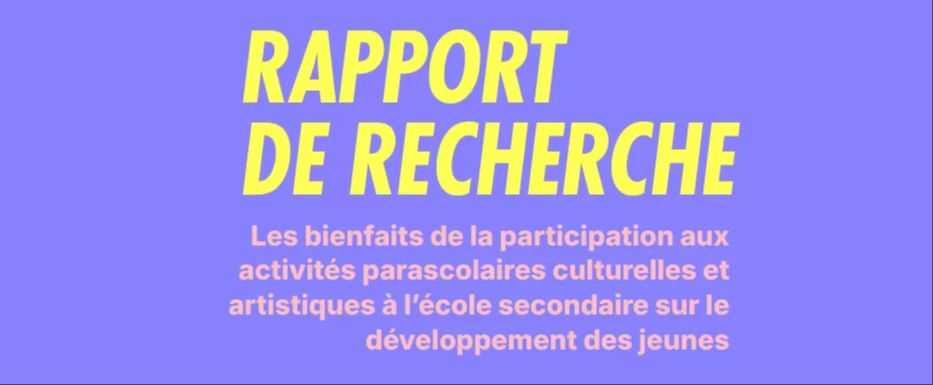
Carried out in 2024 by a team of researchers from the Université du Québec à Trois-Rivières at the request of ACLAM, the organization responsible for the "Secondaire en spectacle" and "Improvincial" programs, this study demonstrates the many direct and indirect positive effects of extracurricular cultural and artistic activities on high school students.
Direct effects
- pleasure
- sense of well-being,
- peer recognition,
- self-confidence,
- respite,
- sense of freedom,
- experience memorable moments
- academic motivation
Indirect effects
- better results at school,
- identity affirmation
- a broader world view,
- experience more positive emotions in everyday life, such as pride, enthusiasm and optimism.
- fewer behaviors considered undesirable for their development and for society.
- fewer problem behaviors,
- less bullying of peers,
- consume less alcohol before the age of 18,
- adopt more cooperative and prosocial behaviors.
Skills development
- stress management in high-performance situations,
- more ambition and higher academic expectations,
- vocational exploration,
- social, public and interpersonal communication skills,
- ability to identify and express emotions,
- adaptability,
- work ethic (organization of time, autonomy and perseverance),
- leadership and sense of responsibility,
- ability to take healthy risks,
- reflex to participate in the community,
- project management
- imagination and creativity.
Those who take part in extracurricular activities see them as a springboard of possibilities for the rest of their lives, whether it's the opportunity to travel to present an art form, discover other cultures, land a job or get involved in causes close to their hearts.
The social
The study reveals the extent to which cultural and artistic extracurricular activities enable those who take part in them to forge social relationships, meet people like themselves, and make friends who sometimes stay with them for a lifetime.
Methodology
For this study carried out in 2024, the research team used a mixed methodology. It drew on various literature reviews prior to 2014, a rapid literature review from 2014 to 2023, quantitative primary data collection and qualitative primary data collection from 441 students aged 14 to 17, as well as qualitative data collected from students who participated in the 2024 edition of the Rendez-vous panquébécois "Secondaire en spectacle" and a dozen adult professionals who had participated in extracurricular activities in their previous training.
The data collection process yielded a considerable amount of information. By cross-referencing the results of the different approaches, the research team was able to make findings that summarize the current state of knowledge on the subject, and enable us to formulate pertinent recommendations.
Recommendation
In light of this study, the following recommendation is made to schools:
Encourage the programming of extracurricular activities other than sports in their establishments, and set aside a substantial part of the budget for these activities so that young people can enjoy them in a quality context.
To download the study :
RESEARCH REPORT - The benefits of participation in cultural and artistic extracurricular activities in high school on youth development - Université du Québec à Trois-Rivières - November 2024 - Observatoire québécois du loisir - https://oraprdnt.uqtr.uquebec.ca/portail/docs/GSC4177/O0006254986_DOCUMENT_ACLAM_OQL.pdf
See more articles by this author